If you're shopping for a 4x4 camper van or off-road RV in 2026, the first thing to know is that the market has quietly changed underneath the old buying guides. The true low-range 4x4 Sprinter is gone from dealer lots. The Ford Transit Trail came and went. Most of what's sold as a "4x4 camper" today is actually all-wheel drive, and for most people, that's fine, but you should understand the difference before you spend six figures.
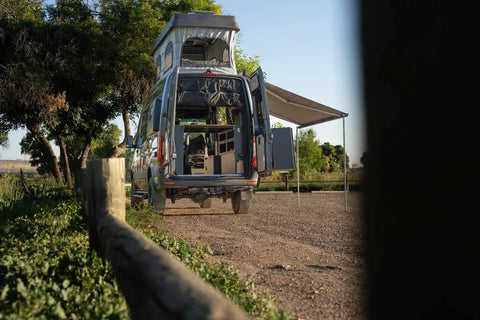
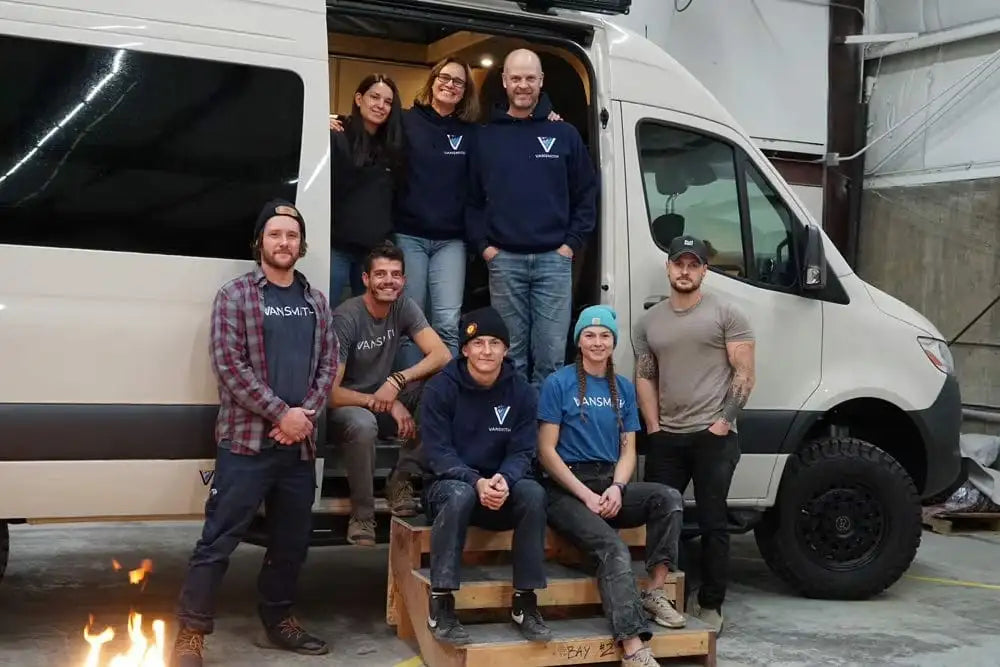
We build camper vans in Boulder, Colorado, over 300 of them so far, a large share on AWD Sprinter and AWD Transit chassis that live their lives on washboard forest roads, mountain passes, and snow. This guide is what we tell people who walk into our shop: what the current platforms actually are, what they cost, and where the trade-offs really sit once you're past the brochure.
2026 4x4 and AWD camper van comparison
Here's the realistic field as of mid-2026, including our own builds alongside the factory options. Prices are approximate, as-equipped ranges.
| Camper | Platform | Drive | Sleeps | Approx. price | Best for |
|---|---|---|---|---|---|
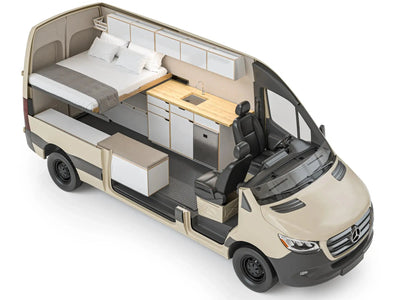
| The Vansmith AWD Sprinter builds | Mercedes Sprinter (diesel) | AWD | 2–4 | From ~$112k turnkey | Couples and four-season mountain travel without factory-RV pricing |
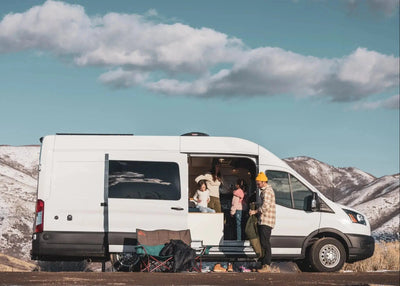
| The Vansmith Family XL Plus (Transit AWD) | Ford Transit (gas EcoBoost) | AWD | 4–5 | ~$105k | Families who want AWD, seats with belts, and easier service costs |
| Winnebago Revel 44E | Mercedes Sprinter 144 (diesel) | AWD | 2 | ~$200k–$250k | Turnkey off-grid with a national dealer network |
| Storyteller Overland MODE | Mercedes Sprinter (diesel) | AWD | 2–4 | ~$155k–$230k | Flexible gear hauling, lounge-style seating |
| Sportsmobile Classic 4x4 | Ford cutaway, fiberglass body | True 4x4 (low range) | 2–4 | ~$175k–$225k | Buyers who genuinely need low-range gearing and a pop-top |
| Outside Van (custom) | Mercedes Sprinter (diesel) | AWD | Varies | Typically $200k+ | Fully bespoke, high-end one-off builds |
| Used Sprinter 4x4 (2015–2022) + conversion | Mercedes Sprinter (diesel) | True 4x4 (low range) | 2–4 | ~$60k–$150k all-in | The only way to get a low-range Sprinter today |
| Used Ford Transit Trail (2023–2024) | Ford Transit (gas EcoBoost) | AWD | DIY/varies | ~$55k–$70k used, before conversion | A factory-lifted AWD base for a custom build |
Want to see what's available right now? Browse our current 4x4 and AWD camper vans for sale.

The naming problem: most "4x4 camper vans" are AWD now
This trips up nearly every buyer we talk to, so let's settle it up front.
Mercedes discontinued the true low-range 4x4 Sprinter after the 2022 model year. Since 2023, the option is a full-time AWD system, no low-range transfer case, no locking center differential, roughly a $6,800 option on a 2026 Sprinter. A 2026 Sprinter AWD cargo van starts around $60,500 before any conversion work. The new AWD system is genuinely good: it's always engaged, it reacts faster than the old part-time 4x4 ever did, and paired with the standard traction control it handles snow and loose surfaces with less drama. What it can't do is crawl. There's no low gear for steep, technical, slow-speed terrain.
Ford's story is similar. The factory-lifted Transit Trail was discontinued for 2025 after supply-chain problems, but Ford's Intelligent AWD remains available on the standard 2026 Transit, and it's a proper full-time mechanical system, not a gimmick. (Ford has also shown a 2027 Transit Raptor, which tells you where they think this market is heading.) We cover the practical differences in more depth in our 4x4 vs AWD camper van guide.
So when you search "4x4 camper van" in 2026, you're really choosing between three things: a new AWD van, a used 2015–2022 Sprinter 4x4 (the values have held up precisely because they're no longer made), or a specialty true-4x4 rig like the Sportsmobile Classic. For probably 90% of the buyers we build for, forest service roads, trailhead access, ski-season driving, AWD with the right tires is the correct answer, and it's meaningfully cheaper.
What we've learned building AWD vans in Colorado

Our shop sits at 5,300 feet, and most of the vans we build get used between 6,000 and 12,000 feet, year-round. That teaches you things a spec sheet won't:
- Tires matter more than the drivetrain. An AWD Sprinter on quality all-terrain tires will out-travel a 4x4 on worn highway rubber every single time. If your budget forces a choice, buy the tires before the suspension lift. This is the cheapest capability upgrade that exists.
- Ground clearance is usually the real limit, and the build can ruin it. The factory van clears most forest roads fine. What hangs up on rocks is what gets bolted underneath afterward: water tanks, gray tanks, steps, and plumbing runs. We keep tanks inside the heated, protected envelope of the van wherever the floor plan allows. It protects them from impact and from freezing, same decision, two wins.
- Weight is the silent capability killer. Every off-road feature list ignores payload. A heavy build with full water, gear, and two mountain bikes can put a van near its GVWR, and an overweight van handles worse off-pavement, brakes longer, and wears suspension fast. It's a big reason we build cabinetry from lightweight plywood instead of MDF and skip features clients won't actually use.
- Altitude favors turbocharged engines, both of them. The Sprinter's 2.0L turbo-diesel and the Transit's EcoBoost gas V6 both hold power well at elevation where naturally aspirated engines wheeze. The diesel wins on range and torque; the gas Transit wins on cheaper service, easier winter cold-starts, and finding a mechanic in a small town.
- Winter is a systems problem, not a traction problem. AWD gets you to the trailhead in a storm. What keeps the trip comfortable is insulation, a diesel or gasoline air heater with a high-altitude kit (standard heaters de-rate badly above ~7,000 feet), and plumbing that can't freeze. If you're heading into a Colorado winter, read our camper van winterization guide.
- Simple systems survive washboard. Vibration is brutal on connections, fasteners, and anything fragile. Marine-grade hardware, properly supported wiring, and a lithium battery system sized to your real usage will outlast a complicated setup with twice the features. Complex plumbing and niche electronics fail at the worst possible time, in the worst possible place.
The platforms, from a builder's bench
Mercedes Sprinter AWD: still the benchmark
The 2026 Sprinter runs a 2.0-liter turbo-diesel (up to 208 hp / 332 lb-ft) through a 9-speed automatic, with AWD optional. It has the best factory ground clearance of the mainstream vans, the tall interior that makes a conversion livable, and diesel range that suits remote travel. The trade-offs are real too: diesel emissions systems (DEF, regen cycles) want regular highway miles, and service is dealer-centric and pricier. We've built more campers on this chassis than any other, and it's still what we recommend for couples planning serious four-season travel. See our Sprinter van conversions, or our Mercedes 4x4/AWD Sprinter buyer's guide for the full chassis breakdown.
Ford Transit AWD: the value play nobody should overlook
The Transit's Intelligent AWD paired with the 3.5L EcoBoost is a sleeper. The gas engine pulls hard at altitude, parts and service are everywhere, and the chassis costs meaningfully less than a Sprinter, savings that can go into the build instead. Clearance is lower than the Sprinter's, which a modest lift and tires largely address. For families especially, the math is hard to argue with: our Transit AWD conversions, including the Family XL Plus at around $105k, deliver belted seating and sleeping for four to five at a price point no Sprinter build can match.
The factory-built adventure vans
The big names still set the reference points, and they're good rigs:
- Winnebago Revel 44E (~$200k–$250k), the long-time class benchmark, now on the AWD Sprinter. Smart power-lift bed and gear garage, dealer support nationwide. The layout is fixed, and you pay for the badge.
- Storyteller Overland MODE (~$155k–$230k), tough finishes, flexible seating/sleeping, strong off-grid power. Heavier when fully loaded, and resale on common floor plans is crowded.
- Outside Van (typically $200k+), fully custom, beautifully executed, with a waitlist and pricing to match.
- Sportsmobile Classic 4x4 (~$175k–$225k), one of the few new rigs with genuine low-range 4x4, on a Ford cutaway with a pop-top. The right tool if you truly crawl; overkill if you don't.
Here's the honest part, because we compete with these companies: the factory vans are not worse, they're fixed. Layouts, components, and systems are locked when the model is designed. As we've written about Class B vans versus custom conversions, the real question is whether a fixed floor plan happens to match how you travel. If it does, buy it, the dealer network is worth something. If it doesn't, a custom build from a established shop typically lands at a similar or lower price with a layout designed around your gear, your dog, your kids, or your remote-work setup. You can design your own van with our online configurator to see what that looks like before ever talking to us.
Our top pick: The Vansmith Bivy Plus (AWD Sprinter)
If we had to point at one van that represents where the off-road camper category landed in 2026, it's our Sprinter Bivy Plus. Built on the AWD Sprinter, it carries the systems that used to be exclusive to the big manufacturers, lithium power, proper insulation, four-season plumbing, in a layout that's been refined across hundreds of Colorado builds rather than designed once for a brochure.
Best for
• Couples and solo travelers who want a refined, four-season AWD van
Pros
• Excellent space efficiency and serviceable, simple systems
• Lightweight construction that protects payload and handling
• Turnkey AWD Sprinter pricing from ~$112k, well under the factory adventure vans
Cons
• Not intended for larger families (that's what our Transit Family builds are for)
What buyers actually regret
After 300+ builds, the regrets we hear are remarkably consistent, and they're rarely about traction:
- Buying more off-road capability than they use. Most owners never engage anything a stock AWD van plus good tires couldn't handle. The $40k–$80k premium for an expedition-grade rig usually buys capability that sits unused.
- Underestimating power needs. Fridges, fans, heaters, and laptops add up over 24-hour cycles. Size the battery bank to real usage with margin, and make sure alternator charging is part of the plan, solar alone won't keep up in winter.
- Choosing a layout for campgrounds, not for weather. Wet-gear storage, easy-clean floors, and good roof ventilation matter far more on day nine of a trip than a second TV. The right van and layout for how you actually travel is the decision everything else hangs on.
- Hanging too much gear outside. Racks and carriers are great, a purpose-built roof rack system beats improvised solutions, but every exterior addition costs fuel, clearance, or both.
Off-road trailers and expedition RVs: the bigger-footprint options
If your travel is basecamp-style rather than drive-daily, off-road trailers and expedition trucks deserve a look. The Bruder EXP-8 (premium, superb suspension) and Kimberley's T-Class lead the trailer category for remote travel; the MDC XT19HRT and Reboot 19.4 cover the family and value ends. On the expedition-truck side, EarthRoamer and EarthCruiser remain the reference points, extraordinary rigs at extraordinary prices.
The trade-off versus a camper van is daily usability. A van parks in a normal spot, drives like a (tall) car, and works as a daily driver. A trailer or expedition truck offers more space once parked but changes every driving day. When evaluating any of them, look past the brochure: check ground clearance, approach and departure angles, and whether tanks and plumbing are protected, MotorTrend's off-road buyer guides are a good primer on what those specs mean on an actual trail.
Final thoughts
The best off-road RV in 2026 is rarely the most extreme one, it's the one whose drivetrain, weight, and layout match how you actually travel. For most people reading this, that's an AWD Sprinter or AWD Transit with good tires, protected systems, and an interior built around their gear and their seasons. You can compare our current off-road-ready builds at 4x4 RVs for sale by The Vansmith, browse our luxury camper vans if comfort leads your list, or start a ground-up spec in our van design tool.
And if you're budgeting, our Sprinter conversion cost breakdown covers what the numbers in the table above are actually made of. Questions about your routes, terrain, or wish list? Talk to us, terrain questions are our favorite kind.
Frequently Asked Questions About 4x4 Camper Vans and Off-Road RVs
What is the best 4x4 camper van?
For most buyers in 2026, the best "4x4" camper van is actually an AWD Mercedes Sprinter, it's the platform behind the Winnebago Revel, Storyteller Overland MODE, and most custom builds, including our own AWD Sprinter conversions (from ~$112k turnkey). If you genuinely need low-range gearing, your options are a used 2015–2022 Sprinter 4x4 or a Sportsmobile Classic 4x4.
Are 4x4 camper vans worth it?
Yes, if you regularly drive snow, forest service roads, or wet trailhead access, AWD/4x4 adds roughly $7k on a new chassis and holds its value well at resale. It's not worth it if you camp mainly at developed campgrounds; in that case, put the money into tires, insulation, and a better power system instead.
What's the difference between a 4x4 and an AWD camper van?
A true 4x4 has a transfer case with low-range gearing for slow, technical terrain; AWD is always engaged, has no low range, and reacts automatically to slip. Since 2023 the Sprinter is AWD-only, and the Ford Transit's Intelligent AWD is also a full-time system. For washboard roads, snow, and trailhead access, what 90% of owners actually drive, AWD with all-terrain tires performs excellently.
What 4x4 RVs are available in 2026?
In the van class: AWD Sprinter-based rigs (Winnebago Revel, Storyteller Overland MODE, custom builds from shops like ours and Outside Van), AWD Ford Transit builds, and the true-4x4 Sportsmobile Classic. Beyond vans, expedition RVs like EarthRoamer and EarthCruiser and off-road trailers like the Bruder EXP-8 cover the larger-footprint end of the market.
Can you still buy a 4x4 Sprinter?
Not new, Mercedes replaced the low-range 4x4 Sprinter with a full-time AWD system starting with the 2023 model year. New 2026 Sprinters offer AWD as roughly a $6,800 option. Used 2015–2022 Sprinter 4x4 vans are the only way to get factory low range, and they hold their value because of it.
Is the Ford Transit good for an off-road camper van?
Yes, the Transit's full-time Intelligent AWD plus the turbocharged EcoBoost engine (which keeps its power at altitude) makes a very capable mountain van, and the chassis costs meaningfully less than a Sprinter. Ford discontinued the factory-lifted Transit Trail after 2024, but standard AWD Transits convert beautifully; our Transit AWD Family XL Plus sleeps a family of four to five for around $105k.