By Santiago Pere, March 18, 2026
For most modern off-grid vans, lithium iron phosphate (lithium) will be the better long-term choice. It usually offers much more usable storage, far longer life, and much lower weight than AGM. That makes lithium a strong pick for trips over several days and frequent camping without hookups. It’s also the main reason so many builders now compare lithium vs AGM van power packs before committing to a system design.
AGM still has a place as a cheaper option for very light, weekend systems. It also works well for starter rigs where ease of use and quick fit with other gear matter more than long-term cost.
This guide walks through storage, cycle life, charging habits, weight, install needs, and safety. It also covers which types of buyers tend to prefer each battery type so you can make a well-informed choice when weighing lithium vs AGM camper batteries for your own build.
If you’d like expert help matching the right battery type to your layout, charging sources, and travel style, schedule a consultation with The Vansmith team. We’ll help dial in a system that fits your van and budget, or you can explore our VS BUILD camper van conversions for ideas.
Introduction: why battery choice matters for camper vans


Batteries are the heart of any camper van electrical system. They decide how long you can run lights, cooling, heating, and devices away from shore power. They also shape the weight, space, and cost of your build.
Choosing the right battery type affects charging plans, alternator fit, system checks, and the long-term cost per use of your system. For vans aiming at true off-grid freedom, battery choice is one of the single most important decisions.
In our work with customers, a couple of careful questions up front often avoids costly rework later. This is even more true when we’re building eco-friendly camper van electrical systems around solar and low-draw components.
Quick comparison: lithium vs AGM for off grid vans

- Usable capacity: Lithium typically offers 80-90% usable capacity; AGM is conservatively sized to 50% usable.
- Cycle life: Lithium 2,000-5,000 cycles; AGM roughly 300-800 cycles.
- Weight & volume: Lithium is roughly half the weight for equivalent usable energy, and industry testing shows that LiFePO4 batteries can deliver significantly higher energy density than comparable lead-acid designs, including AGM, in mobile applications according to AAA’s battery guidance.
- Charging: Lithium accepts higher charge rates and recharges faster; AGM is more tolerant of legacy charge profiles.
- Upfront cost: Lithium costs more initially but usually wins on cost-per-cycle over the system lifetime.
How batteries are measured (what matters for van builds)
Capacity (Ah and usable Wh)
Battery size is quoted in amp hours (Ah) at rated voltage. For simple planning, convert to usable watt-hours for your load math: usable Wh = rated voltage × Ah × usable fraction.
With lithium, use roughly 80-90% usable. With AGM, plan for 50% usable to preserve life.
That gap often means a smaller lithium bank will meet the same needs as a much larger AGM bank.
Depth of discharge and usable capacity
Depth of discharge (DoD) controls cycle life. AGMs have shorter lives when often run past 50% empty.
Lithium handles deeper drains over and over, which changes how you size a bank for a given number of days off-grid.
Cycle life and calendar life
Expect lithium iron phosphate to give thousands of cycles in real-world van use, often many years for a normal owner. AGM loses a lot of storage after hundreds of cycles, which lines up with common lead-acid ranges reported in U.S. Department of Energy battery life summaries.
If you plan to camp often or live full-time, lithium’s longer life starts to matter in real dollars.
Charge/discharge rates (C-rate)
Lithium handles higher C-rate charging and discharge without stress. Solar arrays and DC-DC chargers can refill a lithium bank faster than a same-size AGM bank.
That matters when you rely on engine charging between driving and camping off-grid or when you want rapid top-ups from solar.
Weight, volume, and energy density
Weight savings with lithium are big. For builds where payload, handling, or inside layout matter, lithium cuts needed battery space and frees weight for gear or water.
This is one reason many Vansmith customers choose high-power systems paired with a lithium campervan battery for serious off-grid use in our Class B camper vans and other custom builds. They often look at options like a Battle Born camper battery when they want one of the best battery for campervan 12V setups.
Efficiency and self-discharge
Lithium systems show higher round-trip efficiency and lower self-discharge than AGM. More of the energy you pull from solar or engine charging is there for loads later in the day or night.
Performance and real-world behavior
Charging speed from solar, alternator, and shore power
Lithium charges faster from MPPT solar and well-controlled alternators. To fully gain from this, plan for a DC-DC charger or alternator controller that supports lithium iron phosphate charge settings.
Without that, lithium may not get a full charge and long-term output and life will go down. If you’re unsure whether your alternator setup supports lithium, that’s an easy check before you buy.
Behavior under heavy loads (inverters, microwaves, heaters)
Lithium supports higher steady and peak discharge, so it handles inverter-driven appliances better. AGM banks often see voltage sag under heavy loads, cutting inverter headroom and usable power.
Temperature effects and cold-weather charging
Cold charging is a key limit for lithium iron phosphate. Many cells should not be charged below a set temp without a built-in heater or temp-aware charger.
AGM handles cold charging better in short-term cases, but both battery types lose useful storage in cold weather. For winter use, include heat control plans and check component specs. The National Highway Traffic Safety Administration also recommends verifying that electrical systems and batteries are working correctly before extended trips, especially in extreme temps.
Installation and system requirements
Battery management systems and protections (BMS)
Lithium must have a solid BMS to guard against overcharge, over-discharge, and cell imbalance. Many modern lithium packs include built-in BMS and charge-level readouts.
AGMs rely on whole-system guards and are less likely to need a separate BMS, but smart charging and fusing stay key for both battery types.
Charge-source compatibility (DC-DC chargers, MPPT, alternator)
Match charge voltages and charging stages. For lithium, set bulk, absorption, and float settings as the maker calls for and use a DC-DC or alternator controller that supports lithium.
AGMs are more forgiving of older charge profiles but still gain from smart solar MPPTs and smart chargers to get the most life.
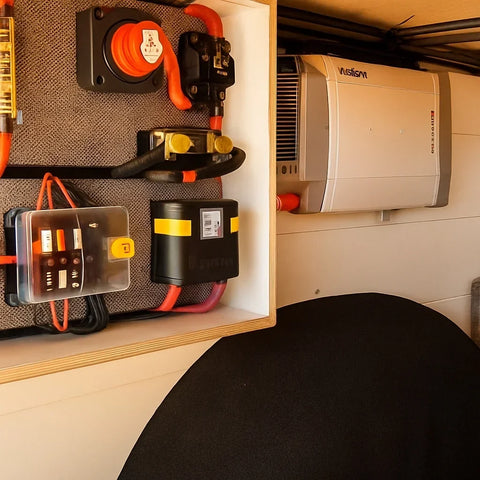
Wiring, fusing, and mounting considerations
Proper wiring gauge, short run-lengths, secure mounting, and correct fusing are a must. Mount batteries low and central where possible for weight balance, and ensure easy access for checks and service.
Follow maker install guides and local electrical standards. If you’re planning a DIY build, pairing a right-size battery bank with parts like our DIY dual-unit kitchen galley kit for Sprinter vans can help you design a level, functional layout from day one.
Safety and maintenance
Overcharge, thermal runaway, and venting differences
Lithium iron phosphate is one of the safer lithium types but still needs a BMS and correct charging to avoid cell damage. AGM will vent in extreme overcharge cases.
Both need correct installation and fused circuits to prevent catastrophic failure.
Routine maintenance and monitoring
AGM needs regular checks and can gain from equalizing in older lead-acid care plans. Lithium needs firmware and BMS watching, occasional firmware updates where needed, and checks that charge sources stay set correctly.
In both cases, watching charge level and voltage under real loads will tell you more than simple dash lights or basic meters.
Cost comparison and total cost of ownership
Upfront cost vs lifecycle cost (cost-per-cycle)
Upfront, AGM is cheaper. Over time, lithium’s longer cycle life and higher usable storage almost always lower cost per use for owners who use their vans often.
For occasional weekend users, AGM can be a pragmatic short-term choice.
When AGM makes financial sense
Choose AGM for low-use, low-load vans where upfront cost is a hard limit and you plan to upgrade later. AGM can be a budget starter option that is simple to tie in with older charging systems.
Buyer profiles and recommendations
Weekend/light users (starter systems)
If you use your van now and then and want the simplest install, AGM is fair. Keep hopes modest for time off-grid and plan to upgrade if your use grows.
Full-time/off-grid vanlifers (high-cycle demands)
Lithium iron phosphate is the clear choice for full-time or heavy-use vanlifers. Faster charging, longer life, and lower weight make the higher upfront spend worth it for people who rely on long off-grid stays and heavy daily loads.
Hybrid users/commuters (balanced approach)
Hybrid travelers who commute and sometimes boondock should weigh weight and life span against budget. For many in this group, a modest lithium bank paired with smart charging gives the best daily feel.
Sizing examples and quick calculators
Example 1: 500 Wh/day weekend rig
For roughly 500 Wh/day: with AGM at 50% usable you’d plan a battery ~1000 Wh rated. With lithium at 80% usable you’d need ~625 Wh rated.
Practically, that means a small lithium pack will outperform a much heavier AGM bank.
Example 2: 2500 Wh/day full-time off-grid rig
For 2,500 Wh/day and several days off-grid, lithium banks cut weight and space needs and offer faster recharge between drives. Those gains add up for full-time living, especially in rigs like our camper vans for sale that are built around real-world off-grid use.
Recommended components and setup checklist
Suggested battery sizes and brands (types only)
Match battery size to your Wh/day and days off-grid goals and plan for usable storage based on battery type. Look at trusted lithium iron phosphate packs with built-in BMS or well-reviewed AGM deep-cycle banks from solid makers.
Charger and alternator considerations
Include a good MPPT solar charge controller and a DC-DC charger or alternator controller that supports lithium settings if you choose lithium. Shore power chargers should also be settable for the chosen battery type.
Monitoring and safety gear
Install a solid battery monitor, right-size fusing, and easy-to-reach service disconnects. Add temp sensors if winter charging is likely.
FAQ
Are lithium batteries worth the extra cost for camper vans?
Yes for many use cases: lithium usually gives 2-4x the usable cycles, lighter weight, and greater usable storage. That mix cuts long-term cost per use and boosts off-grid results. This is why many RV makers and suppliers have shifted toward lithium options in newer models, according to the RV Industry Association RV technology and innovation reports.
AGM can be a reasonable short-term or budget choice for low-power weekend rigs.
Can I charge lithium batteries with my existing alternator and charger?
Not always. Lithium needs set charge voltage curves and often a DC-DC charger or alternator controller that works with lithium.
Without proper charging equipment, lithium batteries can be undercharged or damaged.
How long do lithium and AGM batteries last in real-world van use?
Lithium (lithium iron phosphate) often lasts 2000-5000 cycles based on depth of discharge and use. That adds up to many years for normal van use.
AGM typically lasts 300-800 cycles before significant capacity loss.
Are lithium batteries safe in camper vans?
Modern lithium iron phosphate cells are stable and safer than other lithium types, but they still need a BMS, proper install, temp control, and correct charging to prevent damage and cut risk.
Is cold-weather charging a problem for lithium batteries?
Yes: many lithium batteries should not be charged below a certain temp without a built-in heater or temp-based charger. AGMs handle colder charging better in the short term.
How do I size a battery bank for my camper van?
Estimate daily Wh use and decide how many days off-grid you want. Allow for inverter and system losses, and choose battery-type depth of discharge (50% for AGM, 80-90% usable for lithium).
Then select storage in Wh or Ah at system voltage. As you run the numbers, keep your own usage pattern in mind. This helps you decide where you fall on the lithium vs AGM van battery spectrum and choose the option that best matches your travel style and budget.
From more reading and tools within the Vansmith library, you can dive deeper into our guides on how to power your van and the Complete Guide to Camper Van Conversions. You can also see how we tie strong electrical systems into real-world layouts in our 144 four-seater van gallery and other converted camper vans. Or explore DIY-friendly parts in our DIY conversion van kits, parts, and accessories collection.
About the author

Santiago Pere
Chief Design Engineer
Santiago is Chief Design Engineer at The Vansmith. He writes on topics spanning van design, builds, and life on the road.
Read more about Santiago