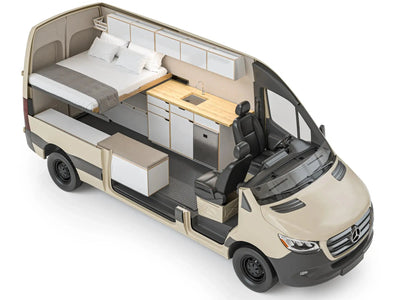
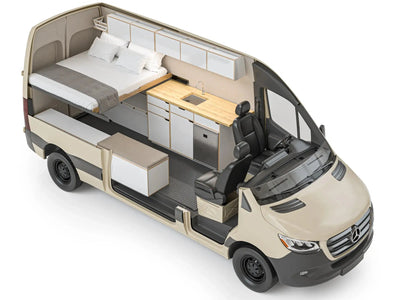
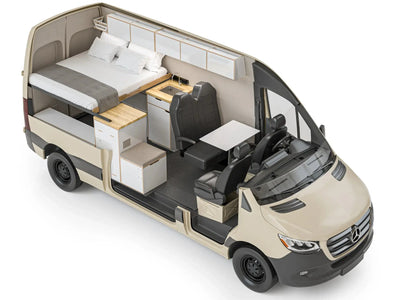
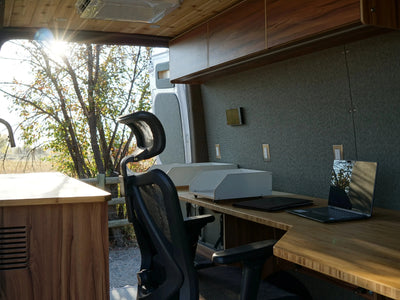
A campervan roof extension can add permanent standing room, but if you haven't bought your van yet, a factory high roof is usually the cleanest way to get full-time headroom. Which option makes sense comes down to one main question: do you need stand-up space all day while driving and stopping, or only when you're parked. That answer separates a fixed high roof from a pop-top pretty fast. It also tells you whether a major roof cut is worth the trouble. Make that call early, because your roof choice affects cabinets, insulation, fan placement, wiring runs, and even where your bed can go.
Campervan roof extension vs pop-top vs factory high roof
These three options all chase the same goal. You want standing room. The big difference is how each one gets there.
A fiberglass roof extension permanently changes the van body. Mercedes treats roof and body changes as formal upfits in its Body and Equipment Guidelines, which tells you right away this isn't just a cosmetic add-on. It's a serious build decision.
A pop-top works differently. Sportsmobile describes its Penthouse Pop Top as adding standing room, ventilation, and an upper sleeping area. So a pop-top is not the same thing as a permanent high-top roof extension. Different tool.
If you're still shopping for a van, factory high-roof models are already normal cargo-van choices from Mercedes, Ford, and Ram. You're not hunting for some rare specialty shell. In our Boulder shop, that matters because a factory roof gives you known geometry from day one. That makes the rest of the build much simpler.
We see the biggest regret when buyers try to fix a chassis choice later with a roof change. Once wiring, insulation, and cabinets are in motion, changing roof strategy gets expensive fast. If you want to see how those early choices shape the whole project, our build process page gives a good overview.
Who each option is really for
A fiberglass van roof extension makes the most sense when you already own a low-roof van and truly want to keep it. In that case, a permanent structural change may be worth it if it gives you more usable interior height. If the van is already the right chassis in every other way, that's a fair argument.
A pop-top fits a different buyer. It works well for someone who wants a lower travel profile on the road or in storage, but still wants standing room once camp is set. Sportsmobile also frames the pop-top as a sleeping-platform move, not just a headroom move, because it can add an upper bed.
Factory high roof is for the buyer who wants to stand up every day, at every stop, without opening anything. That matters more than people think. Cooking lunch in wind, changing layers in sleet, or grabbing gear at a trailhead all feel easier when the height is just there.
For couples and families, full-time standing room usually makes daily life smoother than expected. In our experience, it changes cooking, dressing, and loading gear more than any spec sheet can show. That's one reason our main Sprinter conversions and Transit conversions center on factory high-roof vans.
The decision filter before you spend money
Start with the first question: do you already own the van. If not, comparing chassis options before purchase is usually smarter than planning a major roof conversion later. A lot of trouble starts when that step gets skipped.
Next, ask when you need standing room. If you need it through the day, during quick stops, or in bad weather, factory high roof usually pulls ahead. If you only need headroom once camp is set, a pop-top may cover the need with less full-time height.
Then ask if the roof also needs to create a second sleeping zone. A pop-top can solve both headroom and bed capacity at once, which is why it often shows up in family plans. You can browse our pop-top options or look at family van layouts to see how that choice affects the whole interior.
The last filter is your comfort with structural roof work. Federal guidance from NHTSA treats roof raises as meaningful vehicle modifications, not simple trim changes. In practice, we tell buyers to settle roof choice before solar, roof racks, fans, upper cabinets, and insulation are locked in. That changes everything.
If you want a ready-to-drive path instead of a long mod chain, that matters too. Our Bivy models are sold ready to drive, and semi-custom builds usually run 8-10 weeks as of 2026. For a custom starting point, see Customize your van.
How much standing room do you actually gain?
 This is where factory vans have the cleanest numbers. OEM spec sheets publish official cargo heights, while fiberglass roof-extension gains vary by kit and installer. So if you want the most reliable baseline, start with factory data.
On the 2025 Ford Transit cargo van, maximum cargo height is 56.9 inches in low roof, 72.0 inches in medium roof, and 81.5 inches in high roof, according to Ford's Transit tech specs. That spread is huge. Big difference.
Ram's body-builder chart shows 66.9 inches of cargo height in low-roof ProMaster models and 77.1 inches in high-roof versions, using the published ProMaster views and charts. Ram also shows the sliding-door opening height growing from 58.5 inches to 69.1 inches. That affects more than your posture. It changes how easy it is to load bikes, bins, and bulky gear.
A pop-top shouldn't be sold as full-time standing height. The extra headroom exists only when the roof is raised. A fiberglass high-top can create permanent standing-room potential, but without a verified non-competitor source for universal kit dimensions, it's smarter to avoid claiming one inch gain that fits every roof extension.
Factory roof-height numbers that matter
The Ford Transit low roof at 56.9 inches is well below standing height for most adults. The 81.5-inch high-roof version moves into real stand-up territory for many people. That's why the high roof gets so much attention in full builds.
Ford's 72.0-inch medium roof sits in the middle. It can work for some users, but taller buyers often still lean high roof for easier movement and better overhead cabinet options. In our shop, about 90% of customers choose high roof, and many mid-roof buyers later ask about a pop-top.
The ProMaster high roof at 77.1 inches is one reason people talk about it as a stand-up platform, while the 66.9-inch low roof still leaves many adults ducking. Mercedes also offers current 2026 Sprinter cargo van high-roof configurations from the factory, which reinforces how normal OEM standing-height vans are now.
One thing a lot of builders overlook is the gap between raw cargo height and finished living height. Floors, ceiling panels, insulation, and lights all eat into that number. A van that looks tall enough on paper can feel much tighter after build-out.
Why pop-top height works differently
Sportsmobile describes the pop-top as creating headroom when opened. That makes it great at camp, but it's not the same as permanent stand-up height while the roof is closed for travel. You feel that difference on cold mornings.
The lower closed profile is one of the pop-top's strongest points. Buyers often like it for garage fit, tree cover, parking limits, ferry concerns, or just a lower-looking van on the road. If that travel profile matters more than all-day interior height, a pop-top starts to make a lot of sense.
There is also the bed factor. Sportsmobile notes that bed dimensions vary by chassis in its Penthouse Pop Top article, so the sleeping benefit is model-specific and should be part of the layout plan early. In family builds, that upstairs bed can solve two problems at once.
In our shop, that trade-off comes up all the time. A pop-top often adds sleeper capacity and parked headroom, while a roof extension mainly solves the headroom side. Be honest with yourself about windy trailheads, ski-season stops, and stealth nights when you may not want to open the roof just to change clothes or make coffee.
Cost comparison: roof conversion vs buying a taller van
You have to look at total project cost here, not just roof cost. A late roof change can ripple into fans, wiring, insulation, cabinetry, and schedule. That's where budgets get blurry.
If you haven't bought a van yet, the cheapest path to standing room is often choosing a factory high-roof chassis from the start. Buying a low-roof van and then paying for a camper van roof conversion later can look clever at first. Not always.
| Model | Starting price | Use case |
|---|---|---|
| Transit Duo | $112,450 | Ready-to-drive high-roof camper for two |
| Sprinter Duo | $114,450 | Ready-to-drive high-roof camper for two |
| Transit Family | $117,450 | Ready-to-drive family layout |
| Sprinter Family | $119,450 | Ready-to-drive family layout |
Those 2026 Vansmith numbers give you a real benchmark. Sometimes a buyer compares a major roof retrofit against a full build and realizes the smarter move is to put money toward the right chassis and layout instead of reworking a compromised shell. If you want to see how layouts change the value equation, our DUO XL and Family XL pages are helpful references.
A pop-top isn't just a roof expense either. Once installed, it can change your sleeping plan, upper cabinetry, roof racks, and rooftop accessories. So the price gap is really buying a different layout path, not just a different hole in the roof.
When the cheaper-looking option gets expensive
A low-roof van can look like a bargain at the start. Then the owner adds roof work, interior rework, downtime, and the limits created by the original shell. That's how the cheap option gets expensive.
Factory high-roof vans arrive with OEM-engineered roof structure and published dimensions. That cuts down on uncertainty compared with cutting and rebuilding an existing roof. You know what you're designing around from the start.
Roof changes also trigger secondary costs. Vent fans, lighting runs, ceiling finish, insulation strategy, and roof-mounted gear all need another look. If the van is already built out, undoing finished work is one of the most expensive ways to gain standing room.
For buyers starting from zero, a finished van can be more predictable than a piecemeal upgrade path. The timeline, systems package, and daily livability are known up front. You can explore that route through our Foundation builds page or browse vans for couples if you're building for two.
A practical Vansmith decision benchmark
The real question is not just, can I stand up. It's this: what will the whole van cost when it's actually road-ready. That's the benchmark we keep coming back to.
Our Duo and Family pricing gives you a concrete line in the sand when you're weighing major roof work against a purpose-built high-roof camper. Semi-custom builds usually take 8-10 weeks as of 2026, which also gives you a timeline to compare against an open-ended retrofit. In one Boulder winter consult, a buyer put it best: "I thought I was saving money until I priced the second round of ceiling work."
The Vansmith also backs its cabinetry with a lifetime warranty and holds a 4.8-star Google rating across 85-plus reviews as of 2026. Those details matter when you're deciding whether to keep patching a low-roof plan or move to a finished high-roof build. For readers who already own a van, we also handle vent fans, windows, roof racks, awnings, solar, and electrical troubleshooting, which often come into play once roof strategy shifts.
If your roof plan is still moving, it helps to talk through the knock-on effects early. Our contact page is the simplest next step for that kind of planning.
Safety, structural, and legal realities of a roof raise
Roof-raise work carries real safety weight. NHTSA's final rule specifically discusses vehicles modified by raising the roof and the safety implications tied to federal standards. That alone should reset how casual this topic feels.
NHTSA also notes that roof raises can create a make-inoperative issue if a change affects compliance-related features. You don't need to be deep in the weeds to get the message. Structural roof work belongs in the serious-modification bucket.
Mercedes points builders back to its upfitter guidance for body changes, which reinforces the same point from the OEM side. A factory high roof avoids much of this complexity because the roof structure and geometry were engineered that way from the start. A pop-top still alters the roof, but its design intent is different from a full permanent roof raise because the van keeps a closed travel profile.
From a builder's view, roof choice has to be judged alongside crashworthiness, water management, attachment points, and everything mounted above and below the cut line. That's why roof strategy should come before final layout, not after. You can find more planning context in our van build blog and DIY blog.
What federal guidance means in plain English
NHTSA's roof-raise rulemaking exists because changing a vehicle roof can affect safety-standard compliance, not just looks or comfort. The rulemaking discusses roof-crush and related implications, which gives a clear reason to treat a roof raise as major structural work. That's the plain-English takeaway.
This doesn't mean every roof conversion is off limits. It means the project deserves the same seriousness as any other structural alteration. Mercedes' upfitter documentation supports that same idea by setting technical limits for body changes.
For you as the buyer, the lesson is simple. If a shop can't clearly explain structure, sealing, and how the roof ties into the rest of the build, that's a red flag. The more finished the van already is, the harder it becomes to do roof work cleanly without collateral rework.
Warranty, service, and future upgrade implications
A factory high-roof van starts with OEM roof design and documentation. That usually makes future service planning more straightforward than a heavily modified roof structure. Less guesswork helps later.
Any roof conversion can complicate later additions such as solar panels, awnings, roof racks, Starlink, vent fans, or lighting because the mounting surfaces and load paths change. Pop-tops bring their own long-term questions too, including fabric, hinges, latches, and how often the upper bed gets used.
Permanent roof raises shift the long-term focus toward sealing, finish quality, and how well the conversion blends with insulation and interior trim. In shop planning, roof choice is one of the first calls because many later service issues trace back to that first decision. That's why we usually steer undecided buyers to settle the roof before layout, electrical, and cabinetry are final.
Which roof solution makes the most sense for your build?
If you haven't bought a van yet and want true daily standing room, a factory high-roof Sprinter or Transit is usually the cleanest answer. The height is built in from day one. It also gives you a simpler base for cabinets, insulation, and rooftop systems.
If you already own a low-roof van and want more flexibility without carrying a full-time tall profile, a pop-top may be the better compromise. If you're committed to keeping that van long term and want permanent stand-up space, a fiberglass roof extension belongs on the shortlist, but only with open eyes about structural complexity.
For families, a pop-top often wins extra points because it can add sleeping capacity upstairs as well as headroom. For four-season daily use, factory high roofs usually win because nothing has to be opened in rain, wind, snow, or quick roadside stops. In our builds, that simple fact ends a lot of debates.
The right answer is the one that matches how you travel, not the one that sounds most dramatic on paper. If you want help choosing the right chassis early, that's where our planning process tends to save people the most money and frustration.
Best option by buyer scenario
Choose factory high roof if you're still shopping for a van, want full-time standing room, and plan a full conversion around fixed cabinetry, insulation, and rooftop gear. This is usually the cleanest route for remote work, ski-season travel, and longer indoor stretches. Permanent headroom pays off fast.
Choose pop-top if you value lower travel height, want an open-air feel, and may benefit from an upper sleeping platform. A low-roof owner who only needs occasional standing room at camp may be overbuying with a full roof raise. In that case, a pop-top can be the smarter compromise.
Consider a camper van roof extension only if replacing the van is unrealistic and the base vehicle is worth a permanent structural change. The wrong roof choice gets expensive because it ripples into storage, lighting, ventilation, solar, and the whole feel of the interior.
How to move forward without regret
Start by measuring how you really use the van. Think about daily driving clearance, sleeping needs, weather exposure, and whether you need stand-up room while traveling or only when parked. Honest use beats wishful planning every time.
Use OEM height data first, because factory specs from Ford, Ram, and Mercedes give the most reliable starting point for what a taller van can solve. Then treat structural roof work as a chassis-level decision, not a cosmetic upgrade, because both Mercedes guidance and NHTSA framing point to engineering consequences.
If your needs point toward a finished high-roof camper rather than a retrofit, our Duo and Family models give you concrete next steps on Sprinter and Transit platforms. If your needs point toward a pop-top, start with the pop-top collection so the roof strategy and interior plan stay aligned from the beginning.
FAQ
Is a campervan roof extension better than a pop-top?
It depends on how you use the van. A campervan roof extension aims to create permanent interior height, while a pop-top gives standing room only when opened and can also add an upper sleeping area. Mercedes treats roof and body changes as formal upfits, and Sportsmobile frames pop-tops as deployable space solutions rather than full-time high roofs.
How much taller is a factory high-roof van than a low-roof van?
On the 2025 Ford Transit, maximum cargo height goes from 56.9 inches in low-roof form to 81.5 inches in high-roof form. On the ProMaster body-builder chart, cargo height rises from 66.9 inches in low-roof models to 77.1 inches in high-roof models. Those are the cleanest published numbers in this comparison.
Are fiberglass van roof extensions legal and safe?
They can be, but they should be treated as serious structural modifications. NHTSA specifically discusses roof-raise changes in the context of safety-standard compliance and make-inoperative concerns, and Mercedes requires upfitters to follow Body and Equipment Guidelines for body changes. That's why roof work should never be treated like a simple cosmetic add-on.
Should I buy a factory high-roof van instead of converting a low roof?
If you haven't bought the van yet, usually yes. A factory high-roof Transit, Sprinter, or ProMaster gives you published OEM interior-height data from the start, avoids a major roof cut, and simplifies the rest of the conversion. In most cases, it's the cleaner path to full-time standing room.
Does a pop-top add sleeping space or just headroom?
Often both. Sportsmobile describes its Penthouse Pop Top as adding standing room, ventilation, and an upper sleeping area, and it also notes that bed dimensions vary by chassis. So the sleep-space gain is real, but it should be planned around the specific van layout.
What if I want standing room but also want a finished van quickly?
A finished high-roof build is often the more predictable path than retrofitting a low-roof van. As of 2026, ready-to-drive pricing starts at $112,450 for the Transit Duo and $114,450 for the Sprinter Duo, and semi-custom builds typically take 8-10 weeks. That gives you a clear cost and timeline benchmark before you commit to a long retrofit path.
About the author

Santiago Pere
Chief Design Engineer
Santiago is Chief Design Engineer at The Vansmith. He writes on topics spanning van design, builds, and life on the road.
Read more about Santiago