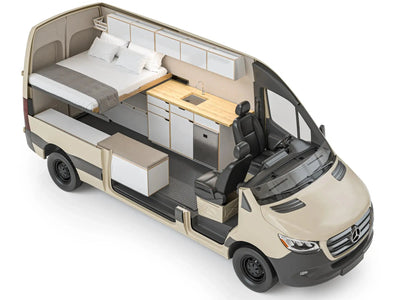
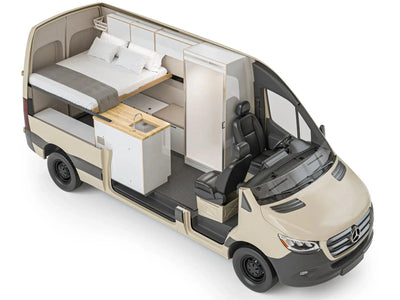
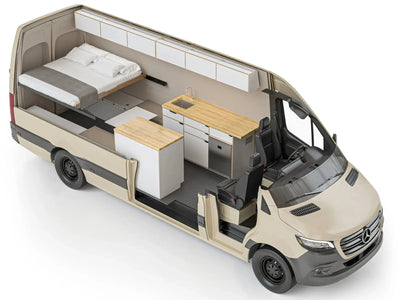
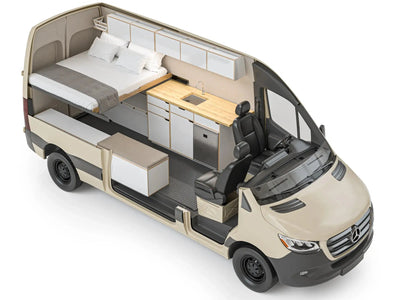
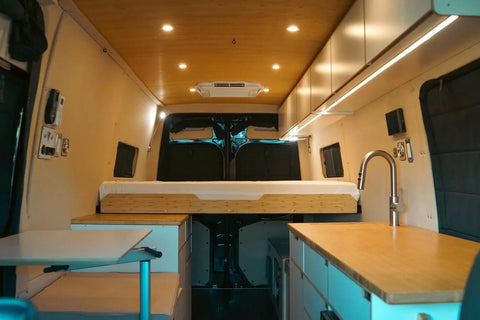
A step van camper conversion gives you more square, room-like interior space than a Sprinter. But the better choice usually comes down to weight class, payload after the build, and how much ownership friction you can live with. Most buyers miss one key thing at first: do you need the box shape itself, or do you just like the idea of it. In real use, that difference affects layout, service, paperwork, and resale more than the photos do. For most adventure-focused buyers, a high-roof Sprinter is still the easier long-term path. A step van makes sense when the extra box efficiency is central to the mission.
Step van camper conversion vs Sprinter: the core decision
 This choice is less about style than platform intent. A walk-in step van was built first as a delivery tool. The 2026 Mercedes-Benz Sprinter Cargo Van is sold in cargo layouts that already line up well with camper use. That difference shapes almost every choice after you buy the shell.
The big draw on a step van is shape. Utilimaster's walk-in van brochure shows the kind of near-vertical walls and rectangular floor area that make cabinet runs, bed bases, and shower walls easier to plan. You spend less time fighting curves and odd tapers.
Sprinters answer with a much more familiar camper platform. Mercedes gives builders a clear OEM framework through its upfitter portal. That matters when you're thinking about weight distribution, wiring, and approved modification paths. In our Boulder shop, that supportability is a big reason buyers keep coming back to Sprinter and Transit.
It's also worth clearing up one common myth. Not every step van is a huge old bread truck. The Utilimaster Velocity F2 can be set up at 9,500 pounds or 9,950 pounds GVWR, while the Sprinter itself runs from 9,050 pounds to 12,125 pounds depending on trim. So you can't assume one rule fits every van. You have to compare the exact chassis.
For most travel buyers, the trade-off stays pretty simple: a step van can maximize box volume, while a Sprinter usually gives you an easier path for service, aftermarket parts, and resale. In our shop, people asking about oddball platforms usually land on the same three filters. They care about drivability, support, and how much compromise they're willing to accept for straighter walls.
Why step vans attract camper builders
There's a reason people get excited by walk-in vans. Utilimaster describes the format around low step-in height, high visibility, and a wide-open cargo area. Those things do translate well to camper life. If you're in and out of the van all day, easy movement matters.
The Velocity F2 adds a low floor and walk-through layout. That can feel easier than climbing in and out of a standard cargo van over and over. If your day includes cooking, working, and moving gear around, that daily ease starts to add up.
Square walls help too. In our experience, they cut down on custom scribing and filler work around upper cabinets, wall panels, and wet-bath walls. That's one reason a step van can feel more like a tiny room than a vehicle shell.
A wider, boxier body also makes side-to-side furniture plans feel more natural. Fixed showers, longer galleys, and office-style interiors fit the shape well. If your top goal is stationary comfort, a step van has a real edge.
Still, the look isn't for everyone. Many step vans keep a strong commercial profile, and some private owners don't love that in campgrounds, trailhead lots, or city parking. If you want something that blends in a bit more, that matters.
Why Sprinters remain the default benchmark
Sprinters stay the benchmark because the platform is easy to study before you build. Mercedes publishes wheelbases, roof heights, and cargo dimensions directly. That makes layout planning more predictable. That's a big help when you're trying to decide between a couple's build and a family layout.
The OEM guidance goes deeper than brochure specs. Mercedes publishes Body and Equipment Guidelines that cover axle loading, center of gravity, and modification basics that builders use every day. Those documents don't make a build simple, but they do give you a much clearer starting point.
There's also a huge practical side to this. Sprinter camper layouts are already built around common van dimensions, so windows, flares, roof racks, heaters, and interior systems are easier to source and package cleanly. That's one reason our current production platforms focus on high-roof Sprinters and Transits, not commercial walk-in bodies.
Price helps make the comparison real. Our 2026 Sprinter Duo starts at $114,450, and the Sprinter Family starts at $119,450. If you want to see how those platforms are set up, you can browse our Sprinter conversions, look at vans for couples, or compare family-ready layouts in our family van collection. Semi-custom builds usually take 8 to 10 weeks. That's a useful benchmark against a more one-off step-van project.
Weight, GVWR, and payload are where step-van projects get real
 GVWR sets the legal maximum loaded weight of the vehicle. That sounds simple, but the real issue is what happens after insulation, cabinets, batteries, water, gear, passengers, and fuel all pile in. A roomy shell can get heavy fast.
The Sprinter's published GVWR range is wide, from 9,050 pounds to 12,125 pounds. That means build planning has to start with the exact chassis, not a generic Sprinter number. A lighter configuration and a heavier one can lead to very different payload margins.
The same goes for step vans. The Velocity F2 shows that some walk-in formats stay at 9,500 pounds or 9,950 pounds GVWR, which is lighter than many buyers expect. Transit-based walk-in bodies matter here too, and Ford's 2026 Transit specs help explain why some of these builds stay in lighter-duty classes than old-school diesel delivery trucks.
Mercedes is also very clear that total weight isn't the whole story. Its Body and Equipment Guidelines stress axle ratings and weight distribution, because a van can sit under GVWR and still overload one axle. That's where poor tank placement or a big rear gear box can bite you.
In real builds, the weight creep usually starts with the must-have list. Bigger lithium banks, more water, a fixed bed, an indoor shower, roof gear, and extra storage all sound reasonable on their own. Together, they stack fast. This is why we tend to push buyers toward disciplined planning instead of chasing square footage first.
Published weight ranges you can actually compare
Here are the numbers that matter most at the first-pass stage. Some Sprinters sit below the common 10,000-pound discussion line, and some sit above it. Some step vans do too. The category name alone doesn't tell you enough.
| Platform | Published GVWR | What it shows |
|---|---|---|
| 2026 Mercedes-Benz Sprinter Cargo Van | 9,050 lb to 12,125 lb | Some trims are below 10,000 lb, some are not |
| Utilimaster Velocity F2 | 9,500 lb | A step-van format can stay under 10,000 lb |
| Utilimaster Velocity F2 | 9,950 lb | Still under 10,000 lb in another configuration |
| Transit-based walk-in formats | Varies by base chassis | The donor chassis changes your payload picture |
Traditional walk-in vans also come in many body lengths, widths, and heights. That can mean more usable room, but it also means more structure and more interior finish material. Bigger isn't free. Bigger usually costs payload.
The practical takeaway is simple: step van is too broad a label for one weight answer. In the shop, the useful question is not which van is bigger. It's how much legal, usable payload you'll still have after your exact build is installed.
How camper systems eat into payload
Camper systems change vehicle dynamics, which is why Mercedes spends so much time on loading and center of gravity in its guidance. Roof racks and solar add weight up high. Tanks tend to sit low and often rearward. Battery banks end up in benches, cabinets, or under seats.
Step vans can tempt people into scaling everything up. The shell looks roomy, so the plan grows with it. Bigger tanks, more cabinetry, heavier finishes, and larger furniture all start to feel justified. That's where a promising floorplan can quietly eat its payload margin.
Sprinters have less rectangular wall space, but that limit can actually help. It forces harder choices earlier, and those choices often keep the finished van in a healthier weight range. We'd skip the oversized tank plan before we'd give up payload margin. Most people never use all that extra capacity.
Trip weight matters too. You need to count passengers, water, food, bikes, recovery gear, and cold-weather gear, not just the build sheet. If you want a reference point for how a complete travel van gets packaged on known platforms, our DUO XL layout, Family XL layout, and Foundation builds show how full-time travel essentials can fit without starting from a blank commercial shell.
Licensing, CDL rules, and RV classification for a step van conversion to camper use
 This is the part that makes many buyers nervous, mostly because a step van looks commercial. At the federal level, the FMCSA non-business transportation FAQ says CDL rules generally do not apply when individuals transport personal property for non-business use, unless a home state says otherwise. So no, a step van does not automatically mean CDL.
That sounds like a lot of hassle for a camper. It can be. The driving side is often manageable, but title class, registration path, and how the finished vehicle gets described can feel less intuitive than with a standard camper van. That's one reason many buyers decide the box shape isn't worth the extra friction.
Weight still matters here, because state-level rules can differ. So can title status and equipment details. The key point is that federal guidance is the baseline, not the whole answer. For most private owners, the bigger challenge is paperwork clarity, not actual driving qualification.
RV classification adds another layer. The RV Industry Association explains that standards and rules focus on the living-quarters part of the vehicle, which helps frame the difference between a real motorhome-style conversion and just putting a bed in a commercial shell. If the build moves through multiple completion stages, NHTSA's multi-stage vehicle handbook shows why labeling and certification can get more complex.
In practice, buyers who want fewer unknowns usually lean back toward a mainstream cargo van. A Sprinter camper path is more familiar to insurers, DMVs, and upfitters. If you want a cleaner process, you can start with Customize Your Van or read through Our Process to see what a standard high-roof build path looks like.
What federal guidance actually says
The FMCSA language is pretty direct. Federal commercial-driver rules generally do not apply when individuals move personal property for non-business use. The key qualifier is that your home state can still require something different.
That distinction matters more with step vans because they look like work vehicles. That commercial look can create confusion during registration, insurance calls, or roadside conversations, even when the use is private. So the right question is really two questions: do I need a CDL, and how will my state classify this finished vehicle.
In our experience, the second question is usually the one that takes more time. Buyers who want fewer gray areas tend to prefer a platform already familiar to insurers, DMVs, and builders. That's part of the ownership picture too.
RV standards and conversion compliance
RVIA's overview is helpful because it keeps the focus on living quarters. That's the part a camper conversion has to get right if you want a true RV-style result, not just a place to sleep. Build quality and clear documentation matter more here than many first-time buyers expect.
A converted commercial vehicle is not always treated the same way as a purpose-recognized RV by every insurer, campground, or state office. That's where a one-off project can get murky. The issue is often less about whether you can build it and more about who is responsible for labels and paperwork when the vehicle is completed in stages.
Sprinter-based camper builds benefit from a much clearer upfitter ecosystem and more common conversion precedents. If your goal is to travel more and sort paperwork less, a conventional van platform usually cuts down the friction.
Cost, fabrication complexity, and long-term ownership
A used step van can look cheap at first glance. But the shell is only one part of the budget. Fabrication, systems integration, service access, and all the small custom fixes can erase that early savings fast.
Sprinter builds benefit from a mature conversion ecosystem. That usually means less one-off work for windows, roof accessories, seating, electrical packaging, and interior modules. When parts are designed around the platform, labor often stays more predictable too.
Walk-in bodies can need more custom work around openings, sealing details, insulation transitions, and mounting points because fewer camper-specific products are made for them. Every odd interface takes time. Every custom mount takes more time. Over a full build, that labor compounds.
Our 2026 pricing gives a real benchmark for a complete camper, not just a shell. The Sprinter Duo starts at $114,450 and the Sprinter Family starts at $119,450. On Transit, the Duo starts at $112,450 and the Family starts at $117,450. Bivy models are sold ready to drive, and semi-custom builds usually take 8 to 10 weeks. That gives you a clean comparison point against a more bespoke step-van path.
Long-term support matters too. We back our cabinetry with a lifetime warranty, and that matters because durability and service are part of total cost. If you want to see the kinds of upgrades and fixes owners often need over time, our van build blog and DIY blog give helpful context.
Why used commercial shells are not always cheap in the end
A used step van may give you a lot of box for the money. It can also bring more unknowns around prior duty cycle, body wear, and service history than a newer cargo van donor. That's not a deal-breaker, but it is a real part of the math.
Because walk-in bodies are less standardized in the camper world, interior products often need more adaptation than off-the-shelf Sprinter parts. OEM upfitter support gives Sprinter builders a clearer engineering baseline, and that lowers guesswork. If your goal is a polished camper with cleaner resale, standard cargo-van platforms usually make the economics easier to predict.
That predictability is a big reason we focus on repeatable Sprinter and Transit layouts instead of commercial walk-in conversions. The hidden cost gap is often not parts. It's the amount of custom problem-solving the platform asks for over the life of the build.
A real benchmark for professional camper pricing
Numbers help here. Our 2026 Duo starts at $114,450 on Sprinter and $112,450 on Transit. The Family starts at $119,450 on Sprinter and $117,450 on Transit.
Those prices are useful because they reflect complete, professionally designed camper platforms. They are not shell-only budgets that still need major systems and interior work. Semi-custom builds generally run on an 8 to 10 week timeline, which gives you a solid sense of what a structured process looks like.
We also have a 4.8-star Google rating across 85-plus reviews, which tells you something about delivery and service after the sale. For a buyer deciding between a one-off step van and a proven cargo-van camper, the real comparison is turnkey use and long-term support, not just shell square footage.
Who should choose a step van, and who should choose a Sprinter
A step van makes the most sense when interior box efficiency is the whole point. If you want a room-like shell, upright walls, and a layout built around large fixed furniture, a dedicated shower room, or a work-focused interior, the walk-in format has clear packaging strengths. That's the niche where it earns its keep.
A Sprinter makes more sense when you want a platform already normalized for camper systems, pro upfitting, and documented OEM guidance. In our shop, that's the better fit for most couples and families who want to travel, park at trailheads, and keep ownership straightforward. High roof is the clear default here. About 90 percent of our customers choose it, and many mid-roof buyers later add a pop-top anyway.
So here's the short version. Choose a step van if you truly need the box. Choose a Sprinter if you want the easier ownership path. For most adventure-oriented buyers, that's the better-balanced vehicle.
Best-fit buyer for a step-van camper
The strongest case for a step van is spatial efficiency. The walk-in body is designed to maximize usable cargo cube with wide, upright walls, and that can make daily living feel more room-like. Low step-in access and walk-through movement also help if your day involves lots of in-and-out use.
Transit-based walk-in formats like the Velocity F2 may appeal to buyers who want some of that usability without jumping straight into a much heavier commercial class. Still, a step van is usually the right answer only when the extra box shape is central to the mission. If you're mostly drawn to the look, it may not pencil out.
Buyers excited by unusual platforms should be honest with themselves. Do you want a travel vehicle, or do you want a custom engineering project. If the answer is, I want the most room-like shell possible and I accept the trade-offs, a step van has a clear niche.
Best-fit buyer for a Sprinter build
The 2026 Sprinter stays the benchmark because it pairs published cargo-van specs with a dedicated OEM upfitter ecosystem. In real ownership, that means accessories, service knowledge, and conversion precedents are easier to find than they are for most walk-in bodies. Big difference.
For buyers who want a professionally built camper, our current lineup gives you a concrete path on both Sprinter and Transit. The Duo and Family layouts cover what most couples and families need without requiring the full rectangular footprint of a step van. If you're ready to talk through your travel goals, the next step is simple: contact us and we'll help you sort out whether a high-roof cargo-van build is the right fit.
FAQ
Do you need a CDL for a step van camper conversion?
Usually not at the federal level if the vehicle is used to transport personal property for non-business purposes. FMCSA says CDL rules generally do not apply in that case unless your home state requires otherwise. That means the smart move is to check state registration and licensing rules before you buy, especially if the vehicle still looks strongly commercial.
Is a step van camper conversion heavier than a Sprinter build?
Not always. The 2026 Sprinter Cargo Van ranges from 9,050 pounds to 12,125 pounds GVWR depending on configuration, while the Utilimaster Velocity F2 can be configured at 9,500 pounds or 9,950 pounds GVWR. The key is comparing the exact chassis and then looking at how much payload is left after the camper build is finished.
What is the biggest advantage of a step van conversion to camper use?
The main advantage is interior shape. Walk-in vans use a more rectangular cargo body with upright walls, which makes straight cabinet runs, larger wet-bath enclosures, and room-like layouts easier to package than in a curved-wall cargo van. If your whole plan depends on that boxy shell, the advantage is real.
Why do many buyers still choose a Sprinter over a step van?
A Sprinter is usually easier to build, service, and support over time because Mercedes provides OEM upfitter guidance and the camper market already designs many products around the platform. For buyers who want a ready-to-drive or semi-custom path, our 2026 Sprinter Duo starts at $114,450 and the Sprinter Family starts at $119,450. That gives you a clear benchmark for a complete camper, not just a shell.
Does a converted step van count as an RV?
It can, but that depends on how the vehicle is titled, registered, and equipped. RVIA explains that standards and regulations focus on the living-quarters portion of the vehicle, which is why a true camper conversion involves more than adding a bed to a commercial shell. In practice, clear documentation and a well-finished living space matter a lot.
About the author

Santiago Pere
Chief Design Engineer
Santiago is Chief Design Engineer at The Vansmith. He writes on topics spanning van design, builds, and life on the road.
Read more about Santiago