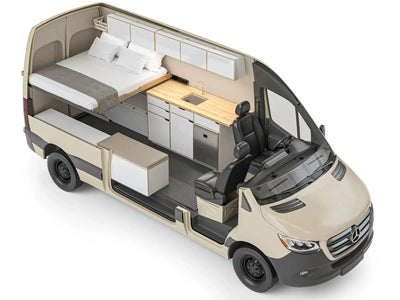
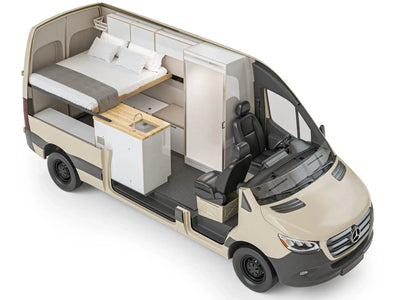
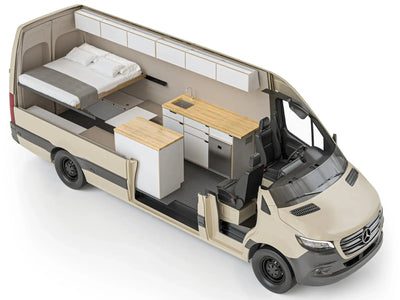
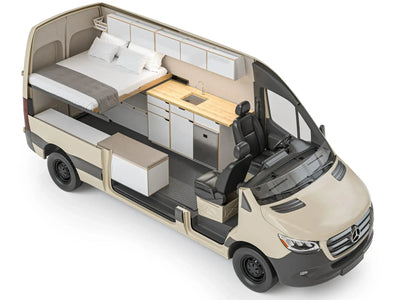
The sprinter passenger van starts as a factory people-hauler with seating for up to 12, while a cargo shell starts as a blank upfit platform. Which one makes sense for you comes down to your finished use: keeping real passenger function, or building a camper with fewer built-in compromises. In our shop, that split is pretty clear. If you want factory windows and regular multi-passenger use, Passenger can fit. If you want layout freedom, cleaner insulation, and fewer parts to undo, Cargo usually wins. At The Vansmith, we strongly favor the blank canvas a cargo van gives you.
Start with the end use, not the badge
Mercedes sells the 2026 Sprinter Passenger Van as a factory people-hauler, not as an empty shell. Depending on spec, it seats up to 12 passengers. That alone makes it a very different starting point from a cargo van.
For 2026, Mercedes positions the Passenger in 144-inch and 170-inch wheelbases with high-roof body styles. That means your first choice is not really trim level. It is whether you want a van that begins life carrying people or a van that begins life waiting for an upfit.
A cargo base is usually the stronger pick if the goal is a purpose-built camper. You start without rear passenger seating, without passenger trim, and without factory side glass that may clash with your bed, galley, or cabinet plan. In our Boulder shop, people who know they want a dedicated camper often regret paying for passenger parts they remove right away.
Passenger makes more sense if factory glazing and OEM passenger packaging are central to the long-term plan. Families who expect to carry kids or guests on a regular basis often like the clearer resale story too. A passenger VIN is easier to explain than a cargo van with aftermarket seating added later.
That simple framework holds up well. Choose Passenger if factory windows and passenger identity are core to the van's future use. Choose Cargo if layout freedom, insulation control, and a cleaner camper shell matter more. Same van family. Very different starting point.
If you're still sketching layouts, it helps to look at real Sprinter conversions and compare them to a blank-shell plan. A lot becomes obvious once you picture where the bed, cabinets, and travel seats will actually go.
What the 2026 sprinter passenger van gives you from the factory
The official Mercedes passenger page makes the intent clear. This van is built around passenger transport, not open cargo volume. That affects seat-delete planning, wall finishes, and how much freedom you have with windows from day one.
Passenger models come with factory side glass and passenger-focused interior packaging. That can save you from cutting windows right away. It can also lock you into glass locations that don't line up with a headboard, upper cabinet run, or shower wall.
Once seats come out, the van can show its history. You may be left with mounting points, trim breaks, and floor transitions that a cargo shell never had. Those details are not deal-breakers, but they do shape labor, finish quality, and how clean the final interior feels.
There is a real upside if you want to keep meaningful OEM seating. Passenger vans can work well for family builds with more than two belted travel seats, and that is where they tend to shine in our builds. If the van ends up as a two-person camper, though, a lot of that factory equipment turns into sunk cost.
Passenger also gives you a clearer resale baseline because it starts as a factory-defined passenger body style. That matters if you want the finished van to keep some multi-use identity. For family-focused layouts, our family vans are the kind of setup where a passenger base can make real sense.
What a sprinter cargo van base changes
A cargo van buyer can often choose window setups based on security and visibility needs. That can mean no windows, rear-door glass only, or side-and-rear glass. For camper planning, that flexibility is huge.
No-window cargo shells have a real security edge. They hide gear better and give you fewer chances for a smash-and-grab. That same logic works for stealthier camper builds where you don't want bikes, bags, or electronics visible from outside.
Starting with cargo also means you place windows only where the layout needs them. You are not forced to build cabinets around factory passenger glass. In our experience, cargo-base Sprinters are simply easier to turn into clean camper layouts because insulation, wiring, wall systems, and window placement all follow the final plan.
You also avoid paying for factory rear seating you may remove on day one. For a van that will sleep two to four instead of carrying 10 to 12, that usually makes the initial purchase more efficient. The trade-off is simple: you need to plan light, visibility, and ventilation more carefully because the shell does not hand those to you.
If you want to start from a blank slate, our customize your van page is the right next step. It helps frame the build around how you travel, not around what the shell happened to include.
Windows are the biggest irreversible choice
Window strategy is often the point of no return. Factory glass placement, aftermarket cut-ins, privacy, tint, and insulation all flow from that one call. Pick wrong here, and you keep working around it for the rest of the build.
Mercedes tells upfitters to use its Body & Equipment Guidelines before making body changes. That makes the BEG the main technical reference before cutting side panels, adding glazing, or changing body openings on a Sprinter.
NHTSA also matters here. Its FMVSS No. 205 interpretation says the windshield, front driver and passenger windows, and any rear window used for driving visibility are subject to the 70% light-transmission rule. That affects both bases. Passenger vans already have glass to work around, and cargo builds with added windows still need to think about which panes become part of driving visibility.
On the daily-use side, cargo vans with less side glass have a real privacy and security edge. Passenger-style full glass gives a more open cabin feel and better outward views. In practice, though, customers rarely regret adding the right windows later. They often regret being stuck with factory passenger glass right where they wanted upper cabinets, bunk walls, or a headboard. Plan the layout first. Plan the layout first.
This is also where service work comes into the picture. The Vansmith handles window, flare, and related upgrade work, and a design-first path usually leads to fewer regrets. If you want to see how that kind of planning fits into a build, our foundation builds page is a useful starting point.
Factory passenger glass vs aftermarket window placement
The 2026 Passenger Van's factory glazing is handy if you want day-one visibility and people-hauler use. It is less handy when you need to place a bed at the right height or run a clean wall of storage. Factory glass can decide those things for you before the build even starts.
Cargo buyers have more choice. You can keep the side panels solid, add rear-door glass, or place side windows only where the finished camper benefits from them most. That might mean a bunk window for cross-flow, a galley window for light, or no driver-side window for more privacy at camp.
Passenger glass also changes the thermal picture. In our builds, more glass usually means more solar gain and less insulated wall area. That can make a van feel bright and airy in the afternoon, then cold around the glass at night.
Mercedes created upfitter guidance for a reason. Body openings and modifications need approved practices, not guesswork. For buyers who want a refined camper instead of a shuttle-derived interior, window placement freedom is one of the best reasons to start with cargo. If you are still comparing ideas, our van build blog has more planning content.
Glazing law, tint, and visibility rules
NHTSA's glazing interpretation is pretty direct. The windshield and front side windows must meet the 70% light-transmission rule, and any rear window used for driving visibility can fall under that standard too. So the question is not just where glass goes. It is how that glass functions once the van is on the road.
Rear and rear-side tint may also be shaped by state law, so a passenger shell does not give you unlimited freedom to darken every pane. This matters more on Passenger builds because you start with more factory glass to manage. Privacy film, shades, and visibility all have to work together.
On Cargo builds, the issue comes up a bit later. You are deciding whether a new window is just for light and air, or whether it becomes part of the driving-visibility system. In shop terms, the smartest path is to decide early which windows are for comfort and which ones are truly needed for driving visibility.
Mercedes' BEG and NHTSA's framework work together here. NHTSA explains the safety interpretation. Mercedes explains how to modify the Sprinter body correctly. If you are planning windows, coverings, or vent changes, our process page shows how those choices fit into the full build.
Seat deletes and HVAC are where simple plans get complicated
Seat removal sounds easy on paper. In a sprinter passenger van, it is a system decision. You are dealing with restraints, trim, airflow, and the final configuration of the van, not just a wrench and a free afternoon.
NHTSA says converting a used passenger van to a cargo-type setup is not prohibited by itself. It also says removing rear seats and belts does not automatically violate federal rules, as long as the modified vehicle still has the safety systems required for the type it becomes. That clears up a common misunderstanding, but it does not make seat deletes casual work.
Mercedes adds the model-specific side of the story. Its Sprinter modification guidance covers constraints tied to things like front passenger seat removal, restraint systems, and airbag concerns. It also warns that modifications must preserve effective windshield and side-window defrosting.
That HVAC point gets missed all the time. In our shop, comfort complaints often trace back to airflow and glass management choices made too early, especially in vans with lots of passenger glass. Passenger buyers should assume seat deletes are only clean when the full plan accounts for restraints, trim, and the final vehicle setup from the start.
That sounds like a lot of work for removing a few seats. It is. If the final van never needed those seats, starting with cargo is usually the simpler path.
What NHTSA says about seat removal
The NHTSA interpretation on conversion vans makes one thing clear: changing a used van from passenger to cargo form is not inherently prohibited. That is the broad federal answer many buyers are trying to find.
The same interpretation says rear seat and seat-belt removal does not automatically violate the make-inoperative rule. That is helpful, but there is still a condition attached. The modified van must keep the safety equipment required for the vehicle type it becomes.
That is why documentation and finish quality matter. A professionally planned conversion tells a cleaner story than a van with casually removed seating, exposed mounts, and half-finished trim. For readers choosing between bases, the takeaway is simple: Passenger-to-cargo conversion can be lawful in principle, but it is still more complex than starting with Cargo when you never needed those seats.
This is also where seat-install work matters if you do need extra belted positions later. The Vansmith handles that kind of planning and install work, and our contact us page is the best place to ask about your seat count and layout together.
Why HVAC and defogging matter more in a passenger shell
Mercedes specifically says effective windshield and side-window defrosting must be preserved after modification. That matters because camper builds add insulation, wall panels, cabinets, curtains, and sometimes partitions. All of those can change how air moves through the cabin.
Passenger vans start with more side glass than cargo vans. So there is simply more interior glass area that can collect condensation, soak up solar heat, and feel cold at night. In mountain climates like Colorado, that becomes very real during shoulder-season camping.
Cargo shells are usually easier to insulate for four-season use and easier to darken for sleep. They may need more planned ventilation and more intentional lighting, but the thermal envelope is easier to control with fewer windows. We'd start with Cargo for a true camper almost every time. The extra glass in Passenger usually creates more work than value.
This one surprises people. A passenger shell can look more finished on day one, yet feel harder to keep comfortable once the camper build is done. If your trip style leans toward ski lots, cold nights, or long shoulder-season travel, that matters a lot.
Cost, sound deadening, and build efficiency
There is no solid source in this brief that gives a Sprinter-specific decibel contest between Passenger and Cargo. So it is better to stay grounded in what shell choice changes physically: how much interior stuff you need to remove, how much glass you need to manage, and how cleanly the final systems can go in.
Passenger vans come with more factory interior content. That can make the van feel less bare at first. It can also create waste and labor once seats, trim, and flooring come out for a camper layout.
Cargo vans usually need more finishing work up front. Yet they often streamline the whole build because insulation, wiring, wall systems, and flooring can be installed once around the final plan instead of after teardown. More glass also means less insulated wall area and more surfaces that pass road noise, heat, and cold.
Think in total build cost, not sticker price alone. Paying for factory passenger seating and trim you will remove is often less efficient than paying once for the exact camper parts you want. For readers comparing finished options, The Vansmith's DUO XL layout and Family XL layout give a real-world look at where a complete plan can land.
| Model | Starting price | Typical use |
|---|---|---|
| Sprinter Duo | $114,450 | Couple or solo travel |
| Sprinter Family | $119,450 | Family-focused travel |
| Semi-custom build timeline | 8 to 10 weeks | Planning benchmark |
As of 2026, those are the real price anchors in our lineup. Ready-to-drive Bivy models are sold complete, and semi-custom builds usually take 8 to 10 weeks. That gives you a concrete alternative if you would rather not solve shell trade-offs alone.
Where the money gets wasted
The most common waste in a Passenger-to-camper path is simple. You pay for factory seats and passenger trim, then pay again to remove or work around them. That money rarely improves the final camper if the van will mostly carry one or two people.
A Cargo base avoids that duplication. Your budget goes toward windows, insulation, electrical, cabinetry, and climate systems instead of undoing OEM passenger hardware. Passenger can still save money if the final van truly keeps substantial OEM seating and glazing.
In our project planning, the best question is not which van is cheaper to buy. It is which van leaves the fewest paid-for parts on the shop floor after teardown. For a couple's camper or solo travel rig, Cargo usually gives the cleaner cost path.
If that sounds familiar, you may also want to browse our vans for couples. Those layouts show why a simpler shell often leads to a cleaner finished camper.
Sound deadening and thermal comfort trade-offs
Mercedes upfitter sources cover interior modifications in broad terms, but they do not hand us a neat Passenger-versus-Cargo sound chart. So the honest way to compare them is by physical trade-offs, not made-up numbers.
A Passenger shell usually has more exposed glass area. That means more need for window coverings if you want a quieter, darker, and better-insulated interior. A Cargo shell gives you larger uninterrupted wall cavities for insulation and finish systems, which usually helps create a more controlled thermal envelope.
Factory passenger trim may soften some bare-metal harshness at first. Once a full camper is underway, though, long-term comfort depends more on final insulation, paneling, flooring, and window strategy than on the original shell label. For mountain travel and cold-weather camping, fewer windows are often easier to live with because every pane is a weaker thermal boundary than an insulated wall.
One thing a lot of builders overlook is how often they camp with shades closed. If that is most nights, extra passenger glass may not be doing much for you. Plan the layout first. Plan the layout first.
Resale: which base tells the cleaner story later?
Resale is not just about price. It is about how easy the van is to explain to the next buyer. A mostly intact Passenger, a Passenger with major seat deletes, and a Cargo built as a camper all tell different stories.
Kelley Blue Book's Sprinter 1500 Passenger page is a useful benchmark because it shows factory Passenger vans sit in a familiar used-market category. You get trade-in, private-party, and depreciation context that helps frame how mainstream that body style is.
That does not prove Passenger always resells for more after conversion. It does show that a true passenger-spec Sprinter starts in a recognizable lane. Cargo has its own resale logic too, especially for buyers who value security, fewer windows, and a cleaner upfit story.
In our experience, a heavily modified Passenger can narrow its audience if it no longer works well as a people-hauler but still carries the compromises of one. A well-executed Cargo camper often reads more cleanly because the buyer sees an empty shell that was intentionally built for travel. Build quality matters here too. The Vansmith holds a 4.8-star Google rating across 85-plus reviews, and our cabinets carry a lifetime warranty, both of which help support buyer confidence long after the build is done.
When Passenger helps resale
Passenger can help resale if the finished van still keeps real passenger-carrying ability. The next buyer may value the factory people-hauler origin, especially if the van still has a coherent mix of travel seats and camper function.
KBB supports the idea that factory Passenger vans live in a familiar used-market category. If seat deletes are reversible and the build still works as a passenger-plus-camper setup, that broader appeal can help. This tends to matter most for family buyers who want belts for more riders.
Passenger resale gets weaker when the conversion strips out the very things that made Passenger valuable in the first place. Once multiple seating rows are gone and the layout reads like a cargo-style camper, the extra glass and altered seating history can feel like baggage. Passenger helps resale most when the finished van still feels like a premium multi-use van.
When Cargo is the better long-term bet
Cargo is often the better long-term bet when the end goal is a dedicated camper. The story stays clean from day one: empty upfit shell to intentional travel van. Buyers tend to understand that right away.
Window count and placement can match the layout, which helps camper buyers see the logic of the build. A Cargo van can also keep some security advantages if it uses fewer windows, and that matters to both stealth-minded travelers and some commercial buyers.
Because there is less deleted OEM passenger gear to explain, Cargo conversions usually raise fewer questions about what was removed and why. For couples and solo travelers shopping used campers, a clean cargo-origin build often feels more purpose-built than a passenger-origin van with visible seat-delete compromises.
That is why many adventure-oriented layouts work best on cargo-style foundations, even though the right answer still depends on how many belted seats you truly need. If you want to compare shell choice with a finished floor plan, our DIY blog and layout pages can help you narrow it down.
FAQ
Is a sprinter passenger van better than a sprinter cargo van for camper conversion?
It depends on the finished use. A 2026 Sprinter Passenger Van starts as a factory people-hauler with seating for up to 12, while a cargo base gives you more freedom to place windows, insulation, and cabinetry around the camper layout you actually want. If you need regular multi-passenger use, Passenger can fit well. If you want a dedicated camper, Cargo is usually the cleaner start.
Can you legally remove seats from a Sprinter Passenger Van?
Yes, it can be legal in principle, but it is not just a mechanical job. NHTSA says converting a used passenger van to a cargo-type configuration is not prohibited by itself, and removing rear seats and belts does not automatically violate federal rules if the modified vehicle still has the safety systems required for its resulting type. Mercedes upfitter guidance still matters for the model-specific side of the work. That is why seat deletes should be planned as part of the whole build.
Are cargo vans better for window placement?
Usually, yes, for camper layouts. Cargo vans can be ordered with no windows, rear-door-only glass, or side-and-rear glass, which gives builders more control over privacy, security, and where to add windows later. That freedom makes it easier to place a bed, galley, or cabinet wall without working around factory passenger glass. In our experience, that is one of the biggest reasons dedicated campers start with Cargo.
Do window and tint rules change if I add windows to a Sprinter cargo van?
They can. NHTSA says the windshield, front side windows, and any rear window used for driving visibility are subject to the 70% light-transmission requirement under FMVSS No. 205, while rear and rear-side tint can also be shaped by state law. The practical question is whether the added window becomes part of the van's driving-visibility system. That should be decided early, before tint and coverings are chosen.
Why does HVAC matter when choosing Passenger vs Cargo?
Mercedes warns in its Sprinter Body & Equipment Guideline that modifications must preserve effective windshield and side-window defrosting. That matters more in passenger shells with more factory glass, because insulation, partitions, cabinets, and window coverings can all change airflow and condensation control. More glass also means more solar gain in the day and more cold surface area at night. A cargo shell is often easier to manage for four-season camper comfort.
What does The Vansmith charge for a finished Sprinter build?
As of 2026, The Vansmith lists the Sprinter Duo at $114,450 and the Sprinter Family at $119,450. Semi-custom builds usually take 8 to 10 weeks, which gives you a useful planning benchmark if you are deciding between a shell-first project and a finished conversion path. Those numbers also help frame the real cost of undoing the wrong factory equipment. Sometimes the cleaner answer is to start with the right base and a clear plan.
About the author

Eugene Smit
CEO
Eugene is the CEO of The Vansmith, based in Boulder, Colorado. He writes across topics related to van builds, ownership, and the camper van industry.
Read more about Eugene