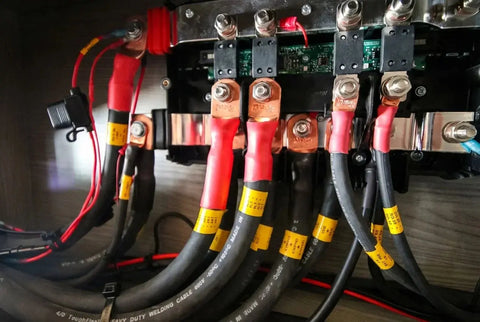
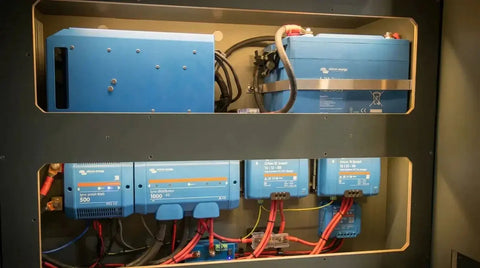
Camper van solar works best as part of a three-part charging system, with solar making power in the sun, batteries storing it, alternator charging helping while you drive, and shore power topping you up when you're plugged in. That matters because most van power problems don't start at the panels. They show up where the house battery, starter battery, alternator, and shore charging all meet. In most modern vans, especially with lithium, the real goal is a balanced charging setup that protects the alternator, keeps the starter side healthy, gives your house bank a steady path to recharge, and lets you start trips fully topped up.
How camper van solar, batteries, and alternators work together
A real van power system usually has more than one way to charge. Renogy's charging guide frames RV charging as a mix of solar, shore power, and alternator charging. That's a helpful way to think about it, because no single source does every job well.
Solar is great for keeping lights, fans, and the fridge running in good sun. Shore power helps you start a trip topped up when you're plugged in at home, at camp, or at a friend's driveway. Alternator charging fills in the gap on drive days, so it should be seen as one part of the bigger plan, not the whole plan.
On the vehicle side, the alternator's first job is not your fridge or your inverter. As Victron explains, the alternator is there to keep the starter battery charged and run the van's own electrical loads while the engine is on. Once you add a house battery, you're creating a second energy system that needs its own charging strategy.
That's one reason we talk so much about integration at The Vansmith. A van build isn't just picking panels off a shelf. If you're planning a custom system through Customize your van or comparing layouts in our van build blog, it's worth seeing the electrical side as a full package.
Modern vans also add a layer of complexity. Victron's service-vehicle guidance points out that charging between the starter side and the service side often needs to be controlled, and that becomes even more true with lithium banks. Battle Born makes the same point, noting that lithium batteries don't behave like a simple add-on to the vehicle battery system.
Why alternator charging matters in a solar-first van
Solar-first is still the right mindset for most camper builds. But solar has limits. Renogy points out that alternator charging is especially useful after cloudy weather, winter camping, or a night where your fridge, fan, lights, and inverter took a bigger bite than expected.
Picture a ski trip weekend. Your van sits in low winter sun, maybe with snow on the roof, and the fan plus heater controls run longer than usual. In that case, a drive back down the canyon can become a very useful recovery window for your house battery.
Shade matters too. So does parking direction, tree cover, and the simple fact that some travel days include lots of driving while some camp days include none. Alternator charging gives you redundancy, which is a fancy word for backup that actually helps in the real world.
Victron treats the service battery as its own energy domain, and that maps well to vanlife. Your house bank needs reliable charging even when solar conditions are weak. Battle Born adds that larger lithium banks can accept charge quickly, which is great for recovery time, but only if the charging path is managed the right way.
That's why we usually tell people to size solar harvest, battery storage, alternator charging, and shore charging as one system. If you're browsing Sprinter conversions or Transit conversions, the best setup depends on how the van will actually be used, not just how many watts fit on the roof.
What the alternator actually does in a camper van
At its core, the alternator is an engine-driven charging source. It keeps the starter battery topped up and supports the van's own electrical system while the engine runs. That's the base job, and your house system comes after that.
Because of that, any house-battery charging plan has to protect the starter side first. You never want the house bank to act like it has equal claim on the van's charging system. Starting the engine still has to come first, every time.
This is where lithium changes the conversation. Battle Born warns that a direct alternator-to-lithium connection can pull heavy current for long stretches, since lithium batteries tend to keep accepting strong charge until they're nearly full. That can overwork the alternator, especially on long drives or hot days.
Modern smart alternators add another wrinkle. Victron notes that variable-voltage alternators may not give a stable charging profile for a second battery bank without added electronics. So alternator charging in a camper van usually isn't just a cable. It's a managed path with hardware in the middle.
In our experience, this is one of the biggest things buyers miss early on. They know they want solar and lithium, but they haven't yet thought about the drive-day charging path. If you're planning a new build through our process, that's exactly the kind of systems question worth sorting out early.
Why lithium batteries change camper van solar design
Lithium batteries have changed van electrical design in a big way. They offer strong usable energy and fast charging, but they also raise the stakes on charge control.
A lithium setup depends on a battery management system, or BMS. That BMS protects against things like high voltage, low voltage, and temperature extremes. It isn't a bonus feature. It's a core part of how the battery stays healthy inside a real van system.
Battle Born explains that lithium can accept high charging current much longer than lead-acid. That's part of why people love lithium. It charges efficiently. But it's also why the alternator side needs more care than many people expect.
Victron specifically points to lithium service banks as a reason to limit alternator charging current. A lead-acid battery often tapers earlier on its own. Lithium often won't. That means the practical gain of lithium, faster charging and more usable power, comes with a need for tighter control between all charging sources.
That's a strong case for pro design, especially if you're adding solar, battery upgrades, or a foundation build that may grow over time.
Lithium vs. lead-acid in alternator charging
The big difference is charging behavior. Battle Born notes that lithium has a flatter voltage curve and can keep taking substantial current until it's close to full. Lead-acid usually starts tapering earlier, so it naturally eases the load sooner.
That means a lithium bank can hold the alternator under heavier demand for longer periods. Same van, same drive, very different charging stress. It's one of those details that doesn't show up on a simple battery spec sheet but matters a lot once the system is in use.
Victron's guidance for service vans offers a clear rule of thumb here. With lithium service batteries, and with either conventional or smart alternators, sizing around 50% of the alternator's rated output is recommended to help avoid overload. That's a useful reality check for anyone assuming the full alternator rating is fair game for house charging.
Lead-acid systems can still benefit from managed charging. But the urgency is higher with lithium, because a direct link is more likely to expose alternator limits. So battery chemistry affects more than storage choice. It shapes cable sizing, charge-control hardware, and how much while-driving charging you can safely use.
For buyers, the real question isn't just lithium or not. It's whether the whole charging system was designed around that chemistry. That's especially true in larger layouts like the DUO XL, where travel style and power use can grow fast once the van is in service.
Why battery protection matters
Battery protection matters because van systems don't live easy lives. They see heat, cold, vibration, long idle periods, and changing charge sources.
A proper lithium battery system is expected to include protections for high voltage, low voltage, overcurrent, and temperature-related risks. That's where the BMS earns its keep. If something goes out of range, the battery needs a way to protect itself and the rest of the system needs to respond well.
Battle Born stresses that charging hardware has to work with the battery chemistry and with BMS behavior. That's a key point. If a BMS disconnects under unsafe conditions, the rest of the electrical system can't be built on the assumption that the battery will always stay online.
One thing a lot of builders overlook is how these parts talk to each other under stress. A listed lithium battery with an integrated or coordinated BMS isn't just easier to sell. It's one of the clearest ways to reduce electrical risk in a camper van.
If you're building for family travel, simple reliability matters even more. That's part of why systems planning matters in layouts like the Family XL or in our family van conversions, where power needs can stay high all day.
Why a DC-DC charger is usually the right alternator solution
In most modern vans, a DC-DC charger is the cleanest way to use alternator charging. Victron's Orion XS page describes it as the device that sits between the vehicle battery and alternator side and the house battery side to provide controlled charging. That's the key phrase, controlled charging.
Current limiting is one of the biggest reasons this matters. A DC-DC charger helps protect the alternator and the batteries from uncontrolled demand. It also matters with smart alternators, which may not hold the voltage profile a house bank needs without boost or regulation.
Battle Born says direct alternator charging to lithium is risky, and a DC-DC charger is one of the most common fixes because it controls both voltage and current. That's why we see it as a charge-management tool, not a replacement for enough solar or enough battery. It solves a different problem.
For most Vansmith clients, that's the sweet spot. You still want a well-sized rooftop array and a battery bank that fits your loads. Then the DC-DC charger gives you a predictable while-driving source that works with the rest of the system, not against it.
What a DC-DC charger solves
First, it regulates output voltage for the house battery. Alternator output alone may not match the charging profile your battery needs, especially if the van uses a smart alternator. The charger smooths that out and gives the house side a more usable charge path.
Second, it limits charging current. That keeps the battery bank from demanding more than the alternator and wiring should deliver for long periods. This is a big deal with lithium, since lithium won't always self-limit early in the charge cycle.
Third, it helps protect the starter battery by separating the vehicle side from the house side. Your house bank should not act like a second engine battery. A managed charger keeps those roles clearer.
With solar and alternator charging in the same build, that predictability matters a lot. You get a known while-driving charge source instead of an uncontrolled one. If you're exploring service upgrades, our DIY blog and contact page can help you map out whether a battery upgrade, more solar, or charging changes make the most sense.
When a second alternator enters the conversation
A second alternator is usually not the first step. For most moderate-use vans, a properly sized DC-DC charger is simpler and makes more sense. But Battle Born notes that a dedicated second alternator can be worth considering in higher-demand systems.
This shows up most in vans with large lithium banks, heavy inverter use, air conditioning, or other power-hungry loads that need serious charging while driving. If the house side keeps asking for more than the stock alternator should comfortably support, that's when the conversation changes.
Air conditioning is the big power hog in most vans. It usually means plugging in, or stepping up to a bigger battery bank and a secondary alternator. Solar helps, but it usually isn't enough by itself for long AC use.
Victron's guidance to size around 50% of rated alternator output for lithium is a useful check here. Even a big factory alternator should not be treated as fully available for house charging. The van still has its own needs, and reliability still matters more than chasing peak numbers.
A second alternator separates house charging demand from core vehicle charging duties. That can improve reliability in four-season or expedition-style builds. It's also a service topic that depends on the full electrical architecture, not just swapping one part, which is why many owners reach out after they've lived in the van for a season and know their real loads.
Smart alternators, current limits, and real-world charging tradeoffs
Smart alternators are one of the main reasons old van electrical advice doesn't always hold up. Victron warns that smart or variable-voltage alternators can make secondary battery charging more complex than older fixed-voltage systems. In plain terms, the van may change alternator output based on its own logic, not based on what your house battery wants.
That can leave a house bank undercharged if it's connected without a charger that can compensate. Then add lithium, which may keep pulling current strongly, and you get a mismatch between what the battery can accept and what the vehicle charging system should safely provide.
Victron's 50% guideline for lithium service banks is one of the clearest manufacturer rules available right now. Renogy also notes that alternator charging is convenient but can add wear if the setup isn't right. So the real question isn't just whether your van has an alternator. It's how much charging it can safely deliver, for how long, and to what battery chemistry.
Understanding smart alternators in plain language
A smart alternator does not sit at one simple fixed charging voltage all day. The vehicle actively manages its output. That's good for the vehicle's own goals, but it can make house-battery charging less straightforward.
Your house battery, especially lithium, usually wants a more stable charging profile than that. So a DC-DC charger acts like a translator between the van's charging behavior and the house battery's needs. That's a much better mental model than thinking of it as just another charger box.
This is why older advice about using a simple isolator or direct link is often out of date for modern vans. If you're building on a current Sprinter or Transit, a managed solution tends to make much more sense. And because about 90% of our customers choose high roof, these builds often carry more comfort gear and longer trip plans, which makes charging consistency even more important than in a stripped-down weekender.
Most mid-roof buyers eventually ask about adding more living space through a pop-top, and that usually brings more electrical planning with it too. More time in the van often means more fan use, lights, and charging loads. Small design choices stack up fast.
Why direct alternator-to-lithium charging is risky
Battle Born is pretty direct on this point. A lithium battery can pull excessive current for long periods if it's tied straight to the alternator. Unlike lead-acid, it doesn't naturally ease off early in the same way.
That sustained current demand can overheat or wear the alternator sooner, especially on long drives or in hot weather. Victron's current-limiting guidance points to the same conclusion. Unmanaged charging can ask more from the alternator than it should continuously provide.
There's also the issue of voltage mismatch. The alternator's output profile may not match what a lithium house bank needs for proper charging. So even if the setup seems to work at first, it may still be hard on parts or leave the battery less well charged than expected.
Controlled solutions like DC-DC chargers, and in larger systems a second alternator, are meant to avoid those problems. For most van owners, this isn't about squeezing out a tiny gain in efficiency. It's about avoiding expensive failures when you're far from home.
How to choose the right charging strategy for your camper van solar system
The best charging strategy is layered. Renogy's broader guidance supports using solar for routine off-grid generation, shore power when it's available, and alternator charging as a recovery source on drive days. That's the most realistic way to plan for changing weather, changing routes, and changing energy use.
Solar is great for keeping lights, fans, and the fridge running. Alternator charging is great backup when the sun doesn't show up. Shore power is the easiest way to start your trip topped up.
A moderate-use van with lithium and a modern electrical system will usually benefit most from a properly sized DC-DC charger, not a direct alternator connection. Higher-demand vans may need more than one charging source because no single source performs best in every condition. Solar depends on weather. Alternator charging depends on drive time. Shore power depends on access.
Battle Born points out that larger or more power-hungry systems are where second alternators start to make sense. Air conditioning is the clearest example. It usually needs shore power, or a bigger battery bank and secondary alternator if you want real off-grid runtime.
For Vansmith clients, the right answer usually comes down to travel style. Weekend trips, full-time use, winter travel, remote work, family travel, and heavy inverter loads all push the balance in different ways. That's why the charging plan should fit your habits, not just your wish list.
Best-fit setups by use case
A fair-weather weekend van can usually lean more on rooftop solar and a modest while-driving charge path. Daily energy recovery is lower, so the system doesn't need to be pushed as hard. That's often a nice fit for couples browsing our vans for couples collection.
A four-season or remote-work van usually needs stronger redundancy. Winter sun is weaker. Shade hurts more. And if you're parked for work all day, the alternator isn't helping because you're not driving.
Lithium upgrades deserve extra attention here because lithium's high acceptance rate changes the safe design envelope. A modern Sprinter or Transit with a smart alternator is a strong candidate for DC-DC charging for exactly that reason. If you're planning future upgrades like more solar, air conditioning, or more battery, it's smart to plan the alternator side early so the system can scale cleanly.
This one surprised us years ago, but it keeps proving true. The biggest battery or charger isn't always the best answer. The best answer is the one matched to how you camp, how long you stay put, and how much comfort gear you actually use.
What readers should ask a builder or installer
Start with the charging path. Ask whether the house battery is charged through a DC-DC charger, a second alternator, shore power, or another managed system, and why that method was chosen for the battery chemistry. That answer tells you a lot about how the system was thought through.
Next, ask whether the van has a smart alternator and how that affects charging while driving. Then ask how charging current is limited to protect the factory alternator, especially if the van has lithium batteries. Those are simple questions, but they get to the heart of system design.
It's also smart to ask how solar, alternator charging, and shore charging are coordinated so the system works as one package. Then ask what future upgrades the system can support, like battery expansion, more solar, air conditioning support, or a secondary alternator, so you don't end up redoing major parts later.
If you're already at that stage, contact us. We handle solar and electrical troubleshooting, battery upgrades, added solar, and secondary alternator planning, and those choices make the most sense when they're tied back to the whole van.
FAQ
Does camper van solar make an alternator charger unnecessary?
Usually no. Renogy treats solar, shore power, and alternator charging as complementary sources, and that lines up with what we see in real vans. Solar is great, but weather, shade, snow, and parking angle can all cut output. A while-driving charge source adds useful backup and helps the whole system stay more reliable.
Can I charge lithium batteries directly from my van’s alternator?
It's usually not a good idea. Battle Born says direct alternator-to-lithium charging is risky because lithium can pull heavy current for long periods. Victron also stresses managed charging and current limiting to protect the alternator and both battery banks.
What does a DC-DC charger do in a camper van?
A DC-DC charger sits between the vehicle battery and alternator side and the house battery side. Victron explains that its main jobs are regulating voltage, limiting current, and helping modern smart-alternator vans charge a second battery bank more reliably. In plain terms, it turns a messy charging source into a more controlled one.
What is a smart alternator, and why does it matter?
A smart alternator is managed by the vehicle instead of staying at one fixed charging voltage. That can work fine for the van itself, but it can make house-battery charging less stable. With a lithium house bank in particular, a DC-DC charger or another managed solution often becomes important.
How much alternator output should go to a lithium house battery bank?
Victron's service-vehicle guidance recommends sizing around 50% of the alternator's rated output when charging lithium service batteries. That applies with both conventional and smart alternators. It's a useful rule of thumb because it helps reduce overload risk and keeps expectations realistic.
When does a camper van need a second alternator?
A second alternator starts to make sense when the house battery bank and loads are large enough that the stock alternator should not carry that demand comfortably. Battle Born ties this to bigger lithium banks, heavy inverter use, air conditioning, and other strong while-driving charging needs. For many vans, a DC-DC charger is enough, but high-demand builds can justify the step up.