San Diego RV parks are easiest to choose by stay style, not by trying to crown one overall winner. Bayfront resorts cost more. Public coastal campgrounds give up some polish for scenery. Inland parks usually mean easier hookups and lower rates. The right pick depends on your rig, your budget, and whether you care most about views, utility hookups, or flexible booking. For a self-contained camper van, that answer often looks very different than it does for a 40-foot motorhome. The happiest stays usually match the park to the trip, then the site to the van.
The featured photo shows the bluffs and beach at South Carlsbad State Beach campground at sunset, one of the public coastal options in this guide. (Photo: Marcel Fuentes, CC0)
How to choose between oceanfront, bayfront, and inland San Diego RV parks

The photo above shows Mission Bay from the air, with the Pacific beaches beyond it. Campland on the Bay and Mission Bay RV Resort both sit on this bay, while inland parks like Santee Lakes sit east of the city. (Photo: Alfred Twu, CC0)
San Diego's official camping overview describes camping across mountain, desert, lake, and beach locations. That's a much better way to sort options than a random top-10 list.
For most travelers, the first tradeoff is pretty simple. Coastal and bayfront parks give you the classic San Diego backdrop. Inland parks usually give you easier parking, easier hookups, and better value.
The four clearest examples here each do a different job. Campland on the Bay and Mission Bay RV Resort are on the premium bayfront side. South Carlsbad State Beach gives you the public coastal campground version. Santee Lakes is the inland full-hookup option.
Van travelers have to judge parks a little differently too. Policy, site size, and whether a park welcomes conversion-style vehicles can matter just as much as the location. If you drive a Sprinter or Transit, you may fit physically and still hit a booking rule.
Van travelers do best when they choose the park style that matches the trip: a bayfront resort for amenities, the public coast for scenery, or an inland full-hookup park for a practical basecamp.
Smaller camper vans have a real advantage here. A Sprinter or Transit can often use parks that feel oversized for it, but the reverse is not true. A public campground with a length cap may work great for a van and knock out a much larger RV.
What coastal and bayfront parks offer that inland parks do not
Campland is one of the clearest waterfront examples because it sits right on Mission Bay. You're paying for that setting as much as the campsite itself. If the whole point of the trip is stepping out near the water, that location does a lot of the work.
Mission Bay RV Resort is also on Mission Bay, but it feels a little different. It leans more toward full-hookup waterfront RV stays than a rustic campground setup. That matters if you want resort function, not just a nice pin on the map.
South Carlsbad State Beach sits on the public campground side of the spectrum. It gives you more of that classic coastal camping feel than a private resort does. You trade some polish for a stronger beach atmosphere.
Santee Lakes is inland and lake-focused, not ocean-focused. That makes it a better match for travelers who care more about hookups, site function, and easier day-to-day camping than direct beach access. For longer stays, that can be the smarter move.
Bayfront and coastal stays make the most sense on shorter trips where location is the splurge, especially if your van already has a bed, kitchen, and power built in. If you're out exploring all day and only need a clean overnight base, inland parks often make better use of your budget.
Which park style fits which traveler
Resort-style bayfront parks fit travelers who want on-site amenities, utility hookups, and easy access to San Diego's urban coastal core. If you're in a larger RV, that setup can feel straightforward. You pull in, hook up, and settle down.
Public coastal campgrounds fit a different kind of trip. They work better for people who want beach atmosphere and a more classic campground setting, even if the infrastructure is simpler. That's often a better fit for van owners who do not need every site to feel like a resort.
Inland full-hookup parks are often the easiest call for first-time renters and families. Parking tends to be simpler, services are clearer, and site types are easier to compare. If you want less guesswork, inland parks usually win.
A self-contained camper van can use location more strategically than a large RV. You may not need the biggest site or the heaviest utility package. A waterfront site can cost a lot just to sleep near the bay, so it is worth deciding whether the view is the point of that night.
Larger rigs should watch for pull-through access and big-rig claims. Those details matter more at Mission Bay RV Resort and some Santee Lakes site types than at a public coastal campground. Van travelers, on the other hand, need to read the rules closely because one park's camper van is another park's restricted conversion.
The fastest way to sort yourself is to pick one: scenic splurge, public coast, or inland utility.
San Diego RV parks cost comparison: what you pay for location
Price matters here because San Diego RV parks cover a wide range. Some are basic or no-hookup sites. Others are premium waterfront resorts where the nightly rate reflects both the setting and the services.
Campland's 2026 rate page is useful because it shows starting nightly rates across no-hookup, water and electric, and full-hookup categories. Mission Bay RV Resort's rate table adds another layer by showing weekday, weekend, weekly, and monthly structures. Santee Lakes pricing gives you the inland benchmark with several site classes.
South Carlsbad adds the public campground angle, which is a different value equation. You are not comparing hookups alone. You are comparing location, atmosphere, and how much resort infrastructure you actually need.
If your van already covers most comfort needs, that extra spend can feel wasted pretty fast. Spend on location when the view matters, then save on the nights when the van can do more of the work.
| Park | Stay type | Published pricing structure | What you're mainly paying for |
|---|---|---|---|
| Campland on the Bay | Bayfront resort | 2026 starting nightly rates by no-hookup, water/electric, and full-hookup site | Mission Bay location plus site class choice |
| Mission Bay RV Resort | Bayfront RV resort | Weekday, weekend, weekly, and monthly rates by site type | Waterfront resort stay and full-hookup utility focus |
| South Carlsbad State Beach | Public coastal campground | Hookup sites from $75 (inland) to $95 (ocean single), per the park map | Beach setting and campground atmosphere |
| Santee Lakes | Inland full-hookup park | 2026 nightly pricing for standard, pull-in, pull-thru, lakefront, and deluxe sites | Utility, site choice, and easier long-stay function |
Bayfront resort pricing: Campland vs Mission Bay RV Resort
Campland shows how much site class can change your budget even within one property. It offers no-hookup, water and electric, and full-hookup options. That spread helps motorhome and trailer guests pay for Mission Bay without always paying for the top utility tier. Note that Campland does not accept conversion vans.
Mission Bay RV Resort is more squarely full-hookup and utility-forward. Its pricing structure also changes by stay pattern, with weekday, weekend, weekly, and monthly options. If you're staying longer, that format gives you a clearer picture of what the resort model costs over time.
For a camper van with solar, fresh water, and a galley, Campland is off the table, so the bayfront option is Mission Bay RV Resort, where the cheapest acceptable site often makes more sense than the most loaded one. You're really paying for bayfront convenience and scenery. A larger RV running rooftop AC and residential-style gear may see more value in full-hookup resort pricing.
A van can often buy location without buying every utility. A big motorhome is more likely to want both.
Public coastal and inland value options
South Carlsbad State Beach is the public coastal option in this guide, and it stands out because it combines a beach campground setting with RV and trailer campsites that include hookups. The feel is still public campground first. That's a big part of the draw.
Santee Lakes gives you a more flexible inland value ladder. Its 2026 pricing covers standard back-in, pull-in, pull-thru, lakefront, and deluxe sites. It also says it has 300 full-hookup campsites, which tells you right away that utility and site choice are the main draw.
An inland park often gives van travelers more room to choose by budget. You are not competing for a limited number of premium waterfront spaces in the same way. For longer stays, that can matter a lot if you need dependable power for work, refrigeration, or climate control.
Public coastal campgrounds usually win on atmosphere. Private inland parks often win on convenience, hookups, and easier reservations.
Hookups, amenities, and what camper vans actually need

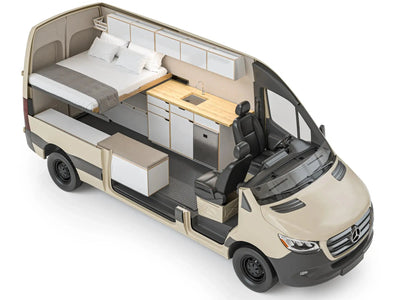
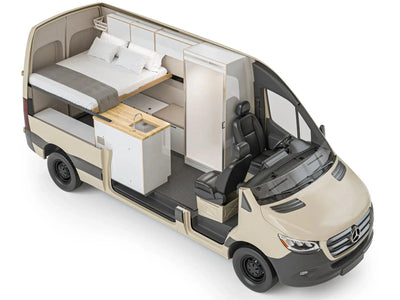
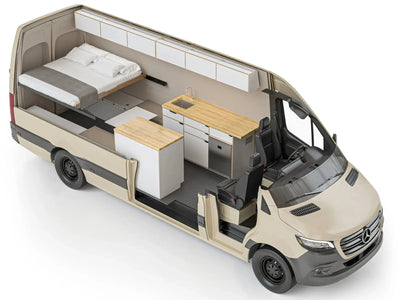
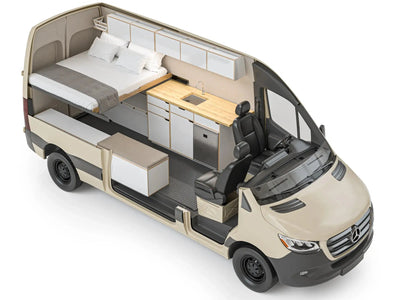
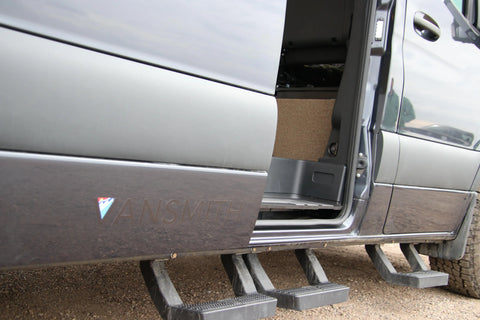
The photo above shows a self-contained Vansmith Sprinter. A van with its own power, water, and kitchen often needs less from a campsite than a large RV, which changes which San Diego site class is worth paying for. (Photo: The Vansmith)
Not all San Diego RV camping options are built around the same utility needs. Some parks mix hookup levels. Others are almost entirely full-hookup oriented, which changes both the price and the kind of traveler they attract.
Santee Lakes and South Carlsbad both offer more than one site type, so a self-contained van does not always need the top utility tier. If your van is set up well, you can pay only for the support you actually need.
Mission Bay RV Resort leans hard toward full hookups with 50-amp service. That's a strong fit for conventional RVs with bigger electrical loads. Santee Lakes also plays the utility card with 300 full-hookup campsites and free Wi-Fi, which matters if the campground is doubling as a work base.
South Carlsbad State Beach offers RV and trailer campsites with hookups, but the overall feel stays closer to campground than resort. In a well-built Sprinter or Transit, hookups are often a convenience instead of a must-have on short stays. Many van owners also overrate sewer needs. For shorter trips, power and water usually matter more.
If you're still sorting out what your own van needs, our van build blog and Foundation builds page show how system choices affect real travel use. The van itself changes the campsite math.
When full hookups are worth paying for
Full hookups make the most sense for larger RVs or for longer stationary stays. Shore power, water, and sewer reduce setup friction when the campsite is part of the trip, not just a place to sleep. If you're parked for several days, those utilities start to feel more valuable.
Mission Bay RV Resort's 50-amp full-hookup setup lines up well with traditional RV needs and bigger electrical loads. Santee Lakes gives you utility certainty too, especially with its large inventory of full-hookup sites. If you need dependable service for work or family travel, those parks are easier to justify.
Families in larger vans may also want hookups more often than a couple would. More devices, more refrigeration, and more climate-control gear add up. In those cases, full-hookup pricing can make sense because the campsite is carrying more of the comfort load.
Think of full hookups as a tool, not an automatic upgrade. They're worth paying for when you'll really use them. If not, you may be buying more site than you need.
When a simpler site is enough for a van
Even at a park with full hookups available, a self-contained camper van can often use a simpler site class and save the difference.
Public campground users also tend to accept fewer amenities in exchange for scenery and a less resort-like feel. That's part of South Carlsbad's draw. For one- or two-night stays, many van travelers care more about a clean site and access to the coast than about sewer hookups.
Smaller vans are easier to place in tighter campground loops, and they usually do not need pull-through access. That opens up more site options, especially in older public campground layouts. Choosing a simpler site can also free up budget for extra nights or for mixing one premium bayfront night with cheaper inland nights.
If your systems are well sorted, a simpler site often feels just fine. You can see how that thinking shapes our Sprinter conversions and Transit conversions, where short-stay comfort matters as much as campground utility.
Rig length limits and which San Diego RV parks fit big rigs vs camper vans
Rig fit is one of the most useful filters in any San Diego guide. Waterfront and public campgrounds often have tighter physical limits than inland resorts. A park can look great online and still be awkward once you arrive.
Mission Bay RV Resort says it is big-rig friendly up to 45 feet and notes some pull-through parking. Campland also asks guests to include vehicle length during booking, and its pull-thru sites top out at 40 to 43 feet. That tells you both parks can work for larger RVs, but site assignment matters.
South Carlsbad State Beach is a different story. Its campground map lists a 35-foot maximum vehicle length, which makes it a more natural fit for camper vans, smaller trailers, and mid-size RVs. Santee Lakes adds flexibility with standard back-in, pull-in, and pull-thru site types.
A 144-inch-wheelbase Sprinter or standard-length Transit is usually much easier to place in mixed campgrounds than a long Class A. Shorter length also helps with check-in, campground circulation, and city driving around San Diego.
Best bets for larger RVs
Mission Bay RV Resort is the clearest large-rig option in this group. It is built around large rigs. If you're renting or driving a long motorhome, that's the safest place to start.
Campland can also work for larger RVs on some sites, but you need to give the park your vehicle length during booking. That extra step matters because correct placement is a big part of whether the stay feels easy or frustrating. Big-rig travelers usually need to think about site assignment before amenities.
Mission Bay RV Resort also gives you a little more nuance in how the property feels. The newer North Resort has unpaved, compacted-earth sites, many of them larger than the South Resort sites. For large rigs, resorts designed around internal circulation and utility access usually make more sense than tighter public campgrounds.
If your RV is long, do not choose the scenic park first and check fit later. That's a common booking mistake. Start with physical fit, then compare the view.
Best bets for Sprinter and Transit camper vans
South Carlsbad's 35-foot maximum makes it especially relevant to Sprinter and Transit camper vans. You get the coastal campground setting without needing big-rig infrastructure. For couples or solo travelers, that smaller-footprint fit can make the whole place feel more relaxed.
Santee Lakes is also a practical van match because its site types are straightforward and its full-hookup inventory is large. Mission Bay RV Resort can work for vans too, but its setup and messaging are more traditional-RV-oriented than van-specific. It's worth knowing before you book.
A Sprinter or Transit is often the easiest thing to travel with in San Diego because it can handle campground nights and city exploring without the bulk of a large motorhome. Layout and utility choices affect where a van can stay comfortably, not just how it looks parked. Our DUO XL layout and vans for couples show how layout choices affect where a van can stay.
Camper-van friendliness: the policy detail that can change your booking
This is the part many roundups skip. Campland on the Bay explicitly says it does not accept conversion vans, converted school buses, or transit buses on its campsite descriptions page. That one rule can change your whole booking plan.
Because of that, you cannot assume every camper van is treated the same as a factory-built RV. Mission Bay RV Resort's public materials focus more on site features and big-rig compatibility than on calling out conversion-van exclusions in the same way. South Carlsbad State Beach and Santee Lakes are better understood through site size, hookups, and campground rules than through resort-style vehicle branding.
Self-built and custom vans should always verify acceptance before booking. Even a clean, fully self-contained build can be treated differently from a factory Class B. For custom Sprinter and Transit builds, one park may welcome the van while another may place it in a restricted conversion category.
Policy checks matter for every custom van, however it is built. If you're planning a new build, our Customize your van page and Our process page show how we think about real travel use, not just interior looks.
Why some parks are better for factory RVs than custom vans
Campland's conversion-van restriction shows how some parks still manage inventory around conventional RV categories. That's less about whether the van fits in the site and more about how the park defines acceptable vehicles. Physical fit and policy fit are not the same thing.
Mission Bay RV Resort's focus on full hookups and big rigs suggests a stronger lean toward traditional RV resort guests. Public campgrounds like South Carlsbad tend to be judged more by length limits and site rules than by luxury-resort vehicle expectations. For a custom van owner, the booking policy may be the real hurdle.
A practical booking checklist for van travelers
Before you book, confirm the park's vehicle-acceptance policy, not just the site dimensions or hookup type. Check the published maximum rig length or any site assignment notes, especially at South Carlsbad State Beach. Those details can save you from a bad surprise at check-in.
If you want full hookups or 50-amp service, Mission Bay RV Resort and Santee Lakes are the clearest options in this source set. If you want a public coastal campground feel, South Carlsbad State Beach is the fit here. If your van is self-contained, ask whether a simpler site class is acceptable before paying for the top utility tier.
If you travel in a custom Sprinter or Transit and want a van that works across campgrounds and everyday driving, our Duo starts at $115,950 in a Sprinter and $114,950 in a Transit as of 2026. A ready-built Bivy takes about 8 to 10 weeks and a tailored build about 12 to 16 weeks. The better your van's systems and layout, the more freedom you have to switch between resort, public, and inland camping styles. If you'd like to talk through that fit, you can contact us or look at our family van layouts if more people are coming along.
FAQ
What are the best San Diego RV parks for a camper van?
For a public coastal campground feel, South Carlsbad State Beach is a strong fit because its campground map lists a 35-foot maximum vehicle length, which works well for Sprinter and Transit camper vans. Santee Lakes is a practical inland choice because it has 300 full-hookup campsites and several site types. Mission Bay RV Resort also works if you want a bayfront resort setting and do not mind a more traditional RV feel.
Do all San Diego RV parks accept conversion vans?
No. Campland on the Bay specifically says it does not accept conversion vans, converted school buses, or transit buses on its campsite descriptions page. For van travelers, that can matter more than site size or hookups. Always confirm the vehicle policy before you pay.
Which San Diego RV camping option is best for large rigs?
Mission Bay RV Resort is the clearest large-rig choice in this group because it says it is big-rig friendly up to 45 feet and offers some pull-through parking. Campland can also handle larger RVs on some sites, but guests need to provide vehicle length so the park can assign the right space. That's why larger rigs should start with fit, then compare amenities.
Are inland RV parks near San Diego cheaper than waterfront parks?
Often, yes. Santee Lakes publishes 2026 nightly pricing across several inland site types, while Campland and Mission Bay RV Resort publish bayfront resort pricing tied to premium location and site class. In simple terms, you're usually paying extra for waterfront access and resort setting, not just for hookups.
Do I need full hookups for a camper van in San Diego?
Not always. Many self-contained camper vans only need a lighter-service site on short stays, and South Carlsbad and Santee Lakes both offer more than one site type. Larger RVs benefit more from full hookups and 50-amp service like the setup Mission Bay RV Resort emphasizes.
About the author

Carin Smit
President
Carin is President of The Vansmith. She writes on a range of topics tied to the business, from vans and builds to the broader vanlife world.
Read more about Carin