A custom Ford Transit Connect is realistic for light, minimalist travel, but it gets compromised fast once build weight climbs. The platform offers about 123 to 146 cubic feet of cargo room, tops out at 2,000 pounds of trailer weight, and starts with modest power even before cabinets, batteries, water, and passengers go in. That makes it a solid fit for simple sleep-and-storage layouts, mobile work, bikes, and weekend trips. It is much less convincing if you expect full-size van comfort, big systems, or easy mountain performance under load.
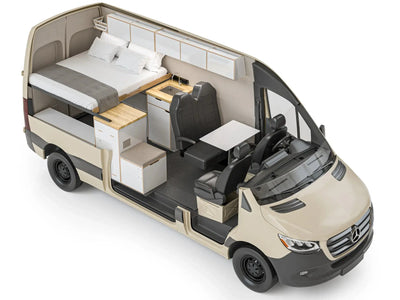
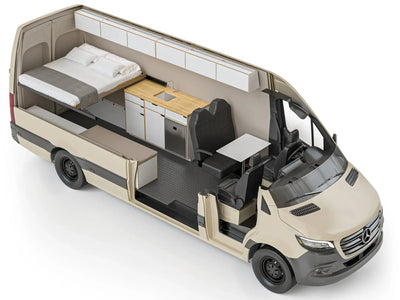
If you're going to invest in a van, it's usually smarter to do it right. A high-roof Transit or Sprinter lets you stand up, sleep better, and cook with far less compromise, and a 144-inch Sprinter or 148-inch Transit still fits in a normal parking spot. At The Vansmith, we only build on full-size Transits or Sprinters because that extra space makes a much better camper platform.
What a custom Ford Transit Connect is actually good at
The Transit Connect sits in a useful middle ground. It is much smaller than a full-size van, yet it still gives you enough room for a disciplined build. According to MotorTrend, cargo volume comes in at 123.2 cubic feet for short-wheelbase cargo models and 145.8 cubic feet for long-wheelbase cargo models.
That is a big drop from a full-size Transit, but it is still enough space for a bed platform, gear storage, and a simple camp setup. If your goal is a stealthier daily driver that can sleep one or two people, those numbers start to make sense. If your goal is a full camper with dense cabinetry and big fixed systems, they get tight in a hurry.
One of the van’s best traits is how easy it is to live with day to day. Edmunds points to its small footprint and tight handling, and that matters a lot if you park in cities, commute during the week, or slip into trailhead lots on weekends. In our experience, that kind of ease is what draws people to compact vans in the first place.
Consumer Reports says it drives well, with agile handling and a steady ride. That backs up the real use case here. This van shines as a practical, efficient tool, not as a heavy expedition rig.
That is why the smartest way to frame the platform is as a minimalist sleep-and-storage build, a mobile office, or a gear hauler for bikes and light adventure use. Once you stack in heavy systems, you run into Ford’s weight and towing limits, plus the loaded performance issues reviewers keep bringing up. A compact van like this rewards restraint.
Ford’s own towing framework makes the point clearly. Ratings depend on configuration, passengers, cargo, and accessories, so there is no blank check for add-ons. Every custom build is a tradeoff, which is also why many buyers who want more room and more system capacity end up looking at full-size Transit conversions instead.
Best-fit use cases for the platform
If you want to sleep inside a Transit Connect, the long-wheelbase cargo model is the better place to start. That jump from 123.2 to 145.8 cubic feet gives you meaningfully more room to plan around. It is still compact, but the extra space helps a simple bed-and-storage layout feel less cramped.
Edmunds says the van handles tightly and drives surprisingly well, which fits buyers who need a city-friendly van first and a weekend escape pod second. Think commuting, parking decks, grocery runs, and then a fast switch into camp mode. That is a much better match than trying to turn it into a rolling cabin.
Comfort is where expectations need a reset. Consumer Reports says it is no substitute for a modern minivan in refinement, so you should expect a utility-first cabin and road feel. That does not make it bad. It just means the charm comes from simplicity and usefulness, not plush touring comfort.
MotorTrend lists two engine choices, a 2.0-liter with 162 horsepower and 144 pound-feet of torque, and a 2.5-liter with 167 horsepower and 171 pound-feet. Those are workable numbers for a light build, but they also explain why this platform does best with moderate expectations. You feel extra weight sooner here than you would in a bigger van.
Towing tells the same story. The factory framework caps maximum loaded trailer weight at 2,000 pounds and tongue load at 200 pounds, which is enough for very light trailer duty but not much more. If towing is central to your plan, this is probably the wrong platform.
A Ford Transit Connect converted for one or two people makes the most sense when the setup stays simple. A bed platform, storage, portable power, and a removable cook kit fit the van’s strengths. A permanent wet bath, large water system, or heavy fixed galley does not leave much margin.
Where expectations usually go wrong
The biggest mistake is expecting full-size-van performance after adding conversion weight. Reviewers keep circling the same point. Edmunds, MotorTrend, and Consumer Reports all describe the Transit Connect as underpowered or only adequate.
Consumer Reports says power is just adequate even with a light load. It also notes that the van can feel slow on hills when seats are filled or payload nears maximum. For camper-style use, that matters a lot, because gear, water, and people all add up fast.
MotorTrend recorded a 0 to 60 mph time of 10.5 seconds for a tested long-wheelbase passenger model. That is a useful baseline because it shows acceleration is already modest before a custom interior goes in. Add dense furniture and the van will not suddenly feel happier on merges or grades.
Noise is another surprise for some buyers. Consumer Reports noted high wind noise in its 2018 road test, so long highway days may feel more tiring than you expect if you are coming from a crossover or minivan. Sparse interiors can make that even more obvious.
Towing hopes can drift out of bounds too. Ford warns that trailer limits are reduced by cargo, passengers, and accessories, so a built-out van towing near the headline max is usually not a realistic plan. The Transit Connect works best when you accept the compact-van strengths and stop before trying to make it a full-size four-season camper.
Payload, curb weight, and why build weight matters first
If you are serious about a custom build, weight is the first thing to sort out. Ford defines curb weight as the vehicle with full fuel and standard equipment, but without passengers, cargo, or optional equipment. That means your build parts, battery bank, water, hitch gear, and every person in the van all count against what is left.
Ford also says curb weight can be derived from GVWR minus payload or passenger-and-cargo capacity. That gives you a factory-backed way to estimate how much room you really have for a build. It is not glamorous, but it is the math that keeps a compact van honest.
There is no single safe conversion weight for every Transit Connect. Ford ties ratings to configuration, cargo, accessories, and passengers, so each van starts from a different place. One thing a lot of builders overlook is how much factory equipment can change the margin before the project even starts.
The practical way to think about it is as one whole system. The van, fuel, passengers, bed platform, storage, battery, water, bikes, hitch rack, and trailer all stack together. In a platform with modest power reserves, that system view matters even more.
Independent reviews help explain why. Edmunds criticizes the engine power, and Consumer Reports says the van gets slow near max load. So if your goal is a build that still feels usable on the highway, weight budgeting should happen before layout design, not after.
For buyers who want more room for systems and a cleaner path to a polished interior, it can help to look at how The Vansmith approaches foundation builds and our process. Starting with a clear weight and use plan saves a lot of backtracking later.
How to calculate realistic build capacity
Start with the label on the specific van. Ford says GVWR and payload or passenger-and-cargo capacity vary by equipment and configuration, so the sticker matters more than generic internet numbers. That is your real starting point.
Remember that curb weight already includes full fuel. So you should not double-count fuel as extra payload when planning a build. That sounds simple, but it is an easy place to get your math wrong.
Passengers count too. Ford explicitly excludes them from curb weight, which means every traveler cuts into the remaining allowance for cabinets, batteries, coolers, bikes, and bags. Two people and a dog can eat up more capacity than many buyers expect.
Optional equipment matters for the same reason. Ford says curb weight excludes optional equipment, so a van with more factory features starts with less remaining room than a bare cargo model. The cleanest plan is to verify the finished van on a scale, because custom builds add too many variables for rough guesses.
Do not forget hitch loads. Tongue load is capped at 200 pounds, and that means a bike rack or trailer setup can use a meaningful slice of the van’s remaining allowance. If you are planning a compact adventure rig, that one detail can shape the whole layout.
What adds weight faster than buyers expect
Every accessory counts against capacity. Fixed cabinetry, larger batteries, water storage, roof gear, and hitch-mounted cargo all chip away at payload before you pack a single duffel. In a small van, those little choices do not stay little for long.
A trailer setup adds pressure in two ways. You have the trailer itself, but you also have tongue weight, and Ford limits that to 200 pounds. Once the van is already carrying a build, that can become a real bottleneck.
Consumer Reports says the van can feel slow when payload is near max, which is why small additions can have a big effect once combined. A cooler here, a water jug there, a second battery under the seat, and suddenly the van feels different on a grade. That matters.
MotorTrend’s modest power figures help explain why added mass shows up so quickly in acceleration and hill climbing. Edmunds goes a step further and says the Transit Connect lacks engine power, which should be read as a warning against heavy all-in builds. A lighter, removable setup is usually the more realistic answer.
If you are still shaping ideas, The Vansmith’s van build blog and DIY blog are good places to see how build choices affect real use. The lesson is usually the same. Keep the platform true to itself.
Power, towing, and highway performance in a Transit Connect converted build
Powertrain specs tell an honest story here. MotorTrend lists the base 2.0-liter inline-four at 162 horsepower and 144 pound-feet of torque. The optional 2.5-liter makes 167 horsepower and 171 pound-feet, so the big difference is torque, not horsepower.
That extra 27 pound-feet matters because loaded vans feel torque shortages first. Starts from a stop, highway merges, and long grades all lean on torque more than a tiny horsepower bump. So if you are choosing between the two, the 2.5-liter is the more sensible fit for a custom build.
Still, neither engine turns the Transit Connect into a strong tow rig or mountain cruiser. Edmunds says it lacks engine power, and MotorTrend also calls it slow or underpowered. Those comments line up closely with the concerns most buyers already have about a loaded compact van.
Towing limits stay modest too. Ford sets a maximum loaded trailer weight of 2,000 pounds, and it requires the Class I Trailer Tow Package for trailer weights over 1,500 pounds. Ford also specifies a 200-pound maximum tongue load and notes that frontal area, passengers, cargo, and accessories all affect towing ability.
That means a realistic build should be planned around self-contained travel and cargo carrying first. Towing is better treated as a light-duty side use, not the center of the concept. If your trips depend on a trailer, a bigger platform usually makes more sense, including a look at Sprinter conversions or a full-size Transit.
Engine choices and what they mean when loaded
The 2.0-liter’s 144 pound-feet of torque is modest for any conversion platform. Once you add build weight, that modest output is easier to feel. It helps explain why reviewers keep bringing up weak power.
The 2.5-liter raises torque to 171 pound-feet, and that does make it the better pick if you can find it. It does not transform the van, but it gives you a bit more breathing room for passengers, gear, and light towing. In a small platform, small gains still matter.
Edmunds’ view that the van lacks engine power should push buyers toward conservative build goals. Consumer Reports adds that it can feel slow on hills when seats are filled or payload is near max, which is especially relevant for mountain-state travel. If you live around grades, overbuilding gets expensive in more ways than one.
MotorTrend’s 10.5-second 0 to 60 mph result is a good reminder that performance starts from a modest baseline. For highway confidence, controlling weight is usually more effective than obsessing over small spec differences. Both engines remain light-duty by camper-van standards.
Towing realism with a custom Ford Transit Connect
Ford’s 2,000-pound maximum loaded trailer weight is an absolute ceiling, not a goal for a fully built van. Once passengers, cargo, and accessories go into the van, the real-world margin shrinks. That is straight from Ford’s framework.
Equipment matters too. Ford requires the Class I Trailer Tow Package for trailers over 1,500 pounds, so buyers with towing plans need to confirm the van is properly set up from the start. It is not something to assume.
The 200-pound tongue-load limit is especially tight for camper-style use. A hitch carrier, bike tray, or trailer tongue can eat through that allowance quickly. Add a built interior, and you can see why hitch-heavy plans often stop penciling out.
Ford also includes frontal-area guidance in its towing info, which is a reminder that drag matters on a small-power platform. For most buyers, the smarter move is to keep the van light and avoid pairing a dense build with near-max towing demands. If you want help sorting that line, customize your van with a use-first plan instead of chasing every feature at once.
Highway manners: ride, noise, handling, and hills
Here is the part that makes the Transit Connect appealing despite its limits. Edmunds says it drives surprisingly well and has tight handling. Consumer Reports also says it has agile handling and a steady ride, which is better than many people expect from a compact commercial van.
That means the base chassis has some real charm. Around town and on normal highway runs, a light build can still feel tidy and easy. You get much of the simple daily usability that pushes people toward compact vans in the first place.
There are tradeoffs, though. Consumer Reports says wind noise is high, and that matters more on long road days than the spec sheet suggests. A cargo shell or sparse build can make that noise stand out even more because there is less soft material inside to soak it up.
Power is the other side of the story. Consumer Reports says it is only adequate with a light load and gets slow when full or near payload max. MotorTrend’s power figures and acceleration test support that view, so highway manners change as weight rises.
The honest takeaway is simple. A Transit Connect converted build can be pleasant on the highway when kept light. Push weight and expectations too far, and the compromises become much easier to notice.
What reviewers say about daily and highway driving
Edmunds highlights the van’s city-friendly size and maneuverability, and that is a real advantage over a full-size van. Parking is easier. Tight streets are easier. Daily life tends to feel less like an event.
Consumer Reports says the ride is steady and the handling agile, which helps explain why people keep coming back to this platform. It feels more composed than its work-van look might suggest. That is a strong point.
Long-trip comfort is less impressive. Edmunds says it is not especially comfortable, and Consumer Reports says it is no substitute for a modern minivan in refinement. So couples planning long interstate miles should expect a more utilitarian feel.
Wind noise is part of that picture too. Consumer Reports called it out clearly, and it becomes more noticeable in a cargo shell with fewer soft surfaces. Put all of that together, and the platform makes the most sense for buyers who value compactness and ease more than quiet, effortless highway travel.
How added build weight changes the experience
Consumer Reports gives the clearest warning here. It says the van can feel slow on hills with seats filled or payload near max. That is exactly the condition a heavy camper-style build can create.
Ford excludes passengers and cargo from curb weight, so every person and every build part moves the van closer to that sluggish zone. MotorTrend’s modest torque figures show why it happens. There is just not much low-end shove to hide extra mass.
Edmunds’ complaint about lack of engine power means the handling can stay neat while the van still feels strained in merges or climbs. Heavy furniture and large utility systems do not just use payload. They also cost drivability and comfort on the road.
A lighter modular build preserves more of the Transit Connect’s best traits. You keep the maneuverability, the decent ride control, and the easy everyday feel. If that compact-van personality is what drew you in, protecting it is usually the smartest build choice.
The most realistic build strategies for a Ford Transit Connect converted van
The best Transit Connect builds are the ones that stay honest. A lightweight, minimalist interior fits the platform far better than a dense camper layout loaded with fixed systems. That is not a compromise so much as the right design brief.
Long-wheelbase cargo models are usually the better foundation if sleeping inside is part of the plan. With 145.8 cubic feet versus 123.2 in the short-wheelbase version, the LWB simply gives you more room to make a bed and storage layout work. In a van this small, every bit helps.
The 2.5-liter engine is also the more realistic choice if available because its 171 pound-feet of torque better suits loaded use than the 2.0-liter’s 144. Even then, towing should stay occasional and light because Ford’s 2,000-pound trailer limit and 200-pound tongue limit do not leave much room for hitch-heavy habits.
Consumer Reports’ comments about sluggishness near max load support a modular approach. Removable gear, portable power, and simple storage tend to preserve more of the van’s drivability than permanent dense interiors. We have found that compact builds work best when they still feel compact after they are done.
For buyers who want more insulation, more water, bigger electrical systems, or stronger highway and mountain performance, moving up to a full-size Transit is often the better long-term call. That is also where The Vansmith’s design work has more room to breathe, whether you are looking at vans for couples or more robust custom layouts.
Smart build priorities for this platform
Start with low-mass essentials. Sleeping, storage, ventilation, and portable power should come first because Ford’s weight method leaves less room for bulky fixed systems than many buyers assume. Keep the mission tight.
Choose the long-wheelbase cargo version when possible. That bump from 123.2 to 145.8 cubic feet materially improves layout flexibility. It can be the difference between a workable sleep setup and a frustrating one.
If engine choice is on the table, favor the 2.5-liter. Its 171 pound-feet of torque is better suited to loaded use than the 2.0-liter’s 144. Also keep hitch loads conservative, because Ford’s 200-pound tongue limit can be reached quickly with bikes or trailer gear.
Plan around realistic highway use too. Moderate cruising, patience on grades, and more cabin noise than a crossover or minivan are part of the deal. A successful custom Ford Transit Connect build still feels like a compact van when finished, not a shrunken Class B.
When to move up to a full-size Transit instead
If your build needs big fixed cabinetry, larger battery banks, more water storage, or frequent mountain driving with passengers and gear, the Transit Connect becomes a bottleneck quickly. The modest power and limited ratings do not leave much reserve. That is where the platform starts asking too much compromise.
MotorTrend’s power figures and 10.5-second acceleration result show there is not much spare performance to absorb a heavy camper-style conversion gracefully. Ford’s 2,000-pound towing ceiling tells the same story if you want meaningful trailer use. This is not the van to stretch into something it is not.
Comfort matters here too. Consumer Reports says it is no substitute for a modern minivan in refinement, and that matters for families or couples planning long interstate miles. For bigger travel goals, more comfort, and more systems, a full-size Transit is the cleaner answer.
Edmunds is still right about the maneuverability. That part is real. But for The Vansmith audience, the decision line is pretty clear: choose a Transit Connect for a disciplined compact build, and choose a full-size Transit when comfort, capability, and system capacity matter more than footprint. If you want to talk through that tradeoff, contact us.
FAQ
Is a custom Ford Transit Connect realistic for vanlife?
Yes, but mainly as a light, minimalist setup rather than a heavy full-camper build. Ford’s weight framework and 2,000-pound max trailer rating show the platform has limited margin. Consumer Reports also says power is only adequate and gets worse near max load, so simplicity is the safer path.
Which is better for a Ford Transit Connect converted build: the 2.0L or 2.5L?
The 2.5L is the better choice if you can find it. MotorTrend lists the 2.0L at 162 horsepower and 144 pound-feet, while the 2.5L makes 167 horsepower and 171 pound-feet. The real gain is torque, and that matters more in a loaded van.
How much can a Transit Connect tow after a conversion?
Ford lists a maximum loaded trailer weight of 2,000 pounds and a 200-pound maximum tongue load. In practice, those numbers are reduced by the passengers, cargo, and accessories already in the van. Ford also requires the Class I Trailer Tow Package for trailers over 1,500 pounds.
Does a Transit Connect converted van feel slow on the highway?
It can, especially when loaded. Edmunds says the Transit Connect lacks engine power, MotorTrend recorded a 10.5-second 0 to 60 mph run for a long-wheelbase passenger model, and Consumer Reports says it feels slow on hills when seats are filled or payload is near max. A light build helps preserve the van’s better road manners.
Is the long-wheelbase Transit Connect better for a custom build?
Usually yes. MotorTrend lists cargo volume at 145.8 cubic feet for long-wheelbase cargo models versus 123.2 cubic feet for short-wheelbase models. That extra space makes a sleeping platform and storage layout much more realistic.
About the author

Eugene Smit
CEO
Eugene is the CEO of The Vansmith, based in Boulder, Colorado. He writes across topics related to van builds, ownership, and the camper van industry.
Read more about Eugene