Short answer: campervan insurance costs $600 to $1,500 per year for recreational use in 2026, or roughly $50 to $125 per month. Progressive's published countrywide average for a motorhome policy was $1,052 a year, and liability-only motorhome policies start near $125 a year. Owners who live in the van full time pay about 25 to 40 percent more.
The number that moves your premium most is not the van's class. It is the insured value of the finished camper van, and whether your policy settles on agreed value or actual cash value. Get that one choice wrong on an $85,000 van and a total loss can pay out less than half of what you have in it.
We have been finishing camper vans in Boulder, Colorado since 2016, and insurance is the part of ownership that most people get wrong twice: once when they buy the policy, and again when they never update it. This guide gives you the real 2026 numbers, the carriers that will actually write a policy on a finished camper van, and the documentation that decides what you get paid after a claim.
Campervan insurance cost in 2026 at a glance
Class B camper vans are the cheapest motorhome class to insure. They are smaller, lower in total value, and drive like a large van rather than a coach. Here is what owners pay across the common use cases.
| How you use it | Per year | Per month | What that assumes |
|---|---|---|---|
| Liability only | $125 - $400 | $11 - $33 | No physical damage cover. Only sensible on an older, low-value van with no loan. |
| Weekends and vacations | $600 - $1,100 | $50 - $92 | Under 5,000 miles a year, garaged or stored off-season, $500 to $1,000 deductible. |
| Extended seasonal travel | $900 - $1,500 | $75 - $125 | Multi-week trips, a fixed home address elsewhere, higher personal property limits. |
| Full-time living | $1,200 - $3,000 | $100 - $250 | Full-timer endorsement with personal liability and loss of use. Adds 25 to 40 percent. |
| High-value van on agreed value | $1,500 - $2,500+ | $125 - $208+ | $80,000 or more insured, appraisal on file, low deductible, high liability limits. |
Two reference points worth keeping in mind. Progressive's published data puts its countrywide average motorhome premium at $1,052 a year and its liability-only motorhome policies starting at $125 a year. Across the 2026 industry ranges published by Foremost, Progressive, Roamly and Good Sam, Class B camper vans land between $500 and $2,000 depending almost entirely on insured value and use.
What actually sets your premium: insured value, not van class
Most cost guides sort premiums by RV class. That is the wrong axis for a camper van. A $42,000 ProMaster with a simple interior and an $118,000 Sprinter 4x4 with a full electrical and water system are both Class B, and they are not the same insurance risk.
Carriers rate a camper van on the total insured value: the base vehicle plus every permanently installed system. Here is how premiums track against that number for a clean driving record on recreational use.
| Total insured value | Typical annual premium | Settlement basis to ask for |
|---|---|---|
| Under $40,000 | $550 - $900 | Actual cash value is usually acceptable |
| $40,000 - $70,000 | $800 - $1,300 | Agreed value, cost records and photos on file |
| $70,000 - $110,000 | $1,100 - $1,900 | Agreed value, third-party appraisal recommended |
| $110,000 and above | $1,600 - $2,800+ | Agreed value with appraisal, specialty carrier or broker |
The practical takeaway: moving from a $45,000 van to a $95,000 van roughly doubles the premium, but it multiplies your exposure by far more than that if the settlement basis is wrong. Which brings us to the single most expensive mistake in camper van ownership.
Agreed value vs actual cash value: the gap that costs owners the most
This is the part of the policy almost nobody reads, and it decides what lands in your account after a total loss.
- Actual cash value (ACV) pays the depreciated market value of the vehicle at the moment of loss. Adjusters start from the base van's book value and add only what they can independently verify.
- Agreed value fixes the payout figure in writing when the policy is issued. If the van is totalled, that is the number, with no depreciation argument.
Here is why it matters in dollars. Take a Sprinter 144 4x4 finished as a camper van:
| Line | Agreed value policy | Actual cash value policy |
|---|---|---|
| Base van market value at loss | Not used | $41,000 |
| Interior systems and cabinetry | Not used | Only what the adjuster can verify |
| Declared value on the policy | $88,000 | None declared |
| Deductible | $1,000 | $1,000 |
| Likely payout | $87,000 | $40,000 - $55,000 |
Illustrative figures, not a quote. But the pattern is consistent: without agreed value and supporting records, adjusters revert to base-vehicle value plus verifiable equipment, which industry documentation guides put at roughly 20 to 40 percent of what owners actually spent on the interior work. On a $45,000 interior package, that gap is a five-figure loss on an event you thought you were insured for.
Ask your agent this exact question: "Is this policy written on agreed value, and what is the declared figure on the declarations page?" If the answer is anything other than a specific dollar amount you recognise, you are not covered for what you think you are.
Which carriers write policies on finished camper vans
Not every insurer will cover a camper van, and the ones that do treat owner-finished and professionally finished vans differently. As of 2026, four carriers routinely write these policies.
| Carrier | Owner-finished vans | Agreed value | Full-time cover | Best for |
|---|---|---|---|---|
| Roamly | Yes, the most flexible | Yes | Yes | Owner-finished vans, and anyone renting the van out on Outdoorsy without breaking policy terms |
| Progressive | Yes, since late 2023 | Limited | Limited | Lowest price on straightforward recreational use, strong bundling with auto and home |
| Good Sam / National General | Yes, with the full systems list | Yes, capped and underwritten | Yes, strong full-timer packaging | Full-time owners and vans in the $50,000 to $150,000 range with good records |
| Foremost | Case by case | Yes | Yes | Non-standard and higher-value vans that other carriers decline |
| State Farm | Agent dependent | Rarely | Rarely | Owners who already bundle and want a local agent relationship |
Two details that change the outcome of a quote. Roamly typically asks for a third-party appraisal once total insured value passes about $30,000; appraisals run $300 to $500 and the carrier uses the appraiser's figure, not yours. Good Sam / National General sends camper vans over $50,000 to a human underwriter for review, so having your records assembled before you apply is the difference between a same-week policy and a month of back and forth.
Get quotes from at least three of these. Identical coverage on the same van routinely varies by 40 percent between carriers, which on a $1,400 policy is $560 a year for a few hours of calls.
Insuring an owner-finished camper van
If you finished the van yourself, you can get proper RV coverage. You cannot get it by describing the van as a cargo van, and you cannot get it before the interior is complete. Until the work is done, insure the vehicle as a standard van; switch the policy once it qualifies.
What insurers require before they will call it a camper van
Carriers look for permanently installed living systems. Progressive, for example, requires permanently installed cooking and sleeping facilities. Most carriers work from a list along these lines, and want several of them present:
- Fixed sleeping accommodation, not an air mattress or a fold-out
- Cooking facilities, permanently mounted
- Fresh water system with a sink
- Refrigeration
- A permanently installed 12V electrical system
- Heating, and in some cases a fixed toilet
RVIA certification is not required by any of the four carriers above. What matters is that the systems are fixed, and that you can prove what they cost.
The documentation that decides your payout
After a loss, the adjuster opens your file and looks for three things. Have all three ready now, stored somewhere that is not inside the van:
- An itemised cost record. A spreadsheet of every component and its price, with receipts. This is what sets the insured value.
- Photographs. Interior, exterior, and each major system, updated whenever you add equipment.
- A third-party appraisal if total value is over $30,000. Budget $300 to $500.
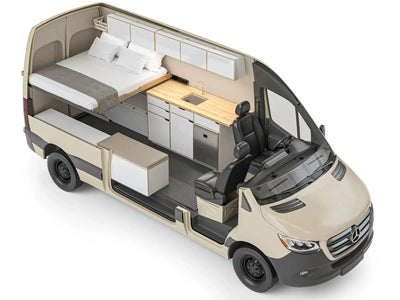
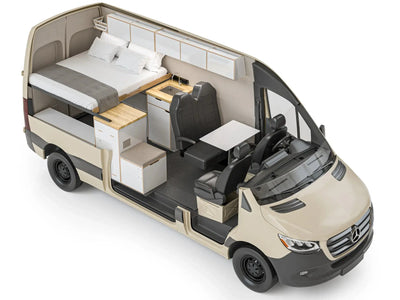
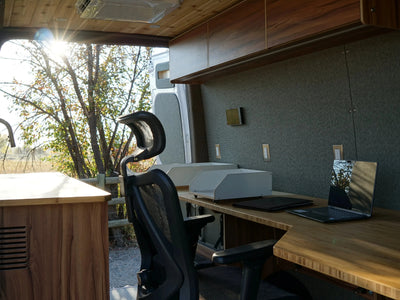
If you bought a professionally finished van, this is simpler: request the itemised invoice and equipment schedule from the shop that did the work. We provide these to owners on request, and they are the fastest route to an accurate agreed value. You can see the specification level typical of a professionally finished van in our gallery of past camper vans.
Do you need to retitle the van as an RV?
Not always, but it usually helps. Retitling reclassifies the vehicle from cargo to motorhome, which makes carriers quote faster and can lower the rate. The process varies by state, and generally runs: a state patrol or DMV inspection, a certified weigh slip with the VIN on it, and a body-type change application at the DMV. California, for example, uses forms REG 256 and REG 256A. Colorado requires a VIN inspection before reclassification.
One sequencing note: get the van retitled before you apply for the policy where you can. Carriers classify a van far faster when the DMV has already classified it.
Full-time living coverage
A standard recreational RV policy assumes the van is not your primary residence. If you live in it six months a year or more and carry a standard policy, a claim can be denied on the grounds that the policy was never rated for full-time occupancy. That is the most common uninsured moment in van life.
A full-timer endorsement adds coverage that behaves more like a homeowner's policy:
- Personal liability for incidents around the van when it is parked
- Loss of use, covering lodging while the van is being repaired
- Higher personal property limits, typically $25,000 and up
- Medical payments for visitors
Expect the endorsement to add 25 to 40 percent to your premium, landing most full-time camper van owners between $1,200 and $3,000 a year. If you are running the numbers on the whole lifestyle, our breakdown of what it costs to live in an RV puts insurance in context against fuel, maintenance and campsites.
What raises and lowers your premium
| Factor | Direction | Typical impact |
|---|---|---|
| Total insured value | Up | The largest single driver. Doubling value roughly doubles the premium. |
| Full-time occupancy | Up | Adds 25% to 40% |
| Recent at-fault claims or violations | Up | Adds 20% to 50% |
| Garaging location and state | Either | Metro California, Florida, Texas and Michigan run 15% to 25% above rural rates |
| Seasonal storage or lay-up | Down | Up to 53% off the comprehensive portion during stored months |
| Bundling with auto or home | Down | 10% to 25% |
| Deductible from $500 to $1,000 | Down | 10% to 15% |
| Low annual mileage | Down | 5% to 15% |
| Paying annually instead of monthly | Down | 3% to 8%, plus avoids $3 to $8 monthly installment fees |
The storage discount is the biggest lever most owners never pull. If your van sits from November to April, tell your carrier. On a Colorado van stored through the winter that alone can take several hundred dollars off the annual premium. Our guide to RV storage costs covers how storage type affects both the storage bill and the policy.
What a campervan policy does not cover
Insurance replaces sudden accidental loss. It does not replace maintenance. Standard exclusions across every carrier above:
- Gradual roof, seal or window leaks, as opposed to a sudden storm event. Our separate guide covers whether RV insurance covers water damage in detail
- Mechanical and appliance breakdown
- Wear, rust and corrosion
- Damage from deferred maintenance
- Business or commercial use under a personal policy
- Full-time occupancy under a recreational policy
- Equipment you never declared. Solar arrays, roof racks, awnings and lithium systems need to be listed to be covered
That last point is the one we see most often. An owner adds a $6,000 solar and lithium system three years in, never tells the carrier, and finds out during a claim that the declared value still reflects the van as delivered. Send your insurer an email with photos and receipts every time you add permanent equipment. It takes ten minutes.
How to get an accurate quote in twenty minutes
Have these ready before you call, and the quote you get will be the quote you pay:
- VIN, current title and registration, showing RV or motorhome classification if you have retitled
- Total insured value: base vehicle price plus itemised interior cost
- The permanent systems list: sleeping, cooking, water, refrigeration, electrical, heating
- Photos, interior and exterior
- Honest annual mileage and months in use
- Where the van is parked overnight, and where it is stored off-season
- Your existing auto and home policies, for bundling
- Your answer on full-time use. Do not understate this
Then ask each carrier the same four questions: is it agreed value and what is the figure, what is the personal property limit, is attached equipment covered and up to what, and is full-time occupancy permitted. Those four answers, not the headline premium, tell you which policy is actually better.
Frequently asked questions
How much is campervan insurance per year?
Campervan insurance costs $600 to $1,500 per year for recreational use in 2026. Progressive's published countrywide average for motorhome policies is $1,052 a year. Full-time owners typically pay $1,200 to $3,000. Liability-only policies start near $125 a year but leave the van itself uncovered.
How much is campervan insurance per month?
Most owners pay $50 to $125 per month for full coverage on a Class B camper van. Full-time owners pay $100 to $250 a month. Paying annually rather than monthly saves 3 to 8 percent and avoids installment fees of $3 to $8 per payment.
Is campervan insurance more expensive than car insurance?
It depends on the van's value. A liability-only camper van policy can cost less than a standard auto policy. Full coverage on a camper van worth $80,000 or more usually costs more than car insurance, because the insured value includes every permanently installed system, not just the vehicle.
Can you insure a van you finished yourself?
Yes. Roamly, Progressive, Good Sam / National General and Foremost all write policies on owner-finished camper vans in 2026. You need permanently installed sleeping and cooking facilities, an itemised cost record with receipts, and photographs. RVIA certification is not required by any of them.
What is the best campervan insurance company?
There is no single best carrier. Roamly is the most flexible for owner-finished vans and rental use. Progressive is usually cheapest for straightforward recreational use. Good Sam / National General is strongest for full-time owners. Foremost handles higher-value and non-standard vans. Quote all of them.
Do I need to retitle my van as an RV to insure it?
Not in every state, but it helps. Retitling reclassifies the van from cargo to motorhome, which speeds up underwriting and can lower your rate. The process generally involves a state inspection, a certified weigh slip showing the VIN, and a body-type change application at the DMV.
What are campervan insurance requirements?
Every state requires liability coverage on a motorised camper van. If the van is financed, your lender will require comprehensive and collision as well. Carriers additionally require permanently installed living systems, usually fixed sleeping and cooking facilities at minimum, before they will write an RV policy.
Does campervan insurance cover solar panels and roof racks?
Only if you declared them. Permanently attached equipment such as solar arrays, lithium batteries, awnings and roof racks is covered under attached equipment coverage, typically with its own limit. Equipment added after the policy was issued and never reported is routinely excluded at claim time.
How much is insurance on a Sprinter camper van?
A professionally finished Sprinter camper van insured at $80,000 to $110,000 typically costs $1,100 to $1,900 a year on agreed value for recreational use. Sprinters sit at the higher end of Class B premiums because parts and specialist labour cost more than Transit or ProMaster equivalents.
Do I need special insurance if I live in my van full time?
Yes. Standard recreational RV policies exclude use as a primary residence, and a claim can be denied on those grounds. A full-timer endorsement adds personal liability, loss of use, and higher personal property limits. It typically raises the premium by 25 to 40 percent.
What is agreed value and do I need it?
Agreed value fixes your payout figure in writing when the policy is issued, with no depreciation applied at claim time. If your camper van is worth more than the base vehicle alone, which is nearly always the case, agreed value is the difference between a full payout and a partial one.
Why is my camper van insurance so expensive?
The three usual causes are a high declared value, full-time occupancy, and a metro garaging address. Recent at-fault claims add 20 to 50 percent. Before switching carriers, check whether you are paying for full-time coverage you do not need, or missing a storage discount you qualify for.
How can I lower my campervan insurance cost?
Apply a seasonal storage or lay-up discount during stored months, which can cut up to 53 percent from the comprehensive portion. Bundle with auto or home for 10 to 25 percent. Raise the deductible from $500 to $1,000 for 10 to 15 percent. Then requote annually.
Does campervan insurance cover water damage?
Sudden accidental water damage from a covered event such as a storm is usually covered under comprehensive. Gradual leaks through deteriorated seals, and damage traced to deferred maintenance, are excluded by every major carrier. We cover the distinction in detail in our guide to RV insurance and water damage.
Get the insured value right before you need it
Insurance on a camper van is not complicated, but it is unforgiving about documentation. Set the value correctly, get it in writing on an agreed value basis, and update it whenever the van changes. That is most of the job.
If you are shopping for a van, the specification you choose sets the insured value you will carry for years, so it is worth understanding before you commit. Browse our Class B camper vans or everything currently available. If you already own a Vansmith van and need an itemised equipment schedule for your insurer, contact our team and we will send it over.
This guide is general information, not insurance advice. Coverage terms, eligibility and pricing vary by carrier and by state. Confirm details with a licensed agent before buying a policy.
About the author

Eugene Smit
CEO
Eugene is the CEO of The Vansmith, based in Boulder, Colorado. He writes across topics related to van builds, ownership, and the camper van industry.
Read more about Eugene