
DUO

Mercedes Sprinter 144
OR
Ford Transit 148

Perfect for solo travelers or couples who want a compact adventure-ready van.
Seat & Sleeps
2Length
19'Shower
Exterior * * Optional Add-OnsClass B RVs, Conversion Vans & Campervans for Sale in Sioux Falls, SD
Mercedes Sprinter 144
OR
Ford Transit 148
Perfect for solo travelers or couples who want a compact adventure-ready van.
Seat & Sleeps
2Length
19'Shower
Exterior * * Optional Add-Ons
Mercedes Sprinter 144
OR
Ford Transit 148

Includes a shower setup for longer trips without compromising comfort or space.
Seat & Sleeps
2Length
19'Shower
Bench * * Optional Add-Ons
Mercedes Sprinter 170
OR
Ford Transit 148 E

Ideal for those who want extra living space and more storage for extended adventures.
Seat & Sleeps
2Length
22'Shower
Full
Mercedes Sprinter 170
OR
Ford Transit 148 E

Luxury model with full amenities, extended power systems, and interior bathroom.
Seat & Sleeps
2Length
22'Shower
Full
Mercedes Sprinter 144
OR
Ford Transit 148

Perfect for families who want space, comfort, and functionality in a compact build.
Seat & Sleeps
4Length
19'Shower
Exterior * * Optional Add-Ons
Mercedes Sprinter 170
OR
Ford Transit 148 E

A larger build for families who love extended adventures and more storage.
Seat & Sleeps
4Length
22'Shower
Bench * * Optional Add-Ons
Mercedes Sprinter 170
OR
Ford Transit 148 E

The luxury upgrade with interior shower and full power systems for long trips.
Seat & Sleeps
4Length
22'Shower
Full
Sioux Falls sits at the intersection of I-29 and I-90, making it a practical starting point for exploring the northern plains. The Black Hills and Mount Rushmore are about five and a half hours west, while Badlands National Park is roughly four and a half hours away. Minnesota's lakes are around three hours north, and
camper vans in Omaha
and
camper vans in Lincoln
are approximately three hours south. Closer to home, Palisades State Park is about 25 minutes northeast, while Newton Hills State Park is roughly an hour south.
South Dakota's climate makes year-round planning important. January can bring prolonged subzero temperatures, snow, and strong winds, while July often brings highs in the upper 80s with humidity. Spring also brings the potential for severe weather. Insulation, dependable heating, ventilation, and a well-planned electrical system can help make a camper van more practical across these changing conditions.
The Vansmith creates Mercedes-Benz Sprinter and Ford Transit camper vans in Boulder, Colorado, and delivers them across South Dakota. Conversion packages start at $46,950, complete vans with the chassis included start at $115,950, and pre-built Bivy models range from $119,700 to $192,570. For the statewide picture, explore
camper vans in South Dakota.
Backpacks, bags, camping stoves and folding chairs all need accessible storage. Under-bed compartments can keep these items organized while leaving the main living area clear. Placing heavier equipment low and toward the front can also help manage weight distribution and handling in South Dakota's frequent crosswinds.
Lake Herman, Lewis and Clark Lake, and the Big Sioux River offer opportunities for fishing and outdoor recreation. Rods, waders and tackle benefit from a dedicated, sealed and drainable storage compartment rather than being kept in the living area. A separate gear space also helps contain dirt and moisture after a day outdoors.
Sioux Falls has an extensive recreational bike trail network, while the Mickelson Trail in the Black Hills offers a destination for longer cycling trips. Depending on the layout and equipment, bicycles can be stored inside a gear garage, on a rear-mounted rack or on the roof. In a state known for strong winds, the added height and wind resistance of a loaded roof rack are worth considering.
Insulated jackets, snow pants, gloves and winter boots take up considerable space and may be wet after outdoor activities. Storage near the heating system's warm-air outlet, where appropriate for the layout, can help manage damp gear. Accessible hooks and dedicated compartments make it easier to separate wet outerwear from dry clothing and bedding.
Dry food, cookware and everyday cooking supplies need organized storage sized to the length of your trip. When traveling west of the Missouri River, resupply options can be spread out depending on your route. Adequate pantry space and refrigeration help you plan meals and carry essential supplies between towns.
Snow and ice melt quickly inside a heated camper van, leaving water that needs a controlled drainage path. A dedicated gear garage with a suitable drain can help keep meltwater away from the living area. Materials, sealing and drainage should be planned together to make cleaning and moisture management easier throughout the winter.
A gear garage beneath a raised bed, accessible through the rear doors, can be one of the most practical features in a four-season camper van. It provides space for larger equipment, camping supplies and outdoor gear without taking over the main cabin. For Midwest travel, consider compartment dimensions, access, drainage and how the storage layout supports your usual activities.
Passengers, water, batteries, food and outdoor equipment all contribute to a camper van's loaded weight. The combined load can add up quickly, so payload capacity should be reviewed before selecting a layout or adding accessories. During the design consultation, The Vansmith can help evaluate the planned load against the selected chassis rating and identify specifications that need confirmation.
| Specification | Why It Matters in Sioux Falls | What Buyers Should Consider |
|---|---|---|
| Heating System | Sub-zero stretches in January, not occasional cold snaps | Output matched to van volume, and fuel consumption per night |
| Insulation | Determines how long fuel and battery last through a plains winter | Coverage on all six sides, and a material that tolerates moisture |
| Air Conditioning | Warm, humid July nights, and plains camping with no hookups | Cooling capacity against usable battery capacity, and overnight runtime |
| Ventilation | Winter condensation is the problem here, not summer humidity | Fan placement, variable speed, and reversible direction for intake or exhaust |
| House Battery | Long cold nights with the heater fan running all of them | Low-temperature charge protection, and usable capacity rather than nominal |
| Solar System | Excellent April to October on open plains, weak and snow-covered in winter | Panel wattage against roof area; do not plan winter power around solar |
| Alternator Charging | Long drives between towns give it plenty of time to work | DC-DC charger output, and what it replaces on a run west on I-90 |
| Shore Power | Driveway charging and South Dakota state park hookups | Onboard charger rating and the input connection fitted |
| Fresh Water | West River services are genuinely far apart | Capacity against your route, plus insulated and drainable lines |
| Wastewater | Dispersed plains and Badlands sites have no dump facilities | Gray capacity matched to fresh, with accessible and fully draining outlets |
| Refrigeration | Long summer trips west; a minimal load in winter | Capacity and power draw; a 12V compressor fridge runs on battery alone |
| Sleeping Capacity | Long drives and long winter evenings mean time spent inside | DUO layouts for two, FAMILY layouts for four; a usable seating area matters |
| Storage Capacity | Fishing, hunting, cycling and bulky winter gear across the year | Gear garage volume, rear door access, and roof rack capacity |
| Tires | Snow, ice, treated roads and sharp gravel county roads | A severe snow rating for winter; sidewall strength as well as tread |
| Brakes | Flat driving, but treated roads can corrode brake lines faster than expected | Service history and line condition; inspect at every service |
| Suspension | Comfort and control when loaded, plus washboard gravel | Setup matched to your load and routes; upgrades available where justified |
| Ground Clearance | Gravel and two-track access, plus unplowed winter entries | Clearance and approach angles; depends on chassis, trim and drivetrain |
| Vehicle Height | Garage openings, and a taller van catches far more plains crosswind | Roughly 9 to 10 ft in high-roof form; measure your own opening first |
| Vehicle Length | Sioux Falls has the space; I-90 crosswind is the real counterargument | Approx. 19.5 ft short wheelbase or 22.5 ft extended, as built |
| Payload Capacity | Water, batteries, winter gear and a family add up faster than expected | Chassis payload rating against your realistic loaded weight; worked out per build |
| Electrical Monitoring | Several days out west, you need to know exactly what is left | A battery monitor showing real state of charge, not a voltage gauge |
| Winterization | An annual job in South Dakota, and the season is long | Accessible drain points, a reachable pump, and tanks that drain completely |
Exact figures for payload, ground clearance, tire sizing and vehicle dimensions depend on the chassis, trim and drivetrain you choose. We confirm each against your selected van during the design call.
Nine tailored layouts across the two-person DUO Series and the four-person FAMILY Series, on Sprinter 144 and 170 wheelbases and Transit 148 and 148 extended, plus three pre-built Bivy trims. Browse all tailored models.
A Class B RV is a camper built inside a van body rather than on a truck chassis. It parks in a standard space, fits most garages, and can be kept indoors over a South Dakota winter, which matters more here than almost anywhere. Browse our Class B RVs for sale.
Our full current stock, including inspected used vans, is on the camper vans for sale page.
Every layout is available as a camper van for sale in Sioux Falls, SD. Pre-built Bivy models are ready in 8 to 10 weeks; tailored builds run 12 to 16 weeks. Use our van designer or call (303) 414-6834 for a fixed, itemized quote.
A Class B drives like a tall van, parks in a standard space and fits most Sioux Falls garages. Unlike a towable or a Class C, it does not need a storage yard or a second vehicle to be usable.
Distances out here are long and towns are far apart. A van removes the need to plan a route around where the motels are, which west of the Missouri River is a genuine constraint rather than a preference.
January lows below zero, wind chill far below that, and around 45 inches of snow a year. The requirements are a fuel-fired heater sized to the van, insulation on all six sides, lithium with low-temperature charge protection, and a water system you can protect or drain quickly.
July highs in the upper 80s with humidity, and shoulder seasons that can swing 35 degrees in a day. Air conditioning with a battery bank that can run it overnight, plus a powered roof fan, covers the warm half of the year.
Fishing gear for the lakes and the Big Sioux, bikes for the Sioux Falls trail loop, hunting gear in autumn, and bulky winter clothing all need space. A gear garage under a raised bed with rear-door access keeps equipment out of the living area.
A real bed, a 12V compressor fridge that runs on battery alone, a sink and a cooktop. On a five-hour drive to the Black Hills, that is the difference between a trip and an expedition.
I-90 west, I-29 north and south, and Highway 12 across the north of the state. Almost everything worth seeing in the region is a day's drive or less.
The Sprinter is available in 144- or 170-inch wheelbases, with all-wheel drive and 4x4 options depending on model year and configuration. See Sprinter van conversions and Sprinter campers for sale.
The Transit costs less to buy and service, Ford dealers exist in most South Dakota towns while Mercedes commercial service does not, and all-wheel drive is offered on eligible model years and configurations. For a buyer who travels rural parts of the state, that service coverage is a real argument. See Ford Transit van conversions and our Sprinter vs. Transit comparison.
Worth having here. Unplowed access roads, gravel county roads and winter mornings all make a case for it, as do gravel approaches into Badlands and Black Hills dispersed camping areas. Choose a drivetrain based on your routes, vehicle configuration and expected conditions.
Sioux Falls has the driveway and garage space for an extended van. The counterargument is wind: a 22.5-foot high-roof van can be noticeably harder to manage on a windy I-90 day than a 19.5-foot one. See small camper vans.
The DUO Series is designed around two adults with generous gear storage. The FAMILY Series sleeps four. See camper vans for couples and family van conversions.
Sioux Falls driving is relatively straightforward, and the van may spend much of its working life on interstate highways. That makes comfort, fuel range and living space important considerations alongside maneuverability.
Use the van designer to work through layouts, battery sizes, heating and storage before you talk to anyone.
Our entry two-person layout, from $46,950 as a conversion package. It includes a fixed bed, galley, and standard electrical, water and heating systems.
From $53,950. Adds capacity and finish over the DUO within the same two-person footprint.
Built on the longer wheelbase for more interior room and a larger gear garage. Call for current pricing.
From $63,950. The fully specified two-person layout on the extended wheelbase.
From $51,950. Sleeps four with a convertible seating and sleeping arrangement.
From $61,950. The four-person layout on the extended wheelbase.
From $68,950. Our most fully specified family layout.
Three pre-built trims on the Sprinter 144 AWD with a pop-top and Havelock wool insulation, ready in 8 to 10 weeks. Bivy Classic is $119,700 with a 5 kWh system. Bivy Plus is $145,845 with 10 kWh, a diesel cabin heater and an exterior shower. Bivy Deluxe is $192,570 with 15 kWh, air conditioning, a Rixen hydronic heater and a secondary alternator. Bivy XL starts at $153,700. See the Bivy comparison.
A fuel-fired air heater runs off the vehicle's own fuel tank, draws relatively little electricity and can help manage interior moisture when paired with suitable ventilation. Size it to the actual volume of the van rather than relying on a catalog minimum. See heater service and our Sprinter heater guide.
Insulation on all six sides is an important consideration, and one that can be difficult to retrofit without removing interior components. In a South Dakota winter, it affects how long your fuel and battery last.
Air conditioning is worth considering. July nights can stay warm and humid, and some of the best camping on the plains has no hookups. See our A/C installation page.
Winter condensation can be a significant concern. Two people breathing in a sealed van at minus 10 degrees can introduce moisture onto cold surfaces. A suitable heat source, ventilation and a roof fan running at low speed overnight can help manage condensation. See our roof vent installation page.
Long cold nights mean the heater fan runs for extended periods, while winter solar production may be limited. Lithium batteries with low-temperature charge protection are an important consideration. See our electrical system installation work and our cold-weather battery charging guide.
Solar can be productive from April through October on the open plains, where there are few trees. Short days, a low sun angle and snow on panels can reduce winter output. DC-DC alternator charging can supplement solar, and longer drives provide time for charging to work. See solar installation.
Tanks should be sized to your trip length, with drain points that are easy to reach. Services west of the Missouri River and around the Badlands can be far apart, so water capacity and a practical drainage plan matter.
Winterization is an annual consideration in South Dakota. Decide before freezing weather whether you will operate with protected plumbing, insulated lines and appropriately equipped tanks, or winterize the system and carry water in containers inside the heated cabin. Our de-winterizing guide covers the spring side.
An all-terrain tire with a severe snow rating is worth considering for mixed winter and gravel-road travel. Gravel county roads can be hard on sidewalls, and treated roads make brake-line corrosion an item to check during regular service.
Ground clearance and drivetrain selection matter when accessing gravel and two-track routes into Badlands and Black Hills dispersed camping areas, as well as unplowed campground entrances in winter.
Falls Park sits within Sioux Falls, with the Big Sioux River trail network providing access to local outdoor recreation. It is not a remote camping destination, but it is one reason the city works as a convenient starting point.
About 25 minutes northeast near Garretson, Palisades State Park features quartzite cliffs above Split Rock Creek, with climbing opportunities and a small campground. It is one of the closest options for a short overnight trip from the city.
Roughly an hour south near Canton, Newton Hills offers wooded hills, a campground and autumn colour. It provides a different landscape from the more open plains around Sioux Falls.
About an hour and a half northwest near Madison, Lake Herman offers lakeside camping, fishing and a convenient option for a family weekend.
About two hours southwest along the Missouri River near Yankton, Lewis and Clark Recreation Area offers extensive camping and boating opportunities. It can be busy during summer.
Roughly four and a half hours west on I-90, Badlands National Park offers striking rock formations and open landscapes. Cedar Pass has a developed campground, while Sage Creek offers primitive camping with no water and gravel-road access. Summer heat can be severe, and shade is limited, so plan water capacity carefully.
About five and a half hours west, the Black Hills offer Custer State Park, Spearfish Canyon, the Needles Highway and Iron Mountain Road. The Needles and Iron Mountain routes include tunnels with height and width restrictions, some below 10 feet. A high-roof van may not clear every tunnel, so check current posted dimensions before choosing a route.
Blue Mounds State Park is roughly an hour east, Minnesota's lake country is around three hours north, and Des Moines is approximately four hours southeast, depending on route and conditions.
Billings is roughly nine hours west, Omaha and Lincoln are around three hours south, and Minneapolis is approximately three and a half hours northeast.
Several campgrounds are within about 30 minutes of Sioux Falls, with many offering hookups. A nearby campground can be useful for your first night in a new van while you learn how its systems operate.
South Dakota state parks require a park entrance license for the vehicle, with camping fees charged separately. Check current license rules, campsite availability and reservation windows before travelling, especially for summer weekends at popular parks.
Rules differ by town, property and business. Trailheads and boat ramps are not automatically overnight campsites. Interstate rest areas generally allow short rest stops rather than camping, so confirm local rules before settling in for the night.
Some campgrounds shut off water service from autumn through spring. Carry your own water, protect plumbing from freezing and expect unplowed access at smaller parks. Winter camping is more practical in a van equipped for cold weather, but conditions can still be challenging.
Ground blizzards can close I-90 and I-29 with little warning. South Dakota may close interstate gates when conditions become dangerous. Check road conditions before a winter departure and be prepared to delay travel or wait somewhere safe.
Services west of the Missouri River can be far apart, and primitive camping areas in the Badlands may have no water or dump facilities. Fill your tanks and plan wastewater disposal before heading west.
Open plains often provide little natural shade. An awning, insulated window covers and a powered roof fan can improve comfort during hot summer travel, particularly when camping without electrical hookups.
South Dakota experiences severe weather, particularly during spring and early summer. A camper van is not safe shelter during a tornado warning. Carry a weather radio or use a reliable alert app, identify substantial buildings along your route, and seek appropriate shelter when warnings are issued. Straight-line winds and large hail can also damage a parked vehicle.
Fire restrictions can apply in South Dakota's grasslands, state parks and the Black Hills during dry periods. Check current restrictions for your specific destination before lighting a campfire or using outdoor cooking equipment.
Supply your own Sprinter or Transit, or buy a complete van with the chassis included from $115,950. If sourcing your own, read new vs. used vans first.
Cabinetry, bed platform, galley, seating and finished surfaces are installed in our Boulder shop. Cabinets carry a lifetime warranty to the original owner.
A lithium house battery, roof solar, DC-DC alternator charging, shore power input, an inverter and a battery monitor showing real state of charge.
A 12V compressor fridge running on battery power, a sink with a pressurized water system, and a cooktop.
A fixed or convertible bed depending on layout, with insulated window covers. Bivy models add a pop-top.
Upper cabinets, galley storage and a gear garage beneath the bed platform with rear-door access on most layouts. Roof racks are available.
Fresh and gray tanks sized to your layout and trip length, a pressurized pump, and accessible drain points for seasonal maintenance and winterization.
A fuel-fired air heater running off the vehicle's own fuel tank, and a powered roof fan with variable speed and reversible direction. Air conditioning is available depending on the selected configuration.
Air conditioning, additional solar, larger battery banks, suspension upgrades, severe snow-rated tire packages, exterior showers, awnings, roof racks and bike mounts. See repairs, installations and services.
Lifetime warranty on cabinetry to the original owner, with no mileage or year limit. Appliance warranties come from their manufacturers. The Vansmith is NOAH certified, which may be relevant when discussing insurance and financing.
Nine tailored layouts plus three pre-built Bivy trims, configured around how you travel rather than around what fits a dealer lot.
More than 300 vans built since 2016 across both platforms and multiple wheelbases.
The lithium bank, solar, DC-DC charging, shore power, inverter and monitoring are designed as one system. In South Dakota, suitable battery capacity and dependable charging are especially important when powering a heater through a cold night.
Gear garages with rear-door access, roof racks and interior tie-downs support fishing, hunting, cycling, camping and bulky winter gear.
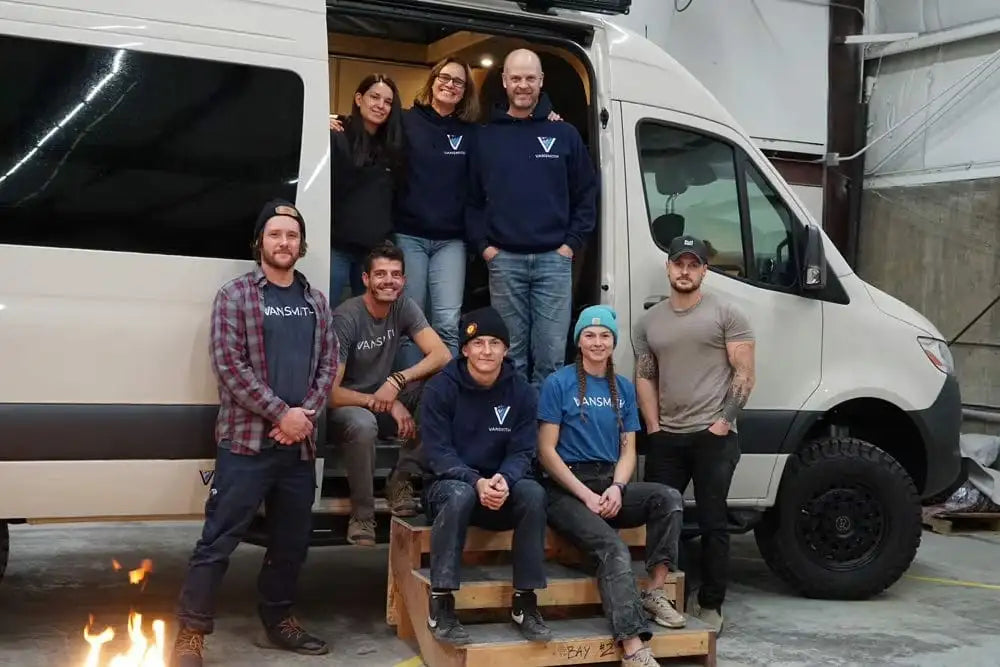
Everything is installed by our own team in our own shop, keeping one company accountable for the overall van.
The Vansmith is a Boulder family business. Buyers work with the people responsible for their van throughout the process.
We work in Colorado, where cold temperatures, snow and long-distance travel are familiar design considerations. That experience is relevant for buyers planning four-season travel across South Dakota and the Great Plains.
Video design calls, build photos throughout the process and staged payments support buyers purchasing from out of state.
Boulder to Sioux Falls is approximately 750 miles, depending on the route. Transport can be arranged as part of the purchase, or you can fly into Denver and drive the van home.
The original owner receives a lifetime cabinet warranty with no mileage or year limit, alongside access to service and upgrade work at the Boulder shop.
Conversion packages start at $46,950 for the DUO and run to $68,950 for the FAMILY XLS, fitted to a vehicle you supply.
A complete van with the chassis included starts at $115,950. Pre-built Bivy models are $119,700 for Classic, $145,845 for Plus and $192,570 for Deluxe, with Bivy XL from $153,700.
If you buy the chassis yourself, its cost is separate from the conversion package. Our cost breakdown with real examples explains the components of the total.
For South Dakota, consider prioritizing heater capacity, battery size with low-temperature protection and severe snow-rated tires. Options are priced individually so the quote can be itemized.
A pre-built Bivy is available on a fixed specification and is typically ready in 8 to 10 weeks. A tailored build generally takes 12 to 16 weeks and allows you to select heating, battery capacity and storage around how you travel. For frequent four-season use in South Dakota, compare the available specifications before deciding.
Use our RV loan calculator to estimate monthly payments, and read how to finance a camper van conversion. NOAH certification may be relevant when discussing lender and insurer requirements.
Sioux Falls is approximately 750 miles from Boulder, depending on route. Delivery can be arranged as part of the purchase, or you can fly into Denver and drive the van home.
Check camper vans for sale and used vans. The Foundation shell, listed at $9,970, may be worth considering if you want the shell professionally prepared and plan to finish the interior yourself.
Start with camper vans for sale to see what is currently available.
Compare purchase costs, service access across South Dakota and the drivetrain options available for your intended use.
Decide whether you need two berths or four, and how much gear garage space you need. The van designer lets you work through the available configurations first.
Review heater output, insulation, cold-protected battery capacity, drainable plumbing, tire specifications and ground clearance. Confirm the selected vehicle's measurements and payload against your expected use.
A conversion package fits a vehicle you supply. A complete van includes the chassis. The right choice depends on whether you already own a suitable vehicle.
Chassis availability varies by platform, drivetrain and model year, particularly for AWD configurations, and can affect your timeline.
Call (303) 414-6834 for a fixed, itemized quote, or start with the van designer.
Transport can be arranged as part of the purchase. See our process for the purchase sequence and payment schedule.
Ready to start? Use the van designer, browse camper vans for sale, or call (303) 414-6834. For the statewide view, see camper vans in South Dakota.









Email: info@thevansmith.com
Text: 303-414-6834
Form: Tell us what you need
Call: 303-414-6834
Book a call:
(We are currently not booking any new service work while we revamp our service department.)
Visit us (by appointment):


