
DUO

Mercedes Sprinter 144
OR
Ford Transit 148

Perfect for solo travelers or couples who want a compact adventure-ready van.
Seat & Sleeps
2Length
19'Shower
Exterior * * Optional Add-OnsClass B RVs, Conversion Vans & Campervans for Sale in Des Moines, IA
Mercedes Sprinter 144
OR
Ford Transit 148
Perfect for solo travelers or couples who want a compact adventure-ready van.
Seat & Sleeps
2Length
19'Shower
Exterior * * Optional Add-Ons
Mercedes Sprinter 144
OR
Ford Transit 148

Includes a shower setup for longer trips without compromising comfort or space.
Seat & Sleeps
2Length
19'Shower
Bench * * Optional Add-Ons
Mercedes Sprinter 170
OR
Ford Transit 148 E

Ideal for those who want extra living space and more storage for extended adventures.
Seat & Sleeps
2Length
22'Shower
Full
Mercedes Sprinter 170
OR
Ford Transit 148 E

Luxury model with full amenities, extended power systems, and interior bathroom.
Seat & Sleeps
2Length
22'Shower
Full
Mercedes Sprinter 144
OR
Ford Transit 148

Perfect for families who want space, comfort, and functionality in a compact build.
Seat & Sleeps
4Length
19'Shower
Exterior * * Optional Add-Ons
Mercedes Sprinter 170
OR
Ford Transit 148 E

A larger build for families who love extended adventures and more storage.
Seat & Sleeps
4Length
22'Shower
Bench * * Optional Add-Ons
Mercedes Sprinter 170
OR
Ford Transit 148 E

The luxury upgrade with interior shower and full power systems for long trips.
Seat & Sleeps
4Length
22'Shower
Full
Des Moines sits on I-80 roughly halfway between Chicago and Denver, and that is the practical case for owning a camper van here. The Rockies are a long day west. The Black Hills are eight hours northwest. The Boundary Waters and the Minnesota lakes are six to seven hours north, the Ozarks five hours south. Closer to home, Ledges State Park is 40 minutes away, Lake Red Rock an hour, and the Loess Hills along the Missouri River about two hours west.
What a van has to survive in Iowa is winter. Des Moines gets sustained cold rather than cold snaps, with January lows in the single digits and stretches well below zero, roughly 35 inches of snow a year, and heavy road salting that is harder on a vehicle's underbody than the snow itself. Then summer arrives humid and in the 90s. A van that works in Des Moines has to be a genuine four-season build.
The Vansmith builds Mercedes-Benz Sprinter and Ford Transit camper vans in Boulder, Colorado, and delivers them across Iowa. Conversion packages start at $46,950, complete vans with the chassis included start at $115,950, and pre-built Bivy models run from $119,700 to $192,570. For the statewide picture, see
camper vans in Iowa.
| Specification | Why It Matters in Des Moines, Iowa | What Buyers Should Check |
|---|---|---|
| Heating System | Sustained single-digit lows, not occasional cold snaps | Heater output matched to van volume, and whether it adds or removes moisture |
| Insulation | Doing real work in both directions, and cannot be retrofitted easily | Coverage on all six sides, and a material that tolerates moisture |
| Air Conditioning | Humid 90 degree afternoons and dew points that keep nights warm | Cooling capacity against usable battery capacity, and overnight runtime |
| Ventilation | Winter condensation and summer humidity are the same problem | Fan placement, variable speed, and reversible direction for intake or exhaust |
| House Battery | Lithium loses usable capacity in the cold | Low-temperature charge protection, and usable capacity rather than nominal |
| Solar System | Strong April through October, weak in December and January, and panels sit under snow | Panel wattage against roof area, and whether solar alone covers your winter draw |
| Alternator Charging | The charging source that actually works in an Iowa winter | DC-DC charger output, and how much it replaces on a two-hour interstate run |
| Shore Power | Driveway charging and Iowa state park hookups | Onboard charger rating and the input connection fitted |
| Fresh Water System | Trip length, plus the reality of freezing lines from November to March | Capacity against your route, line routing, insulation and drainability |
| Wastewater System | Dispersed and forest sites have no dump facilities, and gray lines freeze too | Gray capacity matched to fresh, with accessible and fully draining outlets |
| Refrigeration | Long summer trips; a smaller load in winter | Capacity and power draw; a 12V compressor fridge runs on battery alone |
| Tires | Snow, ice, brine-treated pavement and gravel county roads | Type, tread condition and age; a winter-capable tire is worth the cost here |
| Brakes | Flat driving, but wet and icy stopping distances | Service history and pad condition; salt accelerates corrosion on brake lines |
| Suspension | Comfort and control when loaded, plus gravel county roads | Setup matched to your load and routes; upgrades available where justified |
| Ground Clearance | Gravel access roads, unplowed campground entries and deep snow | Clearance and approach angles; depends on chassis, trim and drivetrain |
| Vehicle Height | Downtown and skywalk-area structures post low clearances | Roughly 9 to 10 ft in high-roof form; measure your own garage opening first |
| Vehicle Length | Easier here than in denser cities, which opens up the longer layouts | Approx. 19.5 ft short wheelbase or 22.5 ft extended, as built |
| Storage Capacity | Winter gear is bulky, and it overlaps with everything else | Gear garage volume, rear door access, and roof rack capacity |
| Electrical Monitoring | In winter you need to know what you actually have left | A battery monitor showing real state of charge, not a voltage gauge |
| Winterization | You will do this every year in Iowa | Accessible drain points, a reachable pump, and tanks that drain completely |
Exact figures for payload, ground clearance, tire sizing and vehicle dimensions depend on the chassis, trim and drivetrain you choose. We confirm each against your build during the design call.
Nine tailored layouts across the two-person DUO Series and the four-person FAMILY Series, on Sprinter 144 and 170 wheelbases and Transit 148 and 148 extended, plus three pre-built Bivy trims. Browse all tailored models .
A Class B RV is a camper built inside a van body rather than on a truck chassis. It parks in a standard space, fits most garages, and drives like a tall van. In a state with long interstate distances and real winters, a van you can keep indoors between trips is worth more than the extra space of a larger RV. Browse our Class B RVs for sale .
Our full current stock, including inspected used vans, is on the camper vans for sale page. Inventory moves, so check it rather than assuming.
Every layout is available as a camper van for sale in Des Moines. Pre-built Bivy models are ready in 8 to 10 weeks; tailored and custom builds run 12 to 16 weeks. Use our van designer or call (303) 414-6834 for a fixed, itemized quote.
Iowa cold is sustained, not occasional. January averages sit around 20 degrees for a high and single digits for a low, and multi-day stretches below zero happen most winters. That changes what a van needs: a heater sized to the space rather than one that merely takes the edge off, and a battery bank that still delivers in the cold.
Des Moines averages roughly 35 inches of snow a year, and Iowa salts and brines heavily. Salt is the real long-term threat to a camper van here, more than the snow or the cold. An underbody rinse after each thaw, and again in spring, is the single most valuable maintenance habit an Iowa owner can build.
July and August bring highs in the upper 80s and low 90s with high humidity and dew points that make nights uncomfortable. A powered roof fan matters as much as air conditioning, because moving air removes the dampness that cooling alone leaves behind.
Iowa shoulder seasons swing hard. A 70 degree afternoon can become a 35 degree night in October. The practical consequence is that you want heating available from September through May, not just in deep winter.
Iowa sits in an active severe weather corridor, with a spring peak and a secondary fall season. A van is not shelter in a tornado warning, and this is worth planning for properly rather than hoping it does not come up. Travel with a weather radio or alert app, know where substantial buildings sit along your route, treat a watch as a reason to review plans, and a warning as a reason to get out of the van and into a building. Derecho-strength straight-line winds are also a real Iowa risk and are hard on anything parked in the open.
Des Moines is easy driving: flat, a modern grid, light traffic by metro standards, and generous suburban driveways in Ankeny, West Des Moines and Urbandale. A high-roof van stands roughly 9 to 10 feet tall, which rules out some downtown and skywalk-area parking structures, but most residential garages here can take a short wheelbase build. Measure your own opening before you order.
I-80 east and west, I-35 north and south, and I-235 through the metro. Omaha is two hours, Kansas City three, Minneapolis three and a half, Chicago five and a half, and Denver nine. A van turns those into weekends rather than vacations.
A fuel-fired air heater runs off the vehicle's own fuel tank, draws very little electricity and dries the air while it warms it. In an Iowa winter that is not a preference, it is the requirement. Propane furnaces add moisture to a sealed space in cold weather, which is how you end up with condensation on every window. See Heater Service and our Sprinter heater guide .
Insulation is the one thing you cannot add later without taking the interior apart, and in Iowa it is doing real work in both directions. We insulate all six sides of the van. Pre-built Bivy models use Havelock wool, which handles moisture better than foam, and that matters in a climate that is damp in summer and condensing in winter.
Insulate first, ventilate second, cool third. A powered roof fan pulls hot, humid air out through the ceiling while cooler air enters low, insulated window covers keep sun off the glass, and the air conditioner then has much less work to do. See our A/C installation and roof vent installation pages, and our 12V A/C guide .
Winter condensation is the problem most new owners underestimate. Two people breathing overnight in a sealed van at 10 degrees outside will put water on every cold surface. A dry heat source, airflow paths behind cabinets, sealed surfaces and a fan running on low while you sleep are what prevent it collecting where you cannot see it.
Lithium batteries lose usable capacity in the cold and should not be charged below freezing without protection. We size the bank around your realistic load and specify cells with low-temperature charge protection. See our Electrical System work and our cold-weather battery charging guide.
Iowa solar is strong from April through October and weak in December and January, when overcast stretches run long and panels sit under snow. DC-DC alternator charging is what carries you through an Iowa winter, and since most trips here involve real interstate miles, it works well. See Solar Installation and our solar sizing guide .
In Iowa you will winterize, so the system has to be designed for it. Accessible drain points, a pump you can reach, and tanks that drain fully turn winterizing into a 20 minute job instead of an afternoon. Heated tanks and insulated lines extend how late in the season you can keep water aboard. See our de-winterizing guide for the spring side of it.
A 12V compressor fridge runs on battery power alone, needs no propane and does not care whether the van is level. It also costs you very little power in winter, when the ambient temperature does half the work.
Winter clothing and skis in cold months, bikes for the Raccoon River Valley and High Trestle trails in summer, paddling gear for Red Rock and Saylorville, and fishing equipment year-round. A gear garage under a raised bed with rear door access keeps wet and muddy equipment out of the cabin.
Des Moines suburbs generally have the driveway and garage space to make the extended wheelbase layouts realistic, which is not true in older or denser cities. Built short wheelbase vans run about 19.5 feet and extended builds about 22.5 feet. Measure your garage door height as well as the opening width.
Our entry two-person layout, from $46,950 as a conversion package. Fixed bed, galley, and the standard electrical, water and heating systems.
From $53,950. Adds capacity and finish over the DUO within the same two-person footprint.
Built on the longer wheelbase for more interior room and a larger gear garage. Call for current pricing.
From $63,950. The fully specified two-person build on the extended wheelbase.
From $51,950. Sleeps four with a convertible seating and sleeping arrangement.
From $61,950. The four-person layout on the extended wheelbase.
From $68,950. Our most fully specified family build.
Three pre-built trims on the Sprinter 144 AWD with a pop-top and Havelock wool insulation, ready in 8 to 10 weeks. Bivy Classic $119,700 with a 5 kWh system. Bivy Plus $145,845 with 10 kWh, a diesel cabin heater and an exterior shower. Bivy Deluxe $192,570 with 15 kWh, air conditioning, a Rixen hydronic heater and a secondary alternator. Bivy XL starts at $153,700. See the Bivy comparison .
For most Iowa buyers the honest recommendation is a DUO on the shorter wheelbase with the heating, insulation and electrical specified for winter, plus air conditioning for August. If you have the driveway space and plan long trips west or north, the extended layouts give you the living space to wait out weather comfortably. If you would rather not wait on a build, a Bivy Plus arrives in 8 to 10 weeks with the diesel cabin heater already fitted.
Iowa has a strong state park system with well maintained campgrounds, many within an hour of Des Moines. Reservations open months ahead for summer weekends.
Forty minutes north near Boone. A sandstone canyon along Pease Creek, with camping and good short hiking. The closest real scenery to the city.
An hour southeast, Iowa's largest lake, with several campgrounds, a long bike trail and good fishing. An easy single-night trip.
Two hours east near Iowa City. Paddling, swimming and a well-run state park campground.
Two hours west along the Missouri River. Wind-deposited bluffs you do not find anywhere else in North America except parts of China. Narrow ridge roads, some gravel, and quiet camping.
The Mississippi route along Iowa's eastern edge, about three hours away. Effigy Mounds, Pikes Peak State Park and a string of river towns make a good three-day loop.
Three hours northwest around Okoboji and Spirit Lake. Busy in summer, quiet in fall, and genuinely good paddling.
Minneapolis is three and a half hours, the North Shore seven, and the Boundary Waters around eight. A long weekend reaches Lake Superior comfortably.
Kansas City is three hours, the Ozarks five to six, and the Flint Hills about five. Good cold-weather options when Iowa is frozen.
Omaha is two hours, the Sandhills six, the Badlands eight and the Black Hills eight and a half. For a week off, this is the drive most Des Moines van owners make first.
Full-service campgrounds within an hour of the metro, most with electric and water hookups. A van needs much less from a campground than an RV does, which widens your options.
Reservable sites, many with electric hookups, and shoulder-season availability that is far better than summer. Several stay open through winter with reduced services.
Iowa has relatively little public land compared with the western states, so dispersed camping is limited. County conservation areas and Army Corps land around the reservoirs are the main options, and rules vary by site.
Rules differ by city and by business. Ask rather than assume, and never rely on a retail lot as a plan. Iowa rest areas along I-80 and I-35 permit short rest stops, not camping.
Many Iowa campgrounds shut water from November to April. Plan to carry your own, protect the lines, and expect unplowed access roads. Winter camping here is realistic in a properly built van and unpleasant in anything else.
Check the forecast before you leave and again before you settle for the night. A van is not shelter in a tornado warning or in derecho-strength winds. Know where substantial buildings are along your route, and be willing to change plans.
Drain fresh and gray tanks fully, drain or blow out the lines, and either use antifreeze in the system or get everything genuinely dry. Do it before the first hard freeze, not after.
The most valuable maintenance habit for an Iowa owner. Rinse the underbody after each thaw and again thoroughly in spring. Pay attention to frame rails, suspension mounts, brake lines and anywhere salt collects and stays.
If you plan to travel with water in winter, insulated lines, heated tanks and keeping the heater running are what prevent a split line. If not, run dry and carry jugs.
A fuel-fired heater should be run regularly, even out of season, and serviced on schedule. Check the exhaust routing and combustion air intake for obstruction, particularly after a winter of road spray.
Clean or replace filters before summer, confirm condensate drains clear, and run the unit once in spring before you need it.
Inspect every roof penetration twice a year, spring and fall. Freeze and thaw cycling is hard on sealant, and Iowa delivers a lot of it.
Check pressures monthly in winter, since cold air loses pressure. Inspect brake lines for corrosion at every service, which is specifically a salt-state concern.
Keep the bank charged over winter rather than leaving it to sit. Do not charge lithium below freezing without low-temperature protection, and check connections after a salt winter.
Underbody rinse, seal check, heater and A/C test, tire inspection, brake line inspection and a full water-system de-winterization. Our de-winterizing guide covers the sequence.
Indoors if you can manage it. If not, cover the roof penetrations, keep the battery maintained, leave the water system dry and run the heater periodically. Keep snow off the roof, since a loaded roof is weight the van is not designed to carry while parked.
Supply your own Sprinter or Transit for us to convert, or buy a complete van with the chassis included from $115,950. If you are sourcing your own, read new vs. used vans first.
Cabinetry, bed platform, galley, seating and finished surfaces, built in our Boulder shop. Cabinets carry a lifetime warranty to the original owner with no mileage or year limits.
A lithium house battery, roof solar, DC-DC alternator charging, shore power input, an inverter and a battery monitor showing real state of charge.
A 12V compressor fridge running on battery power, a sink with a pressurized water system, and a cooktop.
A fixed or convertible bed depending on layout, with insulated window covers. Bivy models add a pop-top for standing room and a second sleeping level.
Upper cabinets, galley storage and a gear garage beneath the bed platform with rear door access on most layouts. Roof racks available.
Fresh and gray tanks sized to your layout, a pressurized pump, and accessible drain points for winterizing, which you will use every year in Iowa.
A fuel-fired air heater running off the vehicle's own fuel tank, and a powered roof fan with variable speed and reversible direction. Air conditioning available on every build, standard on the Bivy Deluxe.
Air conditioning, additional solar, larger battery banks, suspension upgrades, winter tire packages, exterior showers, awnings, roof racks and bike mounts. See repairs, installations and services .
Lifetime warranty on cabinetry to the original owner, no mileage or year limit. Appliance and component warranties come from their manufacturers. We are NOAH certified.
Conversion packages start at $46,950 for the DUO and run to $68,950 for the FAMILY XLS, fitted to a vehicle you supply.
A complete van with the chassis included starts at $115,950. Pre-built Bivy models are $119,700 Classic, $145,845 Plus and $192,570 Deluxe, with Bivy XL from $153,700.
Used pricing varies with mileage, condition, systems and corrosion history. In Iowa, corrosion history should move the price more than mileage does. Our inspected inventory is on the used vans page.
If you buy the chassis yourself, that sits on top of the conversion package. Our cost breakdown with real examples works through actual numbers.
Check camper vans for sale for what is available now, including vans with no build wait.
Boulder to Des Moines is about 670 miles, which is one of the shorter deliveries we make east of the Rockies. Transport is arranged as part of the purchase, or fly into Denver and drive it home across Nebraska.
More than 300 vans built since 2016, on both platforms, across every wheelbase we offer.
Nine tailored layouts plus three pre-built Bivy trims, so you are choosing a configuration rather than accepting what is on a lot.
Lithium bank, solar, DC-DC charging, shore power, inverter and monitoring designed as one system and installed by the team that designed it.
Gear garages, rear door access, roof racks and interior tie-downs designed around winter gear, bikes, paddling and camping equipment.
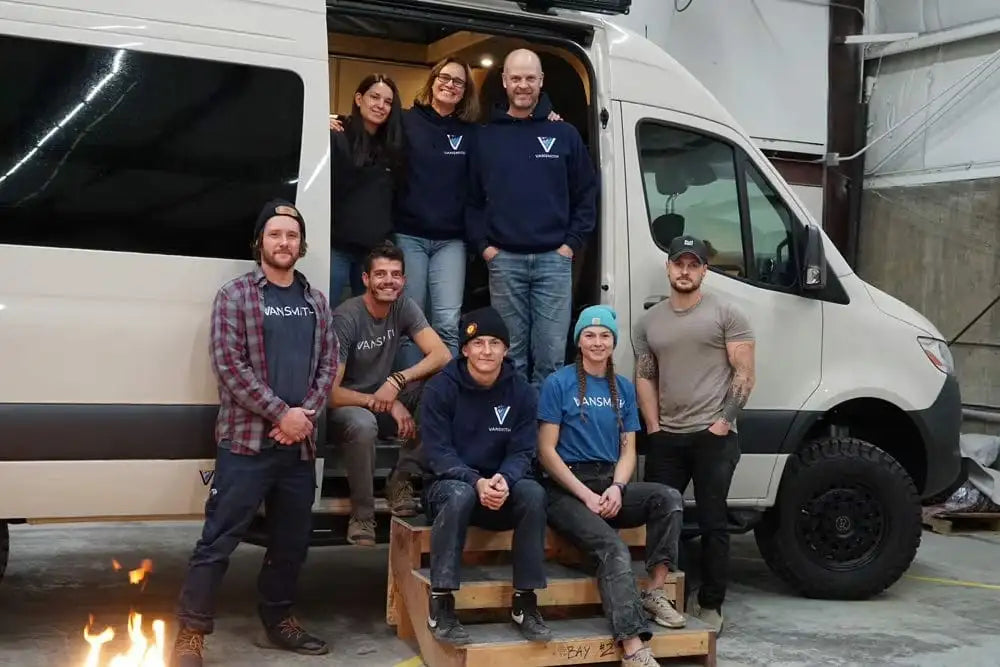
We are a Colorado builder. Cold weather is not an edge case in our builds, it is the baseline: full insulation, fuel-fired heating, protected plumbing, cold-capable batteries. That is the relevant qualification for an Iowa buyer.
Everything installed in our Boulder shop by our own team. NOAH certified, which is what insurers and lenders look for.
Video design calls, build photos throughout, and a clear payment schedule. Most of our buyers are out of state.
We deliver to Des Moines and across Iowa. Remote purchasing is routine for us, not an exception.
Ready to start? Use the van designer , browse camper vans for sale , or call (303) 414-6834. For the statewide view, see camper vans in Iowa .









Email: info@thevansmith.com
Text: 303-414-6834
Form: Tell us what you need
Call: 303-414-6834
Book a call:
(We are currently not booking any new service work while we revamp our service department.)
Visit us (by appointment):
