
DUO

Mercedes Sprinter 144
OR
Ford Transit 148

Perfect for solo travelers or couples who want a compact adventure-ready van.
Seat & Sleeps
2Length
19'Shower
Exterior * * Optional Add-OnsClass B RVs, Conversion Vans & Campervans for Sale in Billings, MT
Mercedes Sprinter 144
OR
Ford Transit 148
Perfect for solo travelers or couples who want a compact adventure-ready van.
Seat & Sleeps
2Length
19'Shower
Exterior * * Optional Add-Ons
Mercedes Sprinter 144
OR
Ford Transit 148

Includes a shower setup for longer trips without compromising comfort or space.
Seat & Sleeps
2Length
19'Shower
Bench * * Optional Add-Ons
Mercedes Sprinter 170
OR
Ford Transit 148 E

Ideal for those who want extra living space and more storage for extended adventures.
Seat & Sleeps
2Length
22'Shower
Full
Mercedes Sprinter 170
OR
Ford Transit 148 E

Luxury model with full amenities, extended power systems, and interior bathroom.
Seat & Sleeps
2Length
22'Shower
Full
Mercedes Sprinter 144
OR
Ford Transit 148

Perfect for families who want space, comfort, and functionality in a compact build.
Seat & Sleeps
4Length
19'Shower
Exterior * * Optional Add-Ons
Mercedes Sprinter 170
OR
Ford Transit 148 E

A larger build for families who love extended adventures and more storage.
Seat & Sleeps
4Length
22'Shower
Bench * * Optional Add-Ons
Mercedes Sprinter 170
OR
Ford Transit 148 E

The luxury upgrade with interior shower and full power systems for long trips.
Seat & Sleeps
4Length
22'Shower
Full
Billings offers access to Yellowstone, the Beartooth Highway, Bighorn Canyon, and the Pryor Mountains, with Glacier National Park within reach for a longer trip. Montana's extreme winter cold, hot and dry summers, strong crosswinds, long distances, and patchy cell coverage make self-sufficiency essential when choosing a camper van.
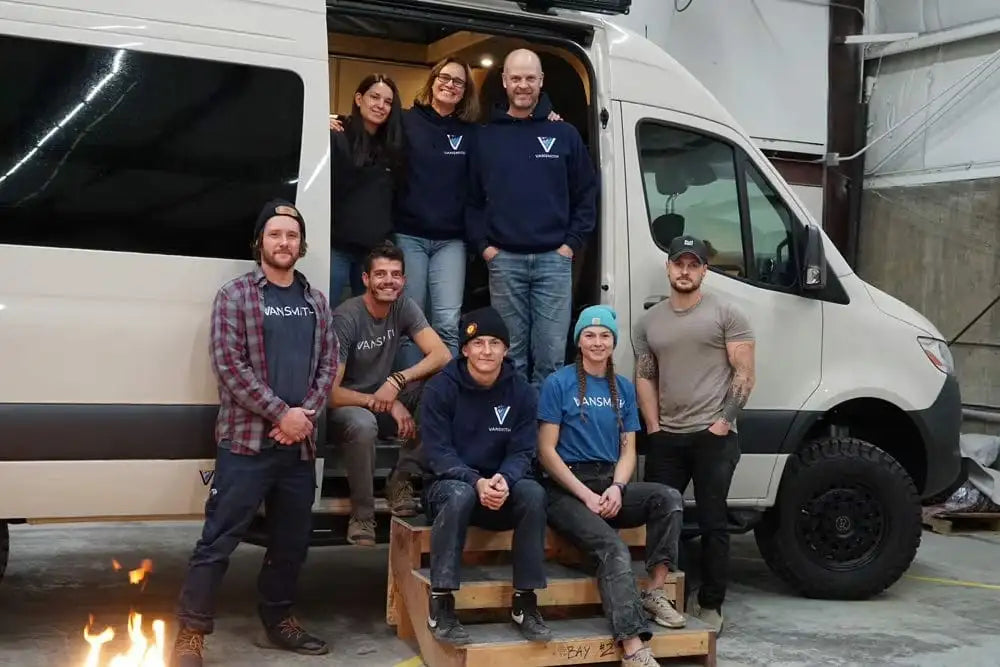
The Vansmith builds Mercedes-Benz Sprinter and Ford Transit camper vans in Boulder, Colorado, and delivers them across Montana. Conversion packages start at $46,950, complete vans with the chassis included start at $115,950, and pre-built Bivy models run from $119,700 to $192,570. For the statewide picture, see camper vans in Montana.
| Specification | Why It Matters in Billings, MT | What Buyers Should Check |
|---|---|---|
| Heating System | Sustained sub-zero nights, not occasional cold snaps | Output matched to van volume, fuel consumption per night, and altitude compensation |
| Insulation | Determines how long your fuel and battery last in a Montana winter | Coverage on all six sides; Havelock wool in pre-built Bivy models |
| Air Conditioning | Useful in July and August, more so for travel east or south | Whether you need it at all, and if so, overnight runtime off battery |
| Ventilation | Winter condensation is the problem here, not summer humidity | Fan placement, variable speed, and reversible direction for intake or exhaust |
| House Battery | Long cold nights with the heater fan running all of them | Low-temperature charge protection, and usable capacity rather than nominal |
| Solar System | Excellent spring through fall, short and low-angle in winter with snow on the panels | Panel wattage against roof area; do not plan winter power around solar |
| Alternator Charging | Long distances between Montana towns give it plenty of time to work | DC-DC charger output, and what it replaces on a two-hour drive |
| Shore Power | Driveway charging and Montana state park hookups | Onboard charger rating and the input connection fitted |
| Fresh Water | Towns are far apart and dispersed sites have no refill points | Capacity against your realistic route, plus insulated and drainable lines |
| Wastewater | Forest and dispersed sites have no dump facilities, and gray lines freeze first | Gray capacity matched to fresh, with accessible and fully draining outlets |
| Refrigeration | Long summer trips; a minimal load in winter | Capacity and power draw; a 12V compressor fridge runs on battery alone |
| Tires | Winter ice, sharp gravel and washboard forest roads | An all-terrain with a severe snow rating; sidewall strength as well as tread |
| Brakes | Long descents off the Beartooth with a loaded van | Condition and service history; engine braking matters on sustained mountain grades |
| Suspension | Washboard gravel and rough forest access roads | Setup matched to load and routes; upgrades available where routes justify them |
| Ground Clearance | The Pryors, Custer Gallatin forest roads and most dispersed sites | Clearance and approach angles; depends on chassis, trim and drivetrain |
| Vehicle Height | Garage openings, and a taller van catches more crosswind | Roughly 9 to 10 ft in high-roof form; measure your own opening first |
| Vehicle Length | Crosswind handling on I-90 and turnaround space on forest spurs | Approx. 19.5 ft short wheelbase or 22.5 ft extended, as built |
| Payload Capacity | Water, batteries, winter gear and fuel reserves add up fast | Chassis payload rating against your realistic loaded weight; worked out per build |
| Storage Capacity | Skis, fishing and hunting gear, bikes and bulky winter clothing | Gear garage volume, rear door access, and roof rack capacity |
| Electrical Monitoring | Far from help in winter, you need to know exactly what you have left | A battery monitor showing real state of charge, not a voltage gauge |
| Winterization | An annual job in Montana, not an occasional one | Accessible drain points, a reachable pump, and tanks that drain completely |
| Self-Sufficiency | Long distances, patchy cell coverage and few services between towns | Fuel range, water capacity, recovery gear, and a plan if something fails |
Exact figures for payload, ground clearance, tire sizing and vehicle dimensions depend on the chassis, trim and drivetrain you choose. We confirm each against your build during the design call.
Nine tailored layouts across the two-person DUO Series and the four-person FAMILY Series, on Sprinter 144 and 170 wheelbases and Transit 148 and 148 extended, plus three pre-built Bivy trims. Browse all tailored models.
A Class B RV is a camper built inside a van body rather than on a truck chassis. It parks in a standard space, fits most garages, and handles the Beartooth switchbacks and the gravel into the Pryors in a way a larger motorhome cannot. Browse our Class B RVs for sale.
Our full current stock, including inspected used vans, is on the camper vans for sale page.
Every layout is available as a camper van for sale in Billings, MT. Pre-built Bivy models are ready in 8 to 10 weeks; tailored and custom builds run 12 to 16 weeks. Use our van designer or call (303) 414-6834 for a fixed, itemized quote.
A conversion van, in our sense, is a cargo van converted into a camper with a full living interior: bed, galley, electrical system, water, heating and storage. That differs from the older conversion van idea of a passenger van with captain's chairs, which is what most local listings for a conversion van for sale in Billings, MT will show you.
The Mercedes-Benz Sprinter in 144 or 170 inch wheelbase, with all-wheel drive available. See Sprinter van conversions and Sprinter campers for sale.
The Ford Transit in 148 or 148 extended, with all-wheel drive on current model years. Lower purchase and service costs, and Ford dealers in most Montana towns, which matters when the nearest alternative is three hours away. See Ford Transit van conversions.
Two-person layouts with a fixed bed and a large gear garage, or four-person layouts with convertible seating and sleeping. See our layout ideas guide.
Current availability is on our camper vans for sale and used vans pages.
The single most important system in a Montana van. A fuel-fired air heater runs off the vehicle's own fuel tank, draws very little electricity and dries the air while it warms it. Size it to the volume of the van, not to a catalog minimum. See Heater Service and our Sprinter heater guide.
Insulation on all six sides, and the one thing you cannot retrofit without taking the interior apart. In a Montana winter the difference between adequate and good insulation is measured in how long your fuel and battery last. Pre-built Bivy models use Havelock wool.
Useful in July and August, and more useful if you travel east or south. Dry heat means ventilation and window covers carry most of the load.
Winter condensation is the issue, not summer humidity. Two people breathing in a sealed van at minus 10 puts water on every cold surface. A dry heat source plus a fan on low overnight is the answer.
Montana winter nights are long and cold, and the heater fan runs all of them. Lithium loses usable capacity in the cold and must not be charged below freezing without protection. We specify low-temperature charge protection and size the bank around real overnight load. See our Electrical System work and our cold-weather battery charging guide.
Montana has excellent solar from spring through fall and short, low-angle winter days with snow on the panels. DC-DC alternator charging covers winter, and the long distances between Montana towns mean it gets plenty of time to work. See Solar Installation.
You will winterize every year. Accessible drain points, a reachable pump and tanks that drain completely turn it into a 20 minute job. Heated tanks and insulated lines extend your shoulder season considerably, which in Montana is worth real money.
Gravel county roads, washboard forest access and winter ice. An all-terrain tire with a severe snow rating is the right default here, and sidewall strength matters as much as tread pattern on sharp Montana gravel.
The Pryors, the Custer Gallatin forest roads and most dispersed sites are reached on rough roads. Clearance and approach angles decide where you can go.
Skis for Red Lodge, fishing gear for the Yellowstone and Bighorn, hunting gear in fall, bikes and camping equipment. A gear garage under a raised bed with rear door access handles it.
Space is not the constraint in Billings. Wind and forest road turnaround space are. A 19.5 foot van handles crosswinds better than a 22.5 foot one, which is a real consideration on I-90.
Our entry two-person layout, from $46,950 as a conversion package. Fixed bed, galley, and the standard electrical, water and heating systems.
From $53,950. Adds capacity and finish over the DUO within the same two-person footprint.
Built on the longer wheelbase for more interior room and a larger gear garage. Call for current pricing.
From $63,950. The fully specified two-person build on the extended wheelbase.
From $51,950. Sleeps four with a convertible seating and sleeping arrangement.
From $61,950. The four-person layout on the extended wheelbase.
From $68,950. Our most fully specified family build.
Three pre-built trims on the Sprinter 144 AWD with a pop-top and Havelock wool insulation, ready in 8 to 10 weeks. Bivy Classic $119,700 with a 5 kWh system. Bivy Plus $145,845 with 10 kWh, a diesel cabin heater and an exterior shower. Bivy Deluxe $192,570 with 15 kWh, a Rixen hydronic heater, air conditioning and a secondary alternator. Bivy XL starts at $153,700. See the Bivy comparison. For Montana the Deluxe is the serious winter trim: hydronic heat, the largest battery bank and a secondary alternator.
The northeast entrance via Red Lodge and the Beartooth is around three hours when the highway is open, which is roughly late May to mid October. The north entrance at Gardiner is open year-round and about three and a half hours. Park campgrounds post vehicle length limits that a van clears comfortably, and most book out well ahead for summer.
An hour southeast. A dramatic canyon with camping, boating and wild horses in the Pryor range nearby. Far less visited than it deserves.
Dispersed camping and developed campgrounds across a large area south and west of the city. No facilities at dispersed sites.
Ninety minutes to Red Lodge and then up. Nearly 11,000 feet at the top, with switchbacks, steep grades and weather that changes within the hour. Seasonal opening only, typically late May to mid October, and it can close for snow in any month. Check current status before committing, and use engine braking on the descent.
Ninety minutes southwest. Ski town in winter, trailhead base in summer, and the gateway to the Beartooth.
An hour southeast. Worth the stop, and it pairs naturally with a Bighorn Canyon trip.
An hour south. Wild horses, caves and genuinely rough access roads. This is where clearance and tires earn their money, and it is not the place to be without a plan.
Seven hours northwest. Going-to-the-Sun Road is seasonal and has strict vehicle length and width limits, which a van generally meets while larger RVs do not. Vehicle reservations have applied in peak season in recent years, so check current requirements.
Six hours southwest through Wyoming, usually combined with Yellowstone on the same trip.
Bighorn National Forest is three hours, Cody two and a half, and Wyoming generally opens up from there.
Six hours east, with the Badlands on the way. A good late-season option when Montana high country has closed.
Conversion packages start at $46,950 for the DUO and run to $68,950 for the FAMILY XLS, fitted to a vehicle you supply. A complete van with the chassis included starts at $115,950. Pre-built Bivy models are $119,700 for the Classic, $145,845 for the Plus and $192,570 for the Deluxe, with the Bivy XL from $153,700. If you want the shell done professionally and plan to finish the interior yourself, the Foundation shell is $9,970.
Used pricing varies with mileage, condition, systems and corrosion history, and our inspected inventory is on the used vans page. If you are buying the chassis yourself, that cost sits on top of the conversion package, and our cost breakdown with real examples works through real numbers.
Boulder to Billings is about 550 miles, so delivery costs less here than to most of the country, and plenty of buyers simply fly into Denver and drive the van home up I-25. Use our RV loan calculator to work out the monthly figure, and read how to finance a camper van conversion. Call (303) 414-6834 for a fixed, itemized quote, or start with the van designer.









Email: info@thevansmith.com
Text: 303-414-6834
Form: Tell us what you need
Call: 303-414-6834
Book a call:
(We are currently not booking any new service work while we revamp our service department.)
Visit us (by appointment):


