Before buying or driving a camper van, one question can prevent a costly mistake: Will it fit? The answer depends on the relationship between your garage, parking structure, carport, or driveway opening and the highest point of your finished van. A few accurate measurements can tell you whether you have comfortable clearance, a tight fit, or no fit at all.
Camper Van Clearance Checker
Start by measuring the opening and the finished vehicle.
|
Measurement |
What to measure |
Example |
|
Opening height |
Floor to the lowest point of the opening |
114 in |
|
Factory vehicle height |
Published height for your exact van configuration |
108 in |
|
Roof equipment |
Height added above the factory roof |
3 in |
|
Finished vehicle height |
Highest point of the vehicle |
111 in |
|
Available clearance |
Opening height minus finished height |
3 in |
The basic calculation is:
Opening height − highest point of van = available clearance
For the example above:
114 − 111 = 3 inches of clearance
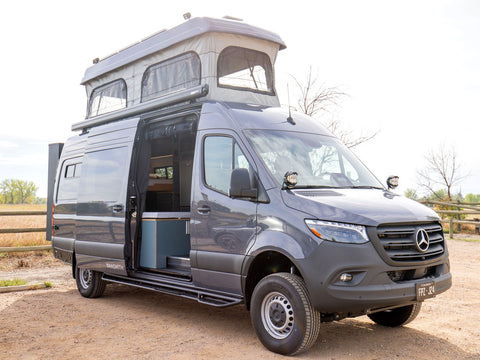
The important number is not simply the factory roof height. It is the highest point of the vehicle in the configuration you will actually drive.
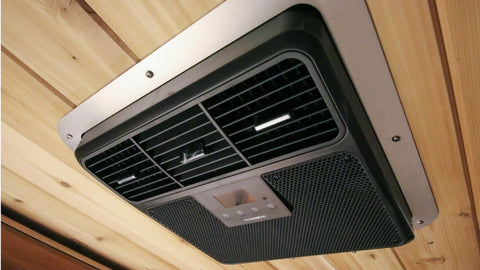
That distinction matters because roof racks, solar panels, vents, air conditioning systems, and other equipment can sit above the factory roofline.
What Counts as the Highest Point?
When measuring a camper van, look at the entire roof rather than the sheet metal alone.
|
Component |
Can affect clearance? |
What to check |
|
Factory roof |
Yes |
Use the exact vehicle configuration |
|
Roof rack |
Yes |
Measure the highest rail or mounting point |
|
Solar panels |
Yes |
Check whether panels sit above the roof |
|
Roof vent |
Yes |
Measure the exterior housing |
|
Fan |
Yes |
Include the full exterior housing |
|
Air conditioner |
Yes |
Use the highest point of the unit |
|
Antenna |
Yes |
Include fixed exterior antennas |
|
Storage equipment |
Yes |
Check the highest mounted section |
|
Awning hardware |
Sometimes |
Check the mounting position |
A van may have plenty of clearance based on its factory specification but much less after equipment is installed.
This is especially important when planning your van before purchase. If your garage opening is close to the vehicle's roof height, account for every item that could become the highest point.
The Vansmith offers Installations & Repairs for systems such as roof racks, solar, roof vents, and air conditioning. If equipment is added later, measure the finished vehicle again rather than relying on the original vehicle specification.
How to Check a Garage Opening
For a fit check, measure the actual usable opening.
Do not rely only on the advertised garage-door size.
Open the garage door completely and identify the lowest point that the van would need to pass beneath.
|
Garage measurement |
What to look for |
|
Door opening |
Actual usable height |
|
Door tracks |
May reduce clearance |
|
Door hardware |
Check anything hanging below the opening |
|
Lights |
Include fixtures near the entrance |
|
Pipes |
Measure any low plumbing or utility lines |
|
Beams |
Check structural obstructions |
|
Storage |
Look for shelving or overhead items |
|
Floor |
Consider whether the approach is level |
Then measure from the ground to the lowest obstruction.
For example:
|
Garage check |
Measurement |
|
Advertised garage height |
9 ft |
|
Advertised height in inches |
108 in |
|
Actual lowest opening point |
106 in |
|
Finished van height |
102 in |
|
Available clearance |
4 in |
The 106-inch opening, not the advertised 108-inch height, is the number to use.
If you are researching the broader question of RV storage and garage dimensions, The Vansmith's existing guide to RV That Fits in a Garage covers that subject in more detail. It is useful as a companion resource, while this page focuses specifically on calculating clearance for a particular vehicle and opening.
Will It Fit in a Parking Structure?
Parking structures require a slightly different approach.
A posted clearance at the entrance does not necessarily represent every point along the route.
|
Parking structure feature |
Why it matters |
|
Entrance clearance |
Establishes the first height limit |
|
Lower levels |
Clearance may change between floors |
|
Concrete beams |
Can sit below the posted height |
|
Hanging signs |
May extend into the driving path |
|
Pipes |
Often run beneath ceilings |
|
Sprinkler equipment |
Can reduce usable clearance |
|
Lighting |
Fixtures may hang below the ceiling |
|
Ramps |
Can change the vehicle's angle |
|
Low sections |
May create a second clearance restriction |
If the entrance says 9 feet but a lower beam inside measures 8 feet 6 inches, the lower measurement is the one that matters.
For a parking structure, think about the entire route, not just the entrance.
If you regularly travel into cities, consider the parking environments you actually use when selecting a van. A vehicle that works well for highway travel and outdoor camping may have fewer options in older city parking structures.
How Does a Driveway Change the Calculation?
A driveway can make a close clearance more complicated because the vehicle may change angle as it approaches the opening.
A flat approach gives you a simple vertical comparison.
A steep approach can raise one end of the van while the other remains on a different section of the driveway. That can change the relationship between the roof and the opening.
|
Driveway factor |
What to check |
|
Driveway slope |
Is the approach flat or steep? |
|
Garage threshold |
Is there a raised edge? |
|
Vehicle angle |
Does the van pitch as it approaches? |
|
Highest roof point |
Where is it located on the vehicle? |
|
Opening height |
What is the lowest point? |
|
Approach distance |
Does the van change angle before reaching the opening? |
|
Visibility |
Can someone safely watch the highest point? |
If your clearance is close:
- Measure the opening.
- Measure the highest point of the van.
- Check the driveway slope.
- Identify where the vehicle changes angle.
- Have someone watch the roof during a slow approach.
- Stop if the clearance becomes uncertain.
A measurement taken only on level ground may not tell the whole story.
Where Can I Find My Van's Height?
Once you know the opening measurement, you need an accurate vehicle measurement.
The Vansmith has detailed guides for the two major platforms we work with most often.
Our Sprinter van dimensions guide covers overall height, length, width, wheelbase, and roof configurations. It can help you establish the factory measurements for the specific Sprinter you are considering.
For Ford Transit shoppers, our Ford Transit van dimensions guide provides the relevant measurements across the different roof and body configurations.
Use those specifications as your starting point.
For the final clearance check, however, use the height of the finished vehicle.
Factory Height vs. Finished Height
This is the distinction that matters most.
Imagine a van has a factory height of 108 inches.
You then add equipment that makes the highest point 111 inches.
Your clearance calculation needs to use 111 inches, not 108.
|
Step |
Measurement |
|
Factory vehicle height |
108 in |
|
Roof-mounted equipment |
+3 in |
|
Finished vehicle height |
111 in |
|
Garage opening |
114 in |
|
Available clearance |
3 in |
That is a very different situation from the six inches you would have calculated using the factory measurement alone.
For a tight space, measure again whenever the exterior configuration changes.
This is particularly important when adding roof-mounted equipment.
How Much Clearance Should You Have?
There is no single clearance number that guarantees a safe fit in every situation.
As a planning guide:
|
Available clearance |
Practical interpretation |
Recommended action |
|
Under 2 inches |
Very tight |
Recheck all measurements |
|
2–4 inches |
Tight |
Verify the actual route and obstructions |
|
5–6 inches |
More practical |
Confirm the finished vehicle height |
|
7+ inches |
More comfortable |
Check the route and highest obstruction |
These are planning ranges, not guarantees.
Vehicle load, tire pressure, uneven ground, measurement errors, and the exact location of the highest point can all affect the result.
If the space is particularly difficult to access, use a more conservative margin.
A Worked Camper Van Clearance Example
Suppose you are checking whether a camper van will fit through a garage.
Your measurements are:
|
Item |
Measurement |
|
Garage opening |
116 in |
|
Factory van height |
108 in |
|
Roof rack and equipment |
3 in |
|
Finished vehicle height |
111 in |
|
Calculated clearance |
5 in |
The calculation is:
116 − 111 = 5 inches
That gives you five inches of measured vertical clearance.
Before driving through, check whether the garage door tracks, lights, pipes, or other objects create a lower point.
The same calculation can be used for a parking structure, carport, covered campsite, or other overhead restriction.
The numbers change. The calculation does not.
What If My Van Does Not Fit?
If the numbers show that your van is too tall, first verify the measurements.
|
Question |
What to verify |
|
Did you measure the actual opening? |
Use the lowest usable point |
|
Did you measure the finished van? |
Include roof equipment |
|
Is the driveway level? |
Check the approach angle |
|
Did you check the entire parking route? |
Look for lower sections |
|
Has equipment been added? |
Measure the vehicle again |
|
Is the clearance very small? |
Recheck before making a decision |
If the clearance is genuinely too tight, consider whether a different vehicle configuration makes more sense.
A shorter platform may also be useful if parking and maneuverability are important parts of your daily use. The Vansmith's small camper vans collection includes shorter Sprinter 144 and Transit 148 platforms for travelers who want a more manageable footprint.
However, exterior size is only one part of the decision.
A smaller platform can affect interior space, storage, sleeping arrangements, and the way you use the van.
The goal is to find the right balance rather than simply choosing the shortest vehicle available.
Height Is Not the Only Dimension
Once you know the van will clear the opening, check the other dimensions.
|
Dimension |
What it affects |
|
Height |
Garage, parking structure, carport, and overhead clearance |
|
Width |
Garage entry, mirrors, walls, and maneuvering space |
|
Length |
Garage depth, driveway space, and parking space |
|
Wheelbase |
Turning and maneuvering around tight areas |
|
Turning radius |
Getting into and out of narrow spaces |
If you are comparing several platforms, The Vansmith's van sizes chart provides a useful overview of these dimensions and how they differ across popular camper van platforms.
You can then compare those measurements with your own parking and storage limitations.
Your Will-It-Fit Checklist
Before buying or parking a camper van, use this checklist.
|
Check |
What to measure or verify |
Done |
|
Opening height |
Lowest usable point |
☐ |
|
Vehicle height |
Highest point of finished van |
☐ |
|
Roof equipment |
Rack, solar, vent, AC, antenna, etc. |
☐ |
|
Available clearance |
Opening minus finished vehicle height |
☐ |
|
Garage tracks |
Check for lower hardware |
☐ |
|
Ceiling obstructions |
Pipes, lights, beams, storage |
☐ |
|
Driveway slope |
Check vehicle approach angle |
☐ |
|
Parking structure |
Check entire driving route |
☐ |
|
Vehicle width |
Check entry and maneuvering room |
☐ |
|
Vehicle length |
Check garage or driveway depth |
☐ |
|
Wheelbase |
Consider tight turns |
☐ |
|
Future equipment |
Recalculate after installations |
☐ |
A Simple Camper Van Fit Formula
The calculation itself is straightforward:
Opening height − finished vehicle height = available clearance
Use this process:
Step 1: Measure the lowest point of the opening.
Step 2: Measure the highest point of the finished vehicle.
Step 3: Include every fixed roof-mounted component.
Step 4: Subtract the vehicle height from the opening height.
Step 5: Check the entire route for lower obstructions.
Step 6: Recalculate if the vehicle receives additional exterior equipment.
|
Example |
Height |
|
Opening |
120 in |
|
Factory vehicle |
109 in |
|
Roof equipment |
2 in |
|
Finished vehicle |
111 in |
|
Available clearance |
9 in |
Choose a Van Around the Way You Actually Travel
Clearance is only one part of choosing a camper van, but it is an important one.
A vehicle should work where you live as well as where you travel.
If your home garage has a strict height limit, start there. If you regularly use city parking structures, include those clearances. If your driveway has a steep approach, measure that too.
Then compare your requirements against the available vehicle platforms and layouts.
The Vansmith's Tailored Models provide a place to compare different platform and layout options based on how you plan to use the van.
Once you know your maximum height, width, and length, you can use those measurements to narrow your search for camper vans for sale.
At The Vansmith, our experience across Colorado has taught us that small dimensional details can have a major effect on everyday use. A van needs to work at the trailhead, campsite, driveway, parking structure, and on the road between them.
Measure first. Then choose the vehicle that fits your real life.
Frequently Asked Questions
How tall is a camper van?
Camper van height varies by vehicle platform, roof configuration, wheelbase, and installed equipment. Use the factory specification for initial research, then measure the finished vehicle when clearance is important.
Will a camper van fit in a standard garage?
It depends on the actual garage opening and the finished height of the vehicle. Measure the lowest point of the opening and compare it with the highest point of the van.
Does a roof rack increase camper van height?
It can. A roof rack, solar system, vent, air conditioner, antenna, or other roof-mounted component can become the highest point of the vehicle.
How do I measure camper van height?
Park the van on level ground and measure from the ground to the highest fixed point. Include all permanent roof-mounted equipment.
Is 9 feet enough for a camper van?
Nine feet equals 108 inches. Whether that is enough depends on the finished height of the specific vehicle. Compare the 108-inch opening with the highest point of the van and account for the available clearance.
Can a high-roof camper van fit in a garage?
Some can, depending on the actual garage opening and finished vehicle height. Do not rely on the words “high roof” alone. Use the actual measurements.
Should I check garage height before buying a camper van?
Yes. If you plan to store the van at home, garage clearance should be part of the vehicle-selection process. Also consider driveway slope, garage depth, width, and maneuvering space.
About the author

Eugene Smit
CEO
Eugene is the CEO of The Vansmith, based in Boulder, Colorado. He writes across topics related to van builds, ownership, and the camper van industry.
Read more about Eugene