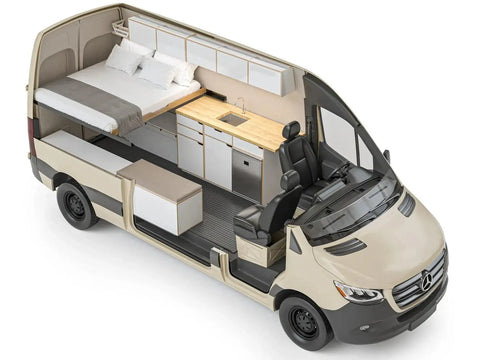
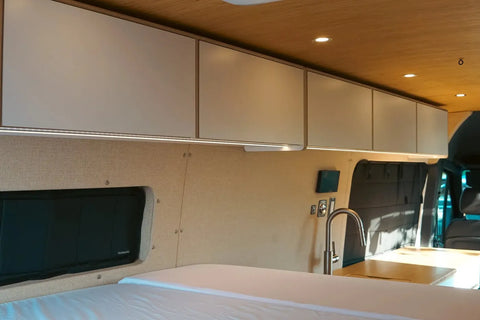
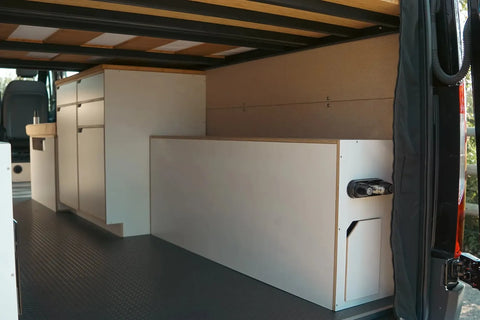
Search "RV that fits in garage" and you'll actually run into two very different questions. Some people mean: can I park my camper inside my home garage? Others are shopping for an RV with a garage — a toy hauler with a built-in cargo bay for hauling motorcycles, ATVs, or gear. Both questions come up constantly, and both deserve real answers with real numbers.
This guide covers both. We'll walk through actual garage door dimensions, which RV classes realistically fit in a standard home garage, what to know about campers that fit in a garage with a bathroom, and how toy hauler "garage" space works if that's what you're actually after. If you're shopping for your next rig, you can browse our full RV for sale and camper van for sale inventory as you read.
Can an RV Actually Fit in a Standard Garage?
Short answer: it depends almost entirely on height, not length. Most residential garages have plenty of floor space — it's the door opening and the ceiling that trip people up.
Here's what a typical home garage looks like:
|
Garage Type |
Width |
Depth |
Door Height |
|
Single-car garage |
~12 ft |
~20 ft |
7–9 ft |
|
Two-car garage |
~20 ft |
22–24 ft |
7–9 ft |
Compare that to average RV heights:
|
RV Class |
Typical Width |
Typical Height (incl. AC/vents) |
|
Class B camper van |
~7–8 ft |
9–10 ft |
|
Class C motorhome |
~8 ft |
10–11 ft |
|
Class A motorhome |
~8.5 ft |
12–13.5 ft |
|
Travel trailer |
Up to 8.5 ft wide |
10–12 ft |
|
Fifth wheel |
~8.5 ft wide |
12–13 ft |
The takeaway: a standard 7–9 foot residential garage door will only comfortably clear a Class B camper van, and even then it's tight once you account for roof-mounted air conditioners, antennas, or vents. Nearly every Class A, most Class C, and most travel trailers and fifth wheels will need a taller opening than a typical home garage provides.
If you're shopping specifically because you want something that lives in your existing garage, a compact Class B camper van is almost always the safer bet than a larger motorhome or towable.
Always Measure — Don't Estimate
Manufacturer spec sheets list an RV's height, but that number often excludes rooftop air conditioners, satellite domes, roof racks, or exhaust stacks — all of which can add 6 inches to a foot. Before you assume anything will fit:
- Measure your garage door opening height and width, not just the garage's interior dimensions.
- Measure your RV's tallest point, including anything mounted on the roof.
- Check the ceiling height inside the garage too — some garages have a shorter door than the interior clearance, and vice versa (watch for garage door openers, light fixtures, and shelving hanging down).
- Leave a buffer. Most guides recommend adding at least 12–24 inches of extra height and width clearance beyond the RV's actual dimensions for safe maneuvering.
RV Garage Dimensions by Class
If you're building or buying a garage specifically to store an RV (rather than checking if your current one works), here's roughly what each class needs.
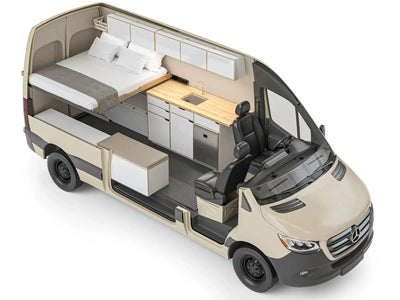
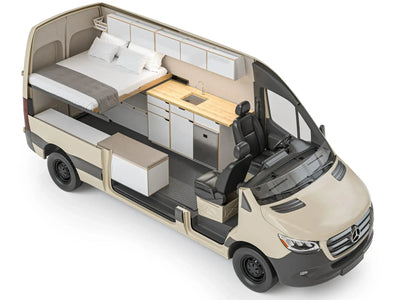
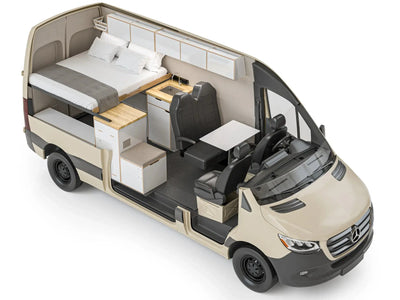
Class B camper vans are the easiest to accommodate. At roughly 9–10 feet tall, they typically need a door around 9–10 feet wide by 9–10 feet tall — often just a slightly upsized version of a standard residential door. This is one of the reasons Class B vans remain popular for people who want RV capability without needing dedicated storage. Take a look at our current Class B camper van lineup, including builds on the Sprinter and Ford Transit platforms.
Class C motorhomes generally call for a door in the 10-foot-wide by 10-foot-tall range, though the cab-over sleeping area can push height requirements higher on some models.
Class A motorhomes are the biggest ask. Plan on a door at least 12 feet wide and 12–14 feet tall, and a garage depth that can run 40–50 feet to accommodate full length.
Travel trailers and fifth wheels vary widely by floor plan, but width typically maxes out around the road-legal limit of 8.5 feet, with heights commonly in the 10–13-foot range. Because they're towed, you also need enough depth to bring in both the tow vehicle and the trailer together, which adds significantly to the garage's required length.
A simple rule of thumb many builders use: take your RV's actual height and add about 2 feet, which leaves room for the door track, motor, and a safety margin.
Travel Trailer That Fits in a Garage: What to Look For
If you're specifically hunting for a travel trailer that fits in a garage, height is your main constraint, followed by length. A few things that help:
- Look at "low profile" or teardrop-style trailers. Many are intentionally built under 9 feet tall, specifically so they clear standard garage doors and carports.
- Check the listed height against the real-world height. As with motorhomes, listed trailer height often doesn't include roof vents or AC units — always verify.
- Consider width carefully, not just height. Most travel trailers run close to the 8.5-foot road-legal maximum, which is wider than a typical single-car garage door, even if the height clears fine.
- Factor in tongue length. A trailer that's short inside can still be considerably longer overall once you include the hitch and tongue, which affects whether it fits within your garage's depth.
Campers That Fit in a Garage With a Bathroom
This is one of the most common searches for a good reason — a lot of people want the comfort of an onboard toilet and shower without needing to store their rig outside year-round. The good news: you don't have to sacrifice a bathroom to get a garage-friendly size.
Several small travel trailers, teardrop-style campers, and compact Class B vans now include a wet bath (a combined shower/toilet compartment) in a footprint under 17 feet long and under 9 feet tall. These units are specifically designed for exactly this use case — small enough to tow with an SUV or midsize truck, and low enough to clear a standard or slightly upsized garage door.
If a full wet bath is a must-have for your build, our van conversions with showers and shower-equipped collections are a good place to start, since every unit in those categories is already built around a compact, garage-friendly footprint rather than a full-size RV bathroom.
What "RV With a Garage" Actually Means: Toy Haulers
Here's where the terminology gets confusing. When people search "RV with garage" or "camper with garage in back," a large share of them aren't asking about storing the RV in their home garage at all — they're asking about toy haulers: RVs and trailers built with a garage compartment inside the rig itself, for hauling motorcycles, ATVs, UTVs, or gear.
A toy hauler's garage sits at the rear of the unit and typically runs anywhere from about 7 to 18 feet long, accessed through a fold-down rear ramp door that doubles as a patio deck once you're parked and the toys are unloaded. Interior garage width is usually somewhere around 7.5 to 8 feet, matching the RV's overall body width.
A few things worth knowing if this is the "garage" you're actually after:
- Garage size varies enormously by floor plan. Compact toy haulers might offer an 8–10-foot garage, while larger fifth-wheel toy haulers can stretch past 14–15 feet.
- Many toy hauler garages double as living space. Fold-down beds, removable furniture, and even a half-bath built into the garage area are common, so the space isn't wasted once your gear is unloaded.
- Cargo capacity matters as much as garage length. A long garage doesn't help much if the trailer's cargo carrying capacity (CCC) can't handle the weight of what you're hauling — always check both numbers together.
- They're heavier and longer than comparable non-hauler RVs, due to the reinforced frame, ramp hardware, and extra structure, so towing capacity and truck class need extra attention.
If a toy hauler-style layout is what you're really after — extra cargo space, a flexible multi-use area, or room to bring gear along — it's worth talking through floor plans with our team, especially if you're also considering a mobile work van that needs similar equipment-hauling flexibility.
Tips for Fitting an RV in Your Garage
If you've measured everything and you're working with limited clearance, a few adjustments can make the difference between "close" and "fits":
- Upgrade to a taller garage door. Moving from a standard 7-foot door to a 9- or 10-foot door is often the single easiest fix, and it's far less invasive than modifying the structure itself.
- Use a jackshaft garage door opener instead of a standard trolley opener. Trolley systems hang down from the ceiling and can eat into your usable height clearance; jackshaft openers mount to the side wall instead.
- Remove or lower roof accessories where possible. Some antennas and vent covers can be retracted or removed for storage, buying you a few extra inches.
- Account for slope. If your driveway or garage entry slopes downward, your RV will effectively be taller relative to the door as it enters — build in extra margin if this applies to you.
- Reinforce the garage floor if needed. RVs are considerably heavier than a typical passenger vehicle, and older garage slabs aren't always rated for that load.
Choosing the Right Rig for Garage Storage
If garage storage is a priority for your next purchase — rather than something you're retrofitting for — it's much easier to buy for it up front than to modify a structure later. A few directions worth considering:
-
Solo travelers or couples who want maximum garage compatibility should look closely at Class B camper vans, including our camper vans for couples collection — the smallest footprint with the best odds of clearing a standard door.
-
Families who need more interior space but still want manageable dimensions can look at compact travel trailers or a family van conversion built on a taller but still garage-manageable chassis.
-
Chassis choice matters, too. A Transit short wheelbase build is easier to store than a Transit long wheelbase, simply due to overall length.
-
Pop-top and pop-up styles can be a clever workaround for height-limited garages. A pop-top or pop-up camper van drives at a lower, garage-friendly height and only extends upward once you're parked and camping.
-
If you want the interior comfort of a larger build without giving up garage compatibility, our luxury camper vans for sale and eco-friendly van conversions are built on Class B and B+ platforms that stay closer to garage-friendly heights than a full Class A or C.
-
If you're located in Colorado, our Colorado van conversions team can walk you through local garage and driveway considerations in person.
-
Don't forget cold-weather storage needs — if you're keeping your rig garaged through winter, pairing it with a proper camper van heater installation helps protect plumbing and interior finishes even when the RV isn't in active use.
-
If you need to shuttle people rather than gear, a passenger van build shares many of the same garage-fit considerations as a camper van conversion, just with a different interior layout.
Frequently Asked Questions
What size garage door do I need for an RV?
It depends on the RV class. Class B vans typically need around 9–10 feet of height and width; Class C motorhomes need roughly 10 feet; Class A motorhomes need 12 feet or more in both width and height. Always add 1–2 feet of buffer beyond your RV's actual measured dimensions.
Can a travel trailer fit in a two-car garage?
Often in terms of length and depth, yes — but height is usually the limiting factor. Most two-car garage doors are only 7–9 feet tall, while many travel trailers run 10–12 feet tall, including roof vents and AC units. Width can also be tight, since trailers commonly approach the 8.5-foot road-legal maximum.
Are there campers that fit in a garage with a bathroom?
Yes. A number of small travel trailers, teardrop-style trailers, and compact Class B camper vans include a wet bath while staying under roughly 9 feet tall and under 17 feet long, making them realistic options for garage storage.
What's the difference between an "RV with a garage" and an RV that fits in my garage?
An RV that fits in your garage is about the RV's exterior dimensions matching your home garage's door and interior space. An "RV with a garage" (or a toy hauler) refers to a built-in cargo bay inside the RV itself, used for hauling motorcycles, ATVs, or gear — a completely different feature.
How much clearance should I leave beyond my RV's measured height?
Most experts recommend at least 12 inches of height clearance and about 18 inches of width clearance beyond your RV's actual measurements to allow safe maneuvering and account for anything you may add later, like a roof rack or antenna.
Final Thoughts
Whether "RV that fits in garage" means squeezing a camper van into your existing home garage, building a dedicated RV garage from scratch, or shopping for a toy hauler with cargo space built in, the answer always comes down to the same exercise: measure carefully, account for roof accessories, and buy with your actual storage situation in mind rather than assuming it'll work out.
If you're ready to find a rig that fits your garage, your driveway, or your lifestyle, browse our full camper van for sale and RV for sale inventory, or reach out to our team — we're happy to help you match dimensions to your specific space before you buy.
About the author

Eugene Smit
CEO
Eugene is the CEO of The Vansmith, based in Boulder, Colorado. He writes across topics related to van builds, ownership, and the camper van industry.
Read more about Eugene