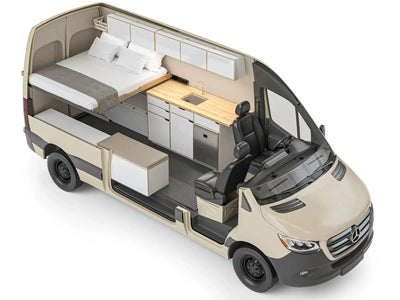
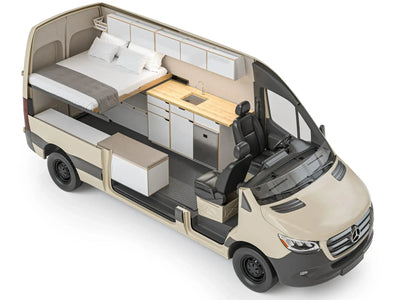
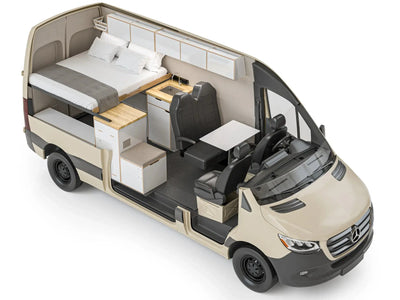
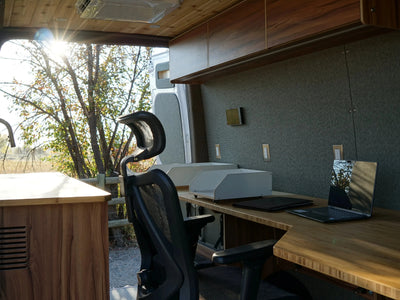
Short answer: four systems decide whether van life works, and everything else is optional. Power, ventilation, sleep and heat. Get those right and a cheap kettle will not ruin your trip. Get them wrong and no amount of gear will save it.
Budget roughly $6,000 to $14,000 for those four systems installed, and treat every additional purchase as something that has to earn its weight and its space. The most common mistake we see is not buying cheap gear. It is buying good gear for the wrong category.
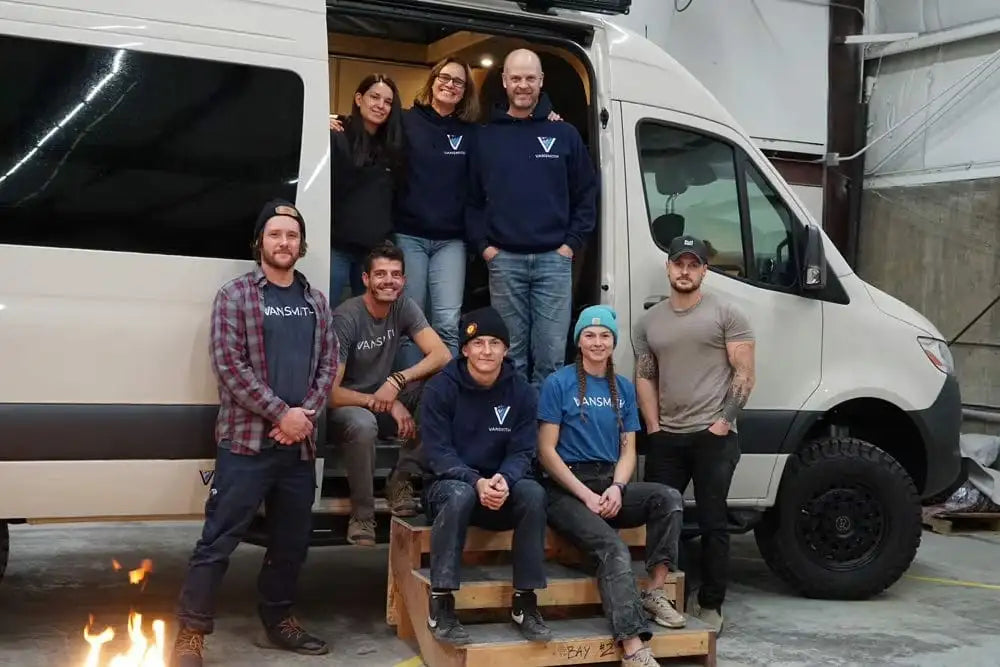
We have been finishing camper vans in Boulder, Colorado for close to a decade, and we stay in touch with the owners afterwards. That gives us something most gear lists do not have: we hear what broke, what got removed after six months, and what people wished they had spent more on.
This is not a list of everything you could buy. It is what is worth the money, what is not, and why.
The verdict table
| Category | What we use | Rough cost | Verdict |
|---|---|---|---|
| Roof ventilation fan | MaxxFan Deluxe 7500K | $200-$300 | Buy first. Cheapest comfort per dollar in the whole van |
| Battery monitor | Victron BMV-712 | $150-$200 | Essential. You cannot manage a system you cannot see |
| Diesel or gasoline air heater | Webasto Air Top 2000 STC | $1,000-$1,500 plus fitting | Essential for any three or four-season use |
| Compressor fridge | Dometic CFX series | $800-$1,200 | Worth it. A cooler costs more in ice and hassle within a year |
| Solar charge controller | Victron SmartSolar MPPT | $200-$600 | Worth it, sized to the array not the battery |
| CO alarm and fire extinguisher | First Alert CO615, AUTO5 | $55-$85 together | Non-negotiable. Cheapest line on this page |
| Satellite messenger | Garmin inReach Mini 2 | $350-$400 plus plan | Worth it if you travel remote or solo |
| Portable air compressor | Viair 88P or similar | $50-$70 | Worth it. Tire pressure is the cheapest traction upgrade |
| Induction cooktop | Duxtop 8100MC | $60-$80 | Worth it if your inverter and bank can carry it. Otherwise stay on propane |
| Satellite internet | Starlink Mini, Roam plan | $249 hardware, $55/mo and up | Worth it for remote work. Wrong plan choice is where people overspend |
| Cell signal booster | WeBoost Drive Reach RV | $500-$600 | Conditional. Only helps where there is weak signal, not zero signal |
| Composting toilet | Nature's Head | $900-$1,000 | Conditional. Excellent full-time, oversized for weekends |
| Gravity water filter | Berkey and similar | $250-$300 | Skip. See below |
| Premium cookware set | All-Clad and similar | $300-$500 | Skip. See below |
| Van security system | Simplisafe and similar | $200-$400 | Skip. See below |
| Boxed memory foam mattress | Consumer bed-in-a-box | $400-$800 | Skip. Buy cut foam instead |
What we would actually skip
Most gear guides never say no to anything. Here is where we think the money goes wrong, and these are the four we get asked about most.
A gravity water filter. They work, but they need counter space and vertical headroom to operate, and a van has neither. You end up storing it, setting it up, waiting, and putting it away. An inline filter on your tank plus a squeeze or pump filter for refilling from questionable sources does the same job for less money and no footprint. Spend the difference on tank capacity.
A $400 cookware set. Heat distribution matters on a home range with a big burner. On a single induction hob or a two-burner propane top you are cooking on a small circle of heat regardless. Two good pans and a pot cost under $120 and perform identically in this application. The weight saving is real too.
A monitored security system. Cellular monitoring does not work where you actually park, which is the whole point of the van. The genuine deterrents are free or cheap: do not leave anything visible, use a steering lock, fit a hidden kill switch, and park thoughtfully. Put the $300 toward better door locks if security worries you.
A boxed consumer mattress. Van beds are rarely a standard size, and a boxed mattress is built for a sprung base with airflow underneath. Cut high-density foam to your platform, and put a moisture-management layer beneath it. Condensation under a mattress sitting flat on plywood is one of the most common problems we get called about.
One pattern runs through all four: gear designed for a house performs worse in a van than gear designed for the space and power available, even when the house version costs more.
The four systems that actually decide comfort
1. Ventilation, before anything else
A roof fan is the highest-value purchase in the van. It manages condensation, pulls cooking smells and heat out, and makes sleeping possible on a warm night. It costs $200 to $300 and it changes more about daily comfort than any $1,000 item on this page. If you are running a heater, you need airflow anyway, because a sealed warm van collects the moisture from breathing and cooking and turns it into damp textiles and eventually mould.
2. Power, sized to real use
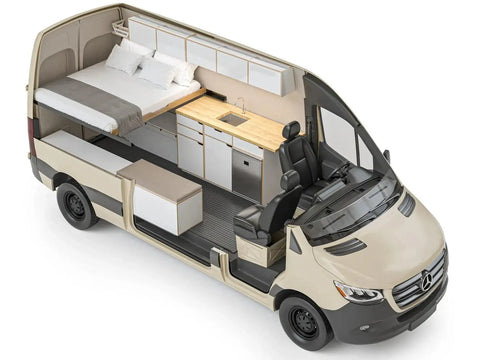
Our standard setup is a 2 kWh lithium system with 300 W of solar, shore charging and alternator charging, with 5 kWh and 10 kWh options. The right size is set by what you actually run, not by the largest number you can afford.
The number most people get wrong is the fridge. A compressor fridge draws roughly 30 to 60 amp hours per day at 12 V depending on ambient temperature and how often the door opens. That alone can be half a small battery bank. Add a diesel heater, a fan, lights and laptop charging and a 100 Ah bank does not last a weekend in winter.
Two things matter more than raw capacity. A battery monitor, because a system you cannot see is a system you will either abuse or underuse. And alternator charging, because solar underperforms badly in winter exactly when your heater is drawing most. Our electrical system work covers the sizing conversation in detail.
3. Sleep
Poor sleep ends more trips than any equipment failure. Cut foam to fit the platform, use a layer that lets air move underneath, and add proper window covers. Insulated covers on single-pane glass do more for warmth than another inch of wall insulation, because glass leaks heat faster than any wall assembly you can fit in a van.
4. Heat
You cannot insulate your way to warmth below freezing. A diesel or gasoline air heater burning a fraction of a gallon per hour will hold a van comfortable well below zero, and the dry heat helps with condensation. Electric heaters are a campground tool only, since a 1,500 W unit draws around 145 amps from a 12 V bank through an inverter and will empty a 400 Ah system in roughly two and a half hours.
If you are specifying this now, we install heating systems and plan them alongside insulation and electrical rather than as a bolt-on afterwards.
Connectivity in 2026
Starlink changed remote work in a van, and it is also where people most often pick the wrong plan and overpay.
| Option | Cost | Who it suits |
|---|---|---|
| Starlink Mini hardware | $249 | Most van owners. Lower power draw and it stows easily |
| Standard dish hardware | $349 | Only if you need the larger dish's performance |
| Roam 100 GB | $55/mo | Weekenders and light users |
| Roam 300 GB | $80/mo | Most remote workers |
| Roam Unlimited | $165/mo | Full-timers relying on it as their only connection |
| Standby mode | $5/mo | Seasonal travellers keeping the account alive over winter |
The detail most people miss: Roam plans can be paused month to month. If you travel half the year, pausing rather than paying Unlimited year-round changes the annual cost substantially. We cover setup, mounting and power draw in our Starlink for RVs guide.
A signal booster is a different tool and is often confused with this one. A booster amplifies weak signal. It cannot create signal where there is none, so it helps at the edge of coverage and does nothing in a canyon.
Safety gear: cheap and non-negotiable
- Carbon monoxide alarm, $30 to $50. Required if you have any fuel-burning appliance, which includes a diesel heater and a propane hob
- Smoke detector, $15 to $25. Separate device, not a combination unit only
- Automotive-rated fire extinguisher, $25 to $35, mounted where you can reach it from the bed and from the sliding door
- First aid kit appropriate to how far you get from help
- Roadside assistance membership. The most overlooked item on any gear list, and the one most likely to be used
Under $150 covers the first four. There is no good reason to skip any of them.
Gadgets worth having in 2026
Most van life gadgets are answers to problems nobody has. These are the exceptions we actually see used.
- A Bluetooth battery monitor. Checking state of charge from your phone in bed sounds trivial. It changes how well you manage power
- A portable air compressor. Airing down for sand or snow and reinflating for the highway is the cheapest traction improvement available
- A satellite messenger. Two-way messaging where there is no cell service, with SOS for genuine emergencies
- A quality multi-tool. Used weekly, not occasionally
- Collapsible kitchen items. Genuinely useful in a galley where every item competes for the same drawer
What we would not bother with: app-controlled lighting, anything requiring a permanent internet connection to function, and single-purpose gadgets that duplicate something you already carry.
What it all costs
| Phase | What it covers | Cost |
|---|---|---|
| 1. The four systems | Power and monitoring, ventilation, heat, sleep platform | $6,000-$14,000 |
| 2. Kitchen and water | Fridge, cooktop, pump, filtration, tanks | $1,500-$3,500 |
| 3. Safety and recovery | Detectors, extinguisher, first aid, compressor, basic tools | $300-$700 |
| 4. Connectivity | Starlink hardware plus first year of service, booster if needed | $900-$2,500 |
| 5. Activity specific | Varies enormously by what you do | $500-$10,000+ |
Work in that order. Almost every owner who regrets a purchase bought from phase 5 before finishing phase 1.
Frequently asked questions
What are the essential van life items?
Four systems matter most: a roof ventilation fan, a lithium electrical system with a battery monitor, a fuel-fired heater, and a properly sized sleeping platform with insulated window covers. After that, a compressor fridge, a carbon monoxide alarm and a fire extinguisher. Everything else is preference.
What van life gear should I buy first?
The roof ventilation fan, at $200 to $300. It manages condensation, removes heat and cooking smells, and makes warm nights sleepable. It improves daily comfort more per dollar than any other item. The electrical system comes second because it determines what else you can run.
How much does van life gear cost?
Budget $6,000 to $14,000 for the core four systems installed, $1,500 to $3,500 for kitchen and water, and under $700 for safety and recovery. A complete fit-out typically lands between $10,000 and $30,000 depending on how much of it is professionally installed.
What van life gear is not worth the money?
Gravity water filters, premium cookware sets, monitored security systems and boxed consumer mattresses. Each is designed for a house and performs worse in a van than a cheaper alternative designed for the space and power available. Spend the difference on tank capacity or battery capacity.
Is Starlink worth it for van life?
Yes if you work remotely. The Mini at $249 suits most vans on power draw alone. Most remote workers need Roam 300 GB at $80 a month rather than Unlimited at $165. Roam plans pause month to month, which matters if you travel seasonally.
What is the best van life fridge?
A 12 V compressor fridge rather than a thermoelectric cooler or an icebox. Expect to pay $800 to $1,200 and to budget 30 to 60 amp hours per day for it, depending on ambient temperature. That draw is usually the single largest item in a van's daily power use.
Do I need solar for van life?
Solar helps but it is not sufficient on its own. Winter output drops exactly when heater and lighting loads peak, so alternator charging through a DC-to-DC charger matters more for four-season travel. Most vans want both, with solar earning while parked and the alternator earning while driving.
What is the best van life toilet?
A composting toilet suits full-time travel because it removes the black tank entirely, at around $900 to $1,000. For weekend and seasonal use a portable cassette toilet costs a fraction of that and is easier to live with. Match it to how many consecutive nights you actually spend off-grid.
How much power do I need for van life?
Add up daily consumption rather than picking a number. A compressor fridge uses 30 to 60 amp hours a day, a roof fan 1 to 3 amps while running, a diesel heater under 2 amps once lit, and laptop charging 5 to 8 amp hours per charge. A 2 kWh system covers most weekend and shoulder-season use.
What van life gear can I skip if I am on a budget?
Skip the security system, the premium cookware, the gravity filter and any branded van life item that has an ordinary equivalent. Never skip the carbon monoxide alarm, the fire extinguisher or the ventilation fan. Safety and airflow are the cheapest items on the list and the least sensible to cut.
What is the difference between van life gear and camping gear?
Van gear has to earn permanent space and survive constant vibration, so durability and multi-purpose function matter more than pack weight. Camping gear is optimised to be carried and then put away. Items that work as seating, storage and a work surface at once are far more valuable in a van than single-use equipment.
Should I buy cheap gear and upgrade later?
It depends on the category. Buy quality once for anything permanently installed or safety related, because replacing it means undoing the interior. Buy cheap and upgrade for anything loose and easily swapped, such as cookware, bedding and organisers, since your preferences will change after the first few trips.
Where to start
Work the four systems first, in order, and let the rest follow from how you actually travel rather than from a list. If you want the components without a full fit-out, our DIY kits and parts cover the electrical and interior hardware we use ourselves.
If you would rather start with a van that already has proven systems in it, browse our camper vans for sale or see finished layouts in the gallery. To talk through priorities for how you travel, contact our team.
About the author

Eugene Smit
CEO
Eugene is the CEO of The Vansmith, based in Boulder, Colorado. He writes across topics related to van builds, ownership, and the camper van industry.
Read more about Eugene