
DUO

Mercedes Sprinter 144
OR
Ford Transit 148

Perfect for solo travelers or couples who want a compact adventure-ready van.
Seat & Sleeps
2Length
19'Shower
Exterior * * Optional Add-OnsClass B RVs, Conversion Vans & Campervans for Sale in Fort Collins, CO
Mercedes Sprinter 144
OR
Ford Transit 148
Perfect for solo travelers or couples who want a compact adventure-ready van.
Seat & Sleeps
2Length
19'Shower
Exterior * * Optional Add-Ons
Mercedes Sprinter 144
OR
Ford Transit 148

Includes a shower setup for longer trips without compromising comfort or space.
Seat & Sleeps
2Length
19'Shower
Bench * * Optional Add-Ons
Mercedes Sprinter 170
OR
Ford Transit 148 E

Ideal for those who want extra living space and more storage for extended adventures.
Seat & Sleeps
2Length
22'Shower
Full
Mercedes Sprinter 170
OR
Ford Transit 148 E

Luxury model with full amenities, extended power systems, and interior bathroom.
Seat & Sleeps
2Length
22'Shower
Full
Mercedes Sprinter 144
OR
Ford Transit 148

Perfect for families who want space, comfort, and functionality in a compact build.
Seat & Sleeps
4Length
19'Shower
Exterior * * Optional Add-Ons
Mercedes Sprinter 170
OR
Ford Transit 148 E

A larger build for families who love extended adventures and more storage.
Seat & Sleeps
4Length
22'Shower
Bench * * Optional Add-Ons
Mercedes Sprinter 170
OR
Ford Transit 148 E

The luxury upgrade with interior shower and full power systems for long trips.
Seat & Sleeps
4Length
22'Shower
Full
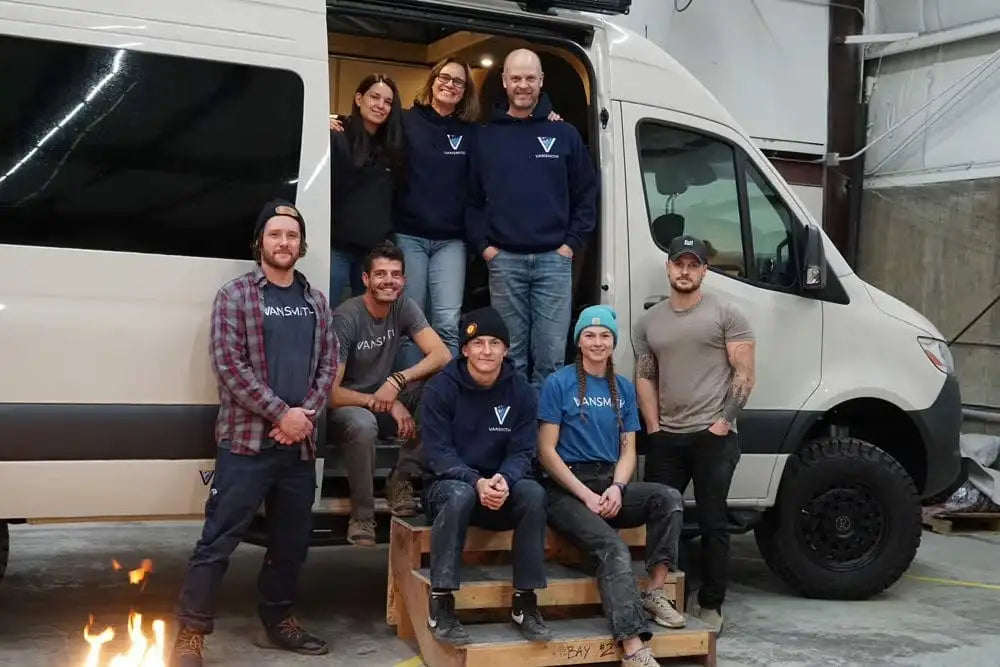
Our shop is about 45 minutes from Fort Collins. We build every van we sell at 7209 Valtec Court, Unit B in Boulder, which means a Fort Collins buyer gets something our out-of-state customers do not: you can walk through a van before you order one, sit in two layouts back to back, and come back for service without shipping anything anywhere.
Fort Collins is also one of the best places to actually use a camper van. Poudre Canyon starts at the edge of town. Rocky Mountain National Park and Estes Park are an hour southwest. Roosevelt National Forest has dispersed camping within 40 minutes of downtown. Wyoming is 45 minutes north, and from there it is an easy run to the Snowies, Vedauwoo and the Red Desert. You are not driving to the mountains from here. You are already in the foothills.
The Vansmith builds Mercedes-Benz Sprinter and Ford Transit camper vans in Boulder. Conversion packages start at $46,950, complete vans with the chassis included start at $115,950, and pre-built Bivy models run from $119,700 to $192,570. For the statewide picture, see our
Colorado van conversions.
| Specification | Why It Matters in Fort Collins, Colorado | What Buyers Should Consider |
|---|---|---|
| Heating System | Mountain nights freeze nine months a year, well below the town forecast | Output matched to van volume, plus altitude compensation for combustion heaters |
| Insulation | A 40 degree daily swing at elevation is routine | Coverage on all six sides; Havelock wool in pre-built Bivy models |
| Air Conditioning | Useful for summer trips east and south, less critical in dry Front Range heat | Whether you need it at all, and if so, overnight runtime off battery |
| Ventilation | Dry air cools fast once the sun drops, so airflow does most of the work | Fan placement, variable speed, and reversible direction for intake or exhaust |
| House Battery | Cold nights with the heater running are the real overnight load | Low-temperature charge protection, and usable capacity rather than nominal |
| Solar System | Around 300 sunny days a year and thin air at altitude make solar productive | Panel wattage against roof area; a well-sized array covers most of the year here |
| Alternator Charging | Covers winter and weeks parked in forest shade | DC-DC charger output, and what it replaces on a canyon drive |
| Shore Power | Home charging plus Colorado state park hookups | Onboard charger rating and the input connection fitted |
| Fresh Water | Dispersed forest camping means no refill for days | Capacity against your route, plus insulated and drainable lines |
| Wastewater | Dispersed sites have no facilities, and gray lines freeze | Gray capacity matched to fresh, with accessible and fully draining outlets |
| Refrigeration | Trip length matters more than ambient heat at elevation | Capacity and power draw; a 12V compressor fridge runs on battery alone |
| Tires | Colorado traction laws in winter, plus rocky forest roads in summer | An all-terrain with a severe snow rating; sidewall strength as well as tread |
| Brakes | Sustained descents off Cameron Pass and out of the Park | Condition and service history; engine braking matters on long mountain grades |
| Suspension | Rough forest roads and a van loaded with gear | Setup matched to load and routes; upgrades available where routes justify them |
| Ground Clearance | Decides which dispersed sites you can actually reach | Clearance and approach angles; depends on chassis, trim and drivetrain |
| Vehicle Height | Trailhead gates, forest canopy and older Old Town garages | Roughly 9 to 10 ft in high-roof form; measure your own opening first |
| Vehicle Length | Turnaround space on narrow forest spurs, not driveway space | Approx. 19.5 ft short wheelbase or 22.5 ft extended, as built |
| Storage Capacity | Bikes, skis, climbing and paddling gear, often all at once | Gear garage volume, rear door access, and roof rack capacity |
| Payload Capacity | Water, batteries, gear and passengers add up faster than people expect | Chassis payload rating against your realistic loaded weight; we work this out per build |
| Electrical Monitoring | At a dispersed site in winter you need to know what you have left | A battery monitor showing real state of charge, not a voltage gauge |
| Winterization | Mountain freezing starts in September and runs into May | Accessible drain points, a reachable pump, and tanks that drain completely |
Exact figures for payload, ground clearance, tire sizing and vehicle dimensions depend on the chassis, trim and drivetrain you choose. Because you are 45 minutes from the shop, we can go through these against a physical van rather than a spec sheet.
Seven tailored layouts across the two-person DUO Series and the four-person FAMILY Series, built on Sprinter 144 and 170 wheelbases and Transit 148 and 148 extended, plus three pre-built Bivy trims. Browse all tailored models , then come see them. Fort Collins buyers almost always change their mind about layout once they stand in two of them.
A Class B RV is a camper built inside a van body rather than on a truck chassis. It parks in a standard space, fits most garages, and handles Poudre Canyon and the Forest Service roads above Red Feather Lakes in a way that a larger motorhome cannot. Browse our Class B RVs for sale .
Our full current stock, including inspected used vans, is on the camper vans for sale page. Because you are local, you can view anything on that page in person rather than relying on photos.
Every layout is available as a camper van for sale in Fort Collins. Pre-built Bivy models are ready in 8 to 10 weeks; tailored and custom builds run 12 to 16 weeks. Use our van designer , or call (303) 414-6834 and come down for a design conversation in person rather than over video.
Most camper van buyers in the country drive hours to reach terrain like this. From Fort Collins, Roosevelt National Forest dispersed sites are within 40 minutes, Poudre Canyon starts at the edge of town, and Rocky Mountain National Park is about an hour. That changes what you should buy: the van gets used more often, in rougher places, for shorter trips.
Fort Collins sits at roughly 5,000 feet, and Cameron Pass on the Poudre route is over 10,000. Engines lose power with altitude, water boils lower, and overnight temperatures drop far below what the valley forecast suggests. Plan for 20 to 30 degrees colder at a high trailhead than in town.
The Front Range can give you a 70 degree afternoon and a snowstorm the same week, and that holds from September through May. Afternoon thunderstorms build fast in the mountains in summer. The practical consequence is that you want a heater available nine months a year and you check mountain forecasts separately from the city forecast.
Fort Collins winters are cold but dry, with about 50 inches of snow a year, much less salt than Midwestern states and more magnesium chloride on the highways. January nights in the single digits are normal, and mountain nights are colder. A fuel-fired heater and cold-protected plumbing are requirements, not upgrades.
Summers reach the low 90s with very low humidity, which is easier on a van than Midwest humidity but harder on sun exposure. At 5,000 feet, UV is intense. Insulated window covers, shade awnings and a powered roof fan do more here than air conditioning alone, because dry air cools quickly once the sun goes down.
Easy driving, a clean grid and generous driveways through most of the city. Old Town has tighter parking and some older garages, but most Fort Collins homes can accommodate a van. A high-roof build stands roughly 9 to 10 feet tall, so measure your own garage door opening before you order.
I-25 runs north to Cheyenne and south through Loveland , Boulder and Denver. Highway 14 climbs the Poudre. Highway 287 heads to Laramie. Within four hours you can reach Steamboat, Winter Park, Medicine Bow, the Snowies, and the eastern edge of the Flat Tops.
A fuel-fired air heater runs off the vehicle's own fuel tank, draws very little electricity and dries the air while it warms it. At 10,000 feet in October that is what makes the difference between sleeping and not. Note that combustion heaters need altitude compensation to run cleanly up high, and this is worth discussing during the design call. See Heater Service and our Sprinter heater guide .
Colorado's daily temperature swing is large: 40 degrees between afternoon and dawn is routine at elevation. Insulation on all six sides is what keeps a van comfortable through that swing rather than tracking it. Pre-built Bivy models use Havelock wool.
In dry Front Range heat, ventilation does most of the work. A powered roof fan pulls hot air out through the ceiling while cooler air enters low, and insulated window covers keep intense high-altitude sun off the glass. Air conditioning is available and genuinely useful for summer trips east or south, but it is less essential here than in a humid climate. See our roof vent installation and A/C installation pages.
Colorado gives you excellent solar and cold nights, which pull in opposite directions. We size the lithium bank around your realistic overnight heating and device load and specify low-temperature charge protection, since charging lithium below freezing without it damages cells. See our Electrical System work and our cold-weather battery charging guide.
Northern Colorado gets roughly 300 sunny days a year and thin, clear air at altitude, which makes solar unusually productive here. A well-sized roof array can cover most of your draw most of the year. DC-DC alternator charging covers winter and the weeks you park in forest shade. See Solar Installation and our solar sizing guide .
Mountain nights freeze from September through May. Insulated lines, heated tanks and accessible drain points are what let you keep water aboard into the shoulder seasons. Our de-winterizing guide covers the spring side.
This matters more here than almost anywhere. Colorado enforces traction laws on I-70 and other mountain corridors during winter storms, and Forest Service roads above Fort Collins are rough enough that sidewall strength matters as much as tread. An all-terrain tire with a proper severe snow rating is the right choice for most Front Range owners.
The dispersed sites worth having above Fort Collins are reached on rutted, rocky forest roads. Clearance and approach angles decide where you can actually go, and they depend on chassis, trim and drivetrain. Suspension and tire upgrades are available where routes justify them. See 4x4 RVs for sale .
Bikes for Horsetooth and Lory, skis for Cameron Pass and Steamboat, climbing gear for Vedauwoo and the Poudre, packrafts and fishing equipment. Fort Collins owners carry more gear and more kinds of gear than most. A gear garage under a raised bed with rear door access is the feature that makes it work.
Fort Collins has the space for extended wheelbase layouts, which is a real advantage. The constraint is not your driveway, it is the forest roads: a 22.5 foot van has fewer turnaround options on a narrow spur than a 19.5 foot one. Decide based on where you plan to camp, not where you plan to park.
Our entry two-person layout, from $46,950 as a conversion package. Fixed bed, galley, and the standard electrical, water and heating systems.
From $53,950. Adds capacity and finish over the DUO within the same two-person footprint.
Built on the longer wheelbase for more interior room and a larger gear garage. Call for current pricing.
From $63,950. The fully specified two-person build on the extended wheelbase.
From $51,950. Sleeps four with a convertible seating and sleeping arrangement.
From $61,950. The four-person layout on the extended wheelbase.
From $68,950. Our most fully specified family build.
Three pre-built trims on the Sprinter 144 AWD with a pop-top and Havelock wool insulation, ready in 8 to 10 weeks. Bivy Classic $119,700 with a 5 kWh system. Bivy Plus $145,845 with 10 kWh, a diesel cabin heater and an exterior shower. Bivy Deluxe $192,570 with 15 kWh, air conditioning, a Rixen hydronic heater and a secondary alternator. Bivy XL starts at $153,700. See the Bivy comparison . The 144 AWD platform and pop-top make the Bivy a strong fit for Front Range forest road camping.
For a Fort Collins buyer who camps on forest roads, the recommendation is usually a DUO on the 144 AWD with a severe-snow all-terrain tire, a fuel-fired heater and a proper gear garage. If you ski, want a fixed bed and have the driveway, the extended layouts earn their length. Come walk through both. It is a 45 minute drive and it settles the question faster than any amount of specification comparison.
Horsetooth, Lory State Park, Bobcat Ridge and the Poudre Trail. Bikes go inside a gear garage, on a rear rack or on the roof. Inside is cleanest for a dusty summer, rear racks affect door access, roof racks affect height and fuel use.
Packs, bags, stoves and chairs in under-bed storage, heavier items low and forward for weight distribution and handling on forest roads.
Cameron Pass, Steamboat and the Park. Skis fit inside a gear garage on most layouts, which is better than a roof box in a winter storm because you are not standing on a bumper in the dark.
Bulky and often wet. A dedicated dry area near the heater outlet and hooks you can actually reach make a real difference on a ski weekend.
The Poudre, the Big Thompson, Horsetooth and the North Platte. Waders and rods belong in a sealed, drainable compartment, not the living space.
Afternoon thunderstorms are routine in the mountains in summer. A washable floor, a drainable gear garage and somewhere to hang gear to dry are worth specifying up front.
A 12V compressor fridge plus dry storage sized to your trip length. For dispersed camping, dry storage matters more than fridge volume.
The gear garage beneath a raised bed, reached from the rear doors, is the most useful storage feature in a Front Range van. It keeps mud, snow and water out of where you sleep.
About an hour southwest via Estes Park. Timed entry reservations apply in peak season, and most park campgrounds have vehicle length limits, often in the 25 to 30 foot range, which a van clears comfortably. Trail Ridge Road closes in winter.
The closest dispersed camping to Fort Collins, within 40 minutes in places. Free, no facilities, and reached on forest roads of varying quality. This is where a van earns its keep over a towable.
Highway 14 climbs from the edge of town to Cameron Pass at over 10,000 feet. Campgrounds along the river, climbing, fishing and dispersed sites on the side roads. Thirty minutes to the first good spot.
Colorado's only designated Wild and Scenic river. Good fishing, paddling in spring runoff, and a string of Forest Service campgrounds along the corridor.
Forty five minutes to an hour, and the gateway to the Park's east side. Busy in summer, pleasant in shoulder seasons, and a useful resupply point.
South through Loveland and Boulder to Denver and Colorado Springs . The whole corridor is within two and a half hours, and the mountain access points off it are endless.
Forty five minutes to the state line. Vedauwoo for climbing, the Snowy Range for alpine camping, and Laramie as a base. Far fewer people than the Colorado side of the border.
Steamboat is three hours, the Flat Tops three and a half, and Grand Junction and the Colorado National Monument about five. Highway 40 over Rabbit Ears is the scenic route.
Moab is seven hours, Arches and Canyonlands just beyond, and Capitol Reef about eight. The classic long weekend for a Front Range van owner, and the trip that justifies water and gray capacity.
Taos is about six hours, Santa Fe seven, and the Jemez and Carson National Forest beyond. Good in spring and fall when Colorado high country is still under snow.
Several within 30 minutes of town, including Horsetooth and Carter Lake area sites. Useful for a first night in a new van when you want hookups while you learn the systems.
Lory, Boyd Lake and Horsetooth are all close, with reservable sites and electric hookups at some. Reservations open months ahead for summer weekends.
Roosevelt and Arapaho National Forests offer both developed campgrounds along the Poudre and dispersed camping on side roads. Developed sites are first come or reservable depending on the campground.
Dispersed camping on national forest land is generally free with a 14 day limit, no facilities and no water. Stay on existing surfaces, camp at least 100 feet from water, and pack out everything. Fire restrictions are common from June through September and change weekly, so check before you go.
Fort Collins restricts overnight parking in various places, and trailheads are not campsites. Check local rules rather than assuming, and never treat a trailhead parking lot as a place to sleep.
Check the mountain forecast separately from the town forecast, because they differ by 20 to 30 degrees and by weather type. Afternoon thunderstorms build fast above treeline in summer, and September snow at Cameron Pass is normal.
Realistic in a properly built van and miserable in anything else. Expect unplowed access roads, closed campground water and genuine cold. Carry more than you think you need, tell someone your plan, and know that Colorado traction laws may apply on your route.
Supply your own Sprinter or Transit for us to convert, or buy a complete van with the chassis included from $115,950. If you are sourcing your own, read new vs. used vans first.
Cabinetry, bed platform, galley, seating and finished surfaces, built in our Boulder shop 45 minutes from your door. Cabinets carry a lifetime warranty to the original owner, no mileage or year limits.
A lithium house battery, roof solar, DC-DC alternator charging, shore power input, an inverter and a battery monitor showing real state of charge.
A 12V compressor fridge running on battery power, a sink with a pressurized water system, and a cooktop.
A fixed or convertible bed depending on layout, with insulated window covers. Bivy models add a pop-top for standing room and a second sleeping level.
Upper cabinets, galley storage and a gear garage beneath the bed platform with rear door access on most layouts. Roof racks available.
Fresh and gray tanks sized to your layout and trip length, a pressurized pump, and accessible drain points. An exterior shower is available and standard on Bivy Plus and Deluxe, which is worth having after a day in the Poudre.
A fuel-fired air heater running off the vehicle's own fuel tank, and a powered roof fan with variable speed and reversible direction. Air conditioning available on every build, standard on the Bivy Deluxe.
Air conditioning, additional solar, larger battery banks, suspension upgrades, all-terrain and severe snow tire packages, exterior showers, awnings, roof racks and bike mounts.
Lifetime warranty on cabinetry to the original owner, no mileage or year limit. Appliance and component warranties come from their manufacturers. We are NOAH certified, which matters for insurance and financing. Warranty work happens 45 minutes down I-25, not across the country.
Conversion packages start at $46,950 for the DUO and run to $68,950 for the FAMILY XLS, fitted to a vehicle you supply.
A complete van with the chassis included starts at $115,950. Pre-built Bivy models are $119,700 Classic, $145,845 Plus and $192,570 Deluxe, with Bivy XL from $153,700.
Used pricing varies with mileage, condition, systems and corrosion history. Our inspected inventory is on the used vans page, and you can view it in person.
If you buy the chassis yourself, that sits on top of the conversion package. Our cost breakdown with real examples works through actual numbers.
Check camper vans for sale for what is available now. The Foundation shell at $9,970 is also worth knowing about if you want insulation, flooring and wall panels done professionally and plan to finish the interior yourself.
Fort Collins buyers do not need delivery. Pick the van up at the shop, and we will walk you through every system before you drive it home. Use our RV loan calculator and read how to finance a camper van conversion .
We build in Boulder, for Colorado conditions, and we drive the same roads you do. The altitude, the cold nights, the forest road access and the traction laws are not things we researched. They are the conditions our own vans live in.
More than 300 vans built since 2016, on both platforms, across every wheelbase we offer.
Seven tailored layouts plus three pre-built Bivy trims, and you can walk through them rather than choosing from photographs.
Lithium bank, solar, DC-DC charging, shore power, inverter and monitoring designed as one system and installed by the team that designed it.
Gear garages, rear door access, roof racks and interior tie-downs designed around bikes, skis, climbing and paddling equipment.
Full insulation, fuel-fired heating, protected plumbing, cold-capable batteries and severe snow tire options. For a Colorado owner this is the baseline, not an upgrade path.
Everything installed in our Boulder shop by our own team. NOAH certified, which is what insurers and lenders look for.
Available, but you do not need it. Come down and do it in person.
We deliver across the country, and we pick up locally. For Fort Collins, pickup is the easier option.
Come see the vans. We are at 7209 Valtec Court, Unit B in Boulder, about 45 minutes down I-25. Call (303) 414-6834 to arrange a visit, use the van designer first if you want to arrive with a configuration in mind, or see all our Colorado van conversions .









Email: info@thevansmith.com
Text: 303-414-6834
Form: Tell us what you need
Call: 303-414-6834
Book a call:
(We are currently not booking any new service work while we revamp our service department.)
Visit us (by appointment):


