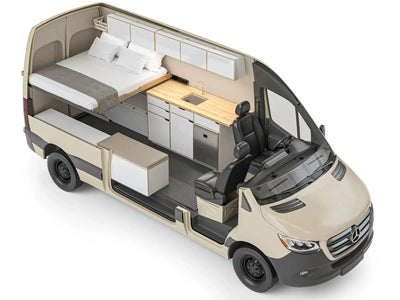
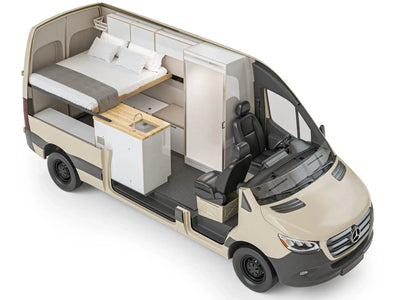
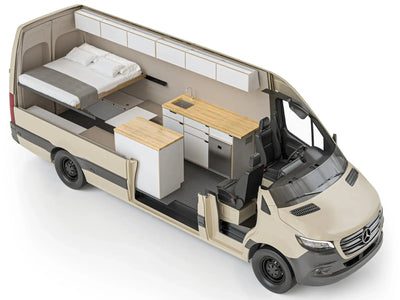
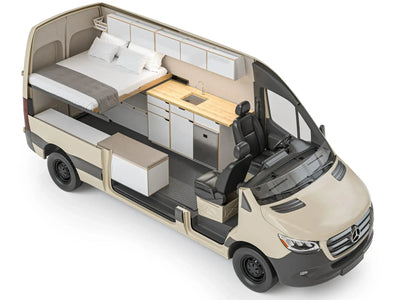
The sprinter 144 vs 170 camper choice comes down to about 40 inches of total length, with the 144 at roughly 234 inches and the 170 at roughly 274 inches. That gap sounds small on paper, but it changes how the van parks, how the layout works, and how much compromise you feel once a real bed, galley, water, and storage go in. In our shop, the 144 is usually the better fit for couples who want easier daily use. The 170 earns its size when you want fixed living zones, more gear space, or a family-ready layout.
Sprinter 144 vs 170 camper: the decision in one glance
 For 2026 buyers, the key cargo wheelbases are 144.0 inches and 170.0 inches, according to Car and Driver's 2026 Sprinter specs. That sounds like a simple wheelbase choice, but most people feel the difference in the full body length. The 144 comes in at about 234.0 inches overall, while the 170 stretches to about 274.0 inches.
That means you're not just picking a number. You're picking how the van behaves at the grocery store, on a ski-town side street, and at a trailhead lot with tight turns. In our Boulder shop, this is one of the first big calls we help people make because it shapes almost every layout choice that follows.
Price muddies the picture a bit. The public Mercedes-Benz Sprinter cargo van page shows visible starting MSRPs like $50,830, $53,680, $54,380, and $57,230, depending on configuration. So you can't assume wheelbase alone sets the cost.
The short version is simple. Pick the 144 if daily drivability and easier parking sit at the top of your list. Pick the 170 if you already know you want more dedicated living zones and fewer interior trade-offs, then explore Sprinter conversions that match that goal.
| Factor | Sprinter 144 | Sprinter 170 |
|---|---|---|
| Overall length | About 234 inches | About 274 inches |
| Parking and maneuvering | Easier in town and tighter lots | Needs more planning and wider swings |
| Garage practicality | Length helps a bit, but height is still the big issue | Harder on length, height still the big issue |
| Layout and sleeping flexibility | Best for compact two-person builds | Better for fixed beds and family layouts |
| Price and resale outlook | Can keep total project spend tighter | Usually costs more, may sell for more dollars later |
Best-fit buyer profiles
A 144-inch Sprinter usually fits a solo traveler or couple who wants a more city-friendly footprint. It works best when you're fine with a tighter plan and don't mind spaces doing double duty. A bench may become seating by day and part of the sleep setup by night, and that can be a smart trade if compact size matters most.
The 170 is the easier fit for buyers who want a fixed bed plus a fuller galley and more storage without crowding every aisle. That's a big reason many people looking at vans for couples start with the 144, while buyers thinking about bigger sleep setups drift toward longer layouts. You simply have more room to let each zone stay what it is.
For family travel, the volume jump is hard to ignore. Caldwell Mercedes-Benz's dimensions summary lists 170 high-roof cargo volume at 430 to 488 cubic feet, versus 281 to 374 cubic feet for the 144 high roof. That extra space makes it much easier to fit more sleeping spots and still leave room to move around.
Our 2026 lineup reflects that split in real life. The Sprinter Duo starts at $115,950, while the Sprinter Family starts at $120,950. Once buyers add kid sleeping, more gear storage, and a cleaner family flow, they usually end up looking at larger layouts like the Family XL layout or our broader family vans collection.
We've also seen a clear pattern in how people travel. Buyers who move camp often, park in towns, or use the van part-time as a daily driver tend to be happier when they size for maneuverability first. Buyers planning longer trips or gear-heavy travel often regret going small if they didn't account for how fast beds, cabinets, and storage eat up floor space.
What the article should help the reader decide
This choice is worth slowing down for because changing wheelbase later isn't a simple upgrade. If you buy the wrong shell, you're usually starting over with a different van. That's why this decision has real cost behind it.
It also helps to look at what is actually available now, not just what sounds best in theory. The Mercedes build and customize tool shows how roof, drivetrain, and body choices interact in the current lineup. Real shopping is configuration-based, not wheelbase-only.
Garage talk gets tricky too. Car and Driver lists overall height across configurations in a broad 96.0 to 111.0-inch range, so many Sprinters are too tall for a home garage no matter which wheelbase you pick. In other words, length fit and height fit are two different questions.
The right answer usually comes from your habits, not your dream mood board. Think about how many people sleep inside, how often you cook indoors, how much gear you carry, and how much parking stress you can live with. If you want help turning that into a real plan, our Customize your van page is a good next step.
Length, turning, and where each Sprinter actually fits
 The raw numbers tell the story fast. The 144 is about 234.0 inches long, and the 170 is about 274.0 inches long, based on Car and Driver's published dimensions. That's about 3 feet 4 inches more van to place in the world every day.
Width is not the main issue here. Both versions are listed at 80.0 inches wide, so most of the daily difference comes from length and roof height, not side-to-side bulk. That's why two vans can feel so different in use even though they share the same basic body width.
If you're checking a driveway, parking pad, or storage spot, use the Mercedes upfitter drawings for exact fit planning. Editorial specs often round numbers, and those rounded numbers don't help much when your gate post or retaining wall is the real limit. Exact body packaging and overhang matter.
In shop conversations, buyers who spend time in cities, ski-town lots, or crowded trailhead parking notice the 170's size every day. The 144 tends to feel easier as a dual-purpose vehicle. Still, every inch you save outside is an inch you lose inside once insulation, wall panels, cabinetry, and a bed platform go in.
Parking and maneuverability
The 170 is nearly 23 feet long. The 144 is about 19.5 feet long. That gap is big enough to change your parking strategy in normal urban spaces, even before you add a rear box, bike rack, or extra caution about backing in.
We've found that 170 owners usually plan ahead more at fuel stations, grocery lots, and older campgrounds. The van works well, but it asks more from you. Wide swings and longer pull-through choices become part of the routine.
By contrast, the 144 tends to feel less committing in town. Owners are more likely to grab it for a day trip, dinner run, or quick errand because it doesn't feel quite as big in daily life. That quality matters more than people expect, and it often shapes how often the van gets used.
The current Mercedes build tool helps here too because it keeps the comparison grounded in real cargo configurations. It's easy to compare an idealized long van to a short van that is actually easier to source. If you're still sorting through those trade-offs, our process page shows how we help narrow the right platform before the build starts.
Garage and storage reality
A lot of people assume the 144 will solve garage storage. Often, it won't. Car and Driver lists the 2026 Sprinter's height range at 96.0 to 111.0 inches depending on setup, which means height is usually the first problem, not wheelbase.
That makes garage fit a roof-height issue before it's a length issue. And in our experience, about 90 percent of customers choose high roof because stand-up comfort is so worth it. Most mid-roof buyers later add a pop-top, which tells you where the real demand sits.
Roof accessories tighten the margin even more. Fans, racks, solar, and air-conditioning units can all eat into clearance. So if home storage is a hard requirement, verify the chassis height and the planned rooftop additions before you commit.
For many owners, driveway fit and neighborhood parking become more relevant than true garage fit once the build becomes a high-roof camper. That's one reason we point people back to exact upfitter drawings early. Guessing here gets expensive fast.
Interior space: fixed bed, gear, and sleeping capacity
 This is where the 170 starts making a very strong case. Caldwell's April 2026 summary lists 144 high-roof cargo volume at 281 to 374 cubic feet, while the 170 high roof jumps to 430 to 488 cubic feet. That's a major gain in usable interior volume.
That volume gap is the clearest spec-based reason people move up. More room means you can dedicate space to sleeping, storage, and circulation instead of making one area do three jobs. It also gives the build more breathing room once real systems go in.
Roof choice matters a lot too. Caldwell also lists 144 standard-roof volume at 223 to 319 cubic feet, which is a good reminder that stand-up space changes the feel of a camper almost as much as wheelbase does. In our shop, high roof is the clear favorite for that reason.
Still, a 144 can work very well for two people if the layout is disciplined. The bigger point is that sleeping capacity is really about layout flexibility. It's not just about how many bodies can technically fit inside.
Why the 144 works for many couples
A 144 high roof still gives you 281 to 374 cubic feet of cargo volume, based on Caldwell's 2026 interior dimensions summary. That's enough for a well-designed two-person camper if the plan is intentional. You don't need a giant shell to make a refined van for two.
Our Sprinter Duo starts at $115,950, which gives a real example of how a compact couples build can still feel polished and complete. Many couples looking at the DUO XL layout want exactly that balance. They want comfort, but they don't want a van that feels oversized every time they park it.
In practice, the main compromise in a 144 isn't whether a bed fits. It's how much open floor area and storage remain after the bed, kitchen, batteries, and water system are installed. One thing a lot of builders overlook is how quickly the nice empty shell stops feeling roomy once the real parts go in.
So the 144 tends to shine for travelers who pack light, cook simply, and spend most of their time outdoors. That's not a lesser choice. It's a deliberate one, and for many couples it's the sweet spot.
Why the 170 makes family and fixed-layout builds easier
The 170 high roof's 430 to 488 cubic feet of cargo volume gives it a big packaging edge. That extra room makes fixed sleeping zones and longer storage runs much easier to pull off cleanly. You don't have to force every cabinet and aisle into the same small footprint.
Our Sprinter Family starts at $120,950, which is a useful benchmark for buyers thinking about more sleeping function. Once you add kids, dogs, or bulkier four-season gear, the longer shell gets more forgiving. The van can stay functional without feeling over-programmed.
This also matters for buyers who want a permanent bed, a fuller galley, and real gear storage at the same time. The 170 simply gives you more freedom to combine those wants without squeezing circulation space too hard. If you're comparing layouts, our Foundation builds and larger family options show how that extra length gets used in practice.
Dealer summaries usually list cargo-van seating at just 2 to 3 from the factory, so added sleeping capacity in camper use comes from the conversion design, not stock seating alone. That's why family sleeping, indoor showers, and separate kid bunks usually push the conversation toward the 170. It becomes the less compromised platform pretty quickly.
2026 price difference: van cost, build cost, and where money actually goes
Price is one of the biggest reasons this decision gets messy. The public 2026 Mercedes cargo page shows starting prices from $50,830 up to $57,230 across visible configurations. That tells you right away that drivetrain, roof, output, and body setup all shape the number.
So if someone says the 170 costs exactly a fixed amount more than the 144, take that with caution. A like-for-like comparison only works if roof, drivetrain, and equipment are the same. Real shopping rarely stays that clean.
The bigger cost issue is what happens after you buy the chassis. A longer van often invites a bigger build scope, more cabinetry, larger storage systems, and more amenities. In other words, the total project can grow well beyond the base-van price gap.
Our 2026 pricing helps make that real. The Sprinter Duo starts at $115,950, and the Sprinter Family starts at $120,950, with semi-custom builds typically taking 8 to 10 weeks. If you're thinking through timing and scope, you can also start with contacting our team before every layout detail is locked in.
How much more does a 170 cost?
The official Mercedes cargo page shows MSRP entry points like $50,830, $53,680, $54,380, and $57,230, but those numbers reflect different configurations. They are not a clean wheelbase-only ladder. That's why this question needs a little more care than most buyers expect.
The right way to compare is to line up two specific vans with the same roof, drivetrain, and key equipment. Then you can see the real chassis premium. Until then, the spread is too tied to package choices to treat as a fixed rule.
From a build-planning view, the 170 often ends up costing more because owners tend to fill the extra space. Bigger platform, bigger expectations. If you're stretching hard just to reach the 170 chassis, it's smart to budget for the strong chance that the interior scope grows too.
On the other hand, a 144 can keep both footprint and overall spend tighter if you're disciplined about amenities. So this isn't just a size decision. It's a budgeting decision too.
Using The Vansmith as a real-world benchmark
One helpful thing about using real builder pricing is that it pulls the conversation out of theory. As of 2026, our Sprinter Duo starts at $115,950 and our Sprinter Family starts at $120,950. That gives you a grounded way to see how space needs influence finished camper pricing.
Semi-custom builds usually take 8 to 10 weeks, which matters if you're trying to decide whether to buy a chassis now or hold out for the perfect spec. Some buyers also choose ready-to-drive Bivy models because they want a faster path to ownership. Timing is part of the value equation too.
Build quality matters more once you've committed to the right wheelbase. We carry a 4.8-star Google rating across 85-plus reviews and back our cabinetry with a lifetime warranty, which is one reason many buyers prefer to get the platform choice right before the interior plan goes deep. If you want to keep researching first, our van build blog and DIY blog both help frame the next steps.
The key takeaway is simple. You don't need to solve every cabinet and finish detail before you talk with a builder. But you do need to choose the right wheelbase, because that call drives the rest of the design.
Resale, regret, and which wheelbase owners are happier with later
Used-market data gives some helpful context, but it doesn't settle the choice on its own. The Kelley Blue Book 2023 Sprinter values page, viewed in 2026, shows examples around $41,000 for 144 standard roof, about $41,000 for 144 high roof, about $47,500 for 170 high roof, and about $48,500 for 170 extended high roof. So the market is currently paying more in absolute dollars for longer high-roof vans.
That does not prove the 170 keeps a better percentage of its original value. It just shows that longer versions are selling higher in raw dollars. That's a useful distinction, and it's worth keeping the claim modest.
Broader platform strength helps both vans. J.D. Power's 2026 ALG Residual Value Awards named the Sprinter the top model in the Commercial Van segment, and NADA Market Beat adds context for how broader supply and demand can affect timing. In short, Sprinters have solid residual-value credibility, but market conditions still move around.
In our experience, the more useful long-term question is this: what annoyance can you live with better, interior compromise or exterior bulk? That's where regret tends to show up. And that's usually what separates happy owners from people who wish they'd chosen differently.
What resale data actually supports
KBB's spread between roughly $41,000 for 144 versions shown and about $47,500 for a 170 high roof supports one safe claim. Longer, high-roof Sprinters command more money in the used market. They offer more utility and appeal to more upfit use cases, so buyers often pay more for them.
What the data does not support is a blanket statement that one wheelbase is always the better investment. These are absolute-dollar examples, not percentage-retention calculations. That's why it's smarter to treat resale as a supporting factor, not the whole decision.
J.D. Power's 2026 award strengthens the broader point that the Sprinter badge itself carries value well in the commercial-van world. NADA's reporting is a good reminder that market timing still matters. So the safest read is this: both wheelbases benefit from Sprinter demand, but the 170 may recover more dollars later simply because it starts and sells higher.
The regret patterns The Vansmith sees
We see a clear pattern with happy 144 owners. They usually travel as a couple, pack with intention, and value drivability enough that they use the van more often. Ease of use keeps the van in motion, and that matters more than a few extra cabinets.
The most common 144 regret is running out of room once the build becomes real. Insulation, cabinetry, water, batteries, and gear eat space fast. People who thought they were fine with compact living sometimes change their tune once they want a fixed bed and real storage at the same time.
The most common 170 regret is almost never about the interior. It's about parking, turning around in tight places, and feeling less spontaneous about everyday trips. People love the space, but they notice the bulk.
So here's the plain rule we come back to in the shop. If you fear cramped living more than difficult parking, buy the 170. If you fear difficult parking more than a tighter interior, buy the 144.
FAQ
Which is better for a camper conversion: Sprinter 144 or 170?
For most couples, the 144 is the better choice if daily drivability and easier parking matter most. The 170 is better if you want more dedicated living space and fewer layout compromises. Car and Driver lists the 2026 Sprinter at about 234.0 inches long in 144 form and 274.0 inches in 170 form, while Caldwell lists 144 high-roof cargo volume at 281 to 374 cubic feet versus 430 to 488 cubic feet for the 170 high roof.
Is a Sprinter 170 too long for everyday driving?
Not always, but it is a real trade-off. At roughly 274.0 inches overall, the 170 is about 40 inches longer than the 144, so it asks for more planning in parking lots, fuel stations, and urban street parking. If you use the van often in town, that daily friction can matter as much as the extra interior room.
Does a Sprinter 144 fit in a residential garage?
Often no, because height is usually the bigger issue than wheelbase. Car and Driver lists the 2026 Sprinter's height range at 96.0 to 111.0 inches depending on configuration, and roof accessories can reduce clearance even more. A 144 may help on length, but it does not guarantee garage fit.
How much more interior room does a Sprinter 170 have than a 144?
A lot more, especially in high-roof form. Caldwell's April 2026 dimensions summary lists the 144 high roof at 281 to 374 cubic feet and the 170 high roof at 430 to 488 cubic feet. That extra volume is why the 170 is easier to design around fixed beds, larger storage, and family sleeping.
Does the Sprinter 170 have better resale than the 144?
The safest claim is that longer high-roof Sprinters currently sell for more in absolute dollars, not that they always retain a better percentage. KBB's 2023 values page shows examples around $41,000 for 144 versions and about $47,500 for a 170 high roof, while J.D. Power's 2026 ALG awards named the Sprinter the top model in the Commercial Van segment overall. That suggests strong platform demand across both wheelbases.
About the author

Eugene Smit
CEO
Eugene is the CEO of The Vansmith, based in Boulder, Colorado. He writes across topics related to van builds, ownership, and the camper van industry.
Read more about Eugene