
DUO

Mercedes Sprinter 144
OR
Ford Transit 148

Perfect for solo travelers or couples who want a compact adventure-ready van.
Seat & Sleeps
2Length
19'Shower
Exterior * * Optional Add-OnsClass B RVs, Conversion Vans & Campervans for Sale in Medford, OR
Mercedes Sprinter 144
OR
Ford Transit 148
Perfect for solo travelers or couples who want a compact adventure-ready van.
Seat & Sleeps
2Length
19'Shower
Exterior * * Optional Add-Ons
Mercedes Sprinter 144
OR
Ford Transit 148

Includes a shower setup for longer trips without compromising comfort or space.
Seat & Sleeps
2Length
19'Shower
Bench * * Optional Add-Ons
Mercedes Sprinter 170
OR
Ford Transit 148 E

Ideal for those who want extra living space and more storage for extended adventures.
Seat & Sleeps
2Length
22'Shower
Full
Mercedes Sprinter 170
OR
Ford Transit 148 E

Luxury model with full amenities, extended power systems, and interior bathroom.
Seat & Sleeps
2Length
22'Shower
Full
Mercedes Sprinter 144
OR
Ford Transit 148

Perfect for families who want space, comfort, and functionality in a compact build.
Seat & Sleeps
4Length
19'Shower
Exterior * * Optional Add-Ons
Mercedes Sprinter 170
OR
Ford Transit 148 E

A larger build for families who love extended adventures and more storage.
Seat & Sleeps
4Length
22'Shower
Bench * * Optional Add-Ons
Mercedes Sprinter 170
OR
Ford Transit 148 E

The luxury upgrade with interior shower and full power systems for long trips.
Seat & Sleeps
4Length
22'Shower
Full
Medford sits in the Rogue Valley, with Crater Lake two hours northeast, the Oregon coast two and a half hours west, Oregon Caves an hour and a half southwest, and the Rogue River-Siskiyou National Forest in every direction. It is one of the better van bases on the West Coast, and it comes with two conditions that should shape your van's specifications.
The first is heat. The Rogue Valley is one of the hottest parts of Oregon, with summer afternoons regularly reaching the 90s and sometimes triple digits. Although the heat is dry, air conditioning and a battery system capable of running it can make a real difference when staying at campsites without hookups in July.
The second is wildfire and smoke. Southern Oregon can experience severe late-summer smoke, and the Almeda Fire in 2020 demonstrated how quickly fire can move through the valley. Planning for camper van ownership here means understanding fire restrictions, preparing for smoky conditions, and knowing the limits of a vehicle as shelter. A camper van may offer a place to get away from smoke temporarily, but it is never a safe place to shelter from an approaching wildfire.
The Vansmith builds Mercedes-Benz Sprinter and Ford Transit camper vans in Boulder, Colorado, and delivers across Oregon. Conversion packages start at $46,950, complete vans with the chassis included start at $115,950, and pre-built Bivy models range from $119,700 to $192,570. For the statewide picture, explore
camper vans in Oregon.
The defining feature for a Rogue Valley camper van. Air conditioning is available on every build and standard on the Bivy Deluxe. Valley afternoons can reach the high 90s and above, and while nights cool down more than they do in the humid South, the van can still retain substantial heat while parked. Air conditioning is the largest electrical draw in any van, so overnight use without hookups requires a battery bank sized for it. Camping at elevation in the Cascades or Siskiyous is another option, as temperatures can be considerably cooler a few thousand feet above the valley.
A fuel-fired air heater drawing from the vehicle's own fuel tank, plus full insulation on all six sides. The Rogue Valley has mild, wet winters, but Crater Lake sits above 6,000 feet, and camping in the Cascades and Siskiyous can bring genuinely cold nights even in summer. The heater draws very little power from the house battery. Insulation also slows heat gain during August's hot afternoons. Our heater service page covers the systems we install.
A powered roof fan with variable speed and reversible direction, supported by airflow paths behind the cabinetry. In summer, moving dry air through the van can make a meaningful difference to comfort. During the valley's damp, foggy winter periods, ventilation helps manage indoor moisture and reduce condensation behind cabinets. During wildfire smoke events, keep the van closed and avoid drawing smoky outdoor air inside. Use suitable recirculation and filtration where available, and follow local air-quality guidance.
Lithium battery banks sized around your real overnight load, with capacity up to 15 kWh in the Bivy Deluxe, plus roof solar and DC-DC alternator charging. Southern Oregon receives excellent summer sun, although winter in the valley can be gray, and wildfire smoke can reduce solar output when cooling or other electrical systems may still be needed. Size the system around realistic seasonal conditions rather than ideal clear-sky performance. Explore our Electrical System and solar installation services.
Fresh and gray water tanks sized to your layout, a pressurized pump, and accessible drain points. Plan water capacity around longer stays in remote forest campsites, where refill facilities may not be available. Hot, dry weather can increase water use, so consider your expected trip length and daily needs. Drain and winterize the system when freezing temperatures are forecast in the Rogue Valley or at higher elevations.
Battery capacity, water storage, suitable ground clearance and tires, and the ability to keep the cabin closed during smoky conditions all matter for trips around southern Oregon. Many rewarding campsites are reached by forest roads with limited services and no reliable cell coverage. Choose equipment around the roads you plan to travel, the time you expect to spend off-grid, and the conditions you may encounter during wildfire season.
| Specification | What We Build | Why It Matters in Medford |
|---|---|---|
| Base Vehicle | Mercedes-Benz Sprinter or Ford Transit, supplied by you or included in a complete vehicle. | The Transit is cheaper to buy and service in the valley; the Sprinter's 4x4 suits Siskiyou forest roads. |
| Wheelbase and Dimensions | Approximately 19.5 ft on the short wheelbase or 22.5 ft extended, with a high-roof height of 9 to 10 ft. | The shorter van suits the winding road to Oregon Caves, Crater Lake's Rim Drive, and forest spurs. |
| Sleeping Capacity | Two on a fixed bed in the DUO Series, or four with convertible seating in the FAMILY Series. | Sleeping capacity determines the layout, and a fixed bed leaves a gear garage for river and bike equipment. |
| Air Conditioning | Available on every build and standard on the Bivy Deluxe. | Air conditioning makes the van more comfortable during hot Rogue Valley afternoons in July and August. |
| Insulation | Full insulation on all six sides; Havelock wool in pre-built Bivy models. | Slows heat gain while parked in valley heat and helps retain warmth on cold Cascade nights. |
| Ventilation | A powered roof fan with variable speed and reversible direction, with airflow behind cabinetry. | Airflow supports cooling in dry heat. During wildfire smoke events, keeping the van closed and limiting outside air intake can help reduce smoke entering the cabin. |
| Heating System | A fuel-fired air heater running off the vehicle's own fuel tank. | Crater Lake and the high Siskiyous can be cold at night year-round, and the valley can experience hard freezes. |
| House Battery | A lithium battery bank sized around your actual overnight power needs, with capacity up to 15 kWh. | Overnight air conditioning determines much of the required capacity, while wildfire smoke can reduce the solar energy available for recharging. |
| Solar Charging | A roof solar array sized to your layout and daily energy use. | Solar performs well in summer sun, but heavy wildfire smoke and gray winter weather can reduce output. |
| Alternator Charging | A DC-DC charger on every build. | Helps replenish the house battery during smoky periods, cloudy weeks, and drives between campsites. |
| Fresh Water | Tanks sized to your layout, with a pressurized pump and accessible drain points. | Hot, dry weather can increase water consumption, and dispersed forest campsites may not have refill facilities. |
| Wastewater | A gray water tank matched to fresh-water capacity, with accessible drains. | Some Oregon state parks provide dump stations, while dispersed national forest campsites generally do not. |
| Refrigeration | A 12V compressor refrigerator that runs on battery power alone. | It requires no propane or level-parking setup and helps maintain food temperatures in a hot van. |
| Electrical Monitoring | A battery monitor that shows actual state of charge rather than relying on voltage alone. | Accurate monitoring is important when running cooling overnight while solar production is reduced. |
| Payload | The chassis payload rating is evaluated against your realistic loaded weight during the design call. | Fresh water, a large battery bank, and camping equipment all contribute to the vehicle's total loaded weight. |
| Tires and Brakes | Tires and brakes selected around your planned routes, with all-terrain and winter tire options available. | Cascade passes can have winter chain requirements, and gravel forest roads can be hard on tire sidewalls. |
| Ground Clearance | Ground clearance depends on chassis, trim, and drivetrain, with suspension and tire upgrades available. | Clearance helps determine which Rogue River-Siskiyou forest roads and dispersed campsites are accessible. |
| Suspension | Suspension setup matched to your load and routes, with upgrades available. | Washboarded forest roads can place additional demands on shocks, bushings, and exhaust hangers. |
| Warranty | A lifetime cabinetry warranty for the original owner, with no mileage or year limit. | Appliance warranties are provided by their respective manufacturers, and The Vansmith is NOAH certified. |
Exact figures for payload, ground clearance, tire sizing, and vehicle dimensions depend on the chassis, trim, and drivetrain you choose. The Vansmith confirms each specification against your selected van during the design call.
A Class B RV is a camper built inside a van body rather than on a truck chassis. Around Medford, that matters for specific roads: the highway up to Oregon Caves is narrow and winding with length advisories, Crater Lake's Rim Drive is best in a modest vehicle, and forest road camping needs something that can turn around. The Vansmith offers nine tailored layouts plus three pre-built Bivy trims. Browse tailored models and our Class B RVs for sale.
The Sprinter offers all-wheel drive and 4x4, which is the stronger choice for Siskiyou forest roads and winter access to the Cascades. The Transit costs less to buy and service, with all-wheel drive on current model years and good dealer coverage in the valley. See Sprinter van conversions, Ford Transit van conversions, and our Sprinter vs. Transit comparison.
DUO starts at $46,950, DUO S at $53,950, DUO XLS at $63,950, and DUO XL is available on request. FAMILY starts at $51,950, FAMILY XL at $61,950, and FAMILY XLS at $68,950. Complete vehicles start at $115,950. Bivy Classic is $119,700, Bivy Plus is $145,845, Bivy Deluxe is $192,570, and Bivy XL starts at $153,700. Our full current stock, including inspected used vans, is on the camper vans for sale page.
Medford is about 1,250 miles from Boulder, Colorado, with delivery quoted as part of the purchase. Some buyers fly to Denver and drive the van home across the Great Basin, making the collection trip a useful shakedown journey.
Four two-person layouts with a fixed bed and the largest gear garage relative to length. See camper vans for couples.
Three four-person layouts with convertible seating and sleeping. See family van conversions.
Bivy Classic costs $119,700 with a 5 kWh system. Bivy Plus costs $145,845 with 10 kWh, a diesel cabin heater, and an exterior shower. Bivy Deluxe costs $192,570 with 15 kWh, air conditioning, and a Rixen hydronic heater. Bivy XL starts at $153,700. All are based on the Sprinter 144 AWD with a pop-top and Havelock wool insulation, and are typically ready in 8 to 10 weeks. See the Bivy comparison. For the Rogue Valley, the Deluxe is worth considering because air conditioning paired with a 15 kWh battery bank can support overnight cooling without hookups, depending on actual power use and conditions.
The DUO Series sleeps two on a fixed bed, the FAMILY Series sleeps four with convertible seating, and Bivy models accommodate two below plus two in the pop-top. Use the van designer to compare configurations.
Every build includes a lithium bank, roof solar, DC-DC charging, shore power, an inverter, a battery monitor, a fuel-fired heater, a powered roof fan, a 12V compressor fridge, and fresh- and gray-water tanks. Air conditioning, additional solar, larger battery banks, suspension and all-terrain tire packages, exterior showers, awnings, and racks are priced individually. See repairs, installations and services.
Most trips from Medford are one to three nights: the Applegate, the upper Rogue, the Siskiyous, or the coast. A van that loads quickly and parks easily often gets used more than one selected for maximum capacity alone.
The DUO Series is designed for two people with maximum gear storage, while the FAMILY Series accommodates four with convertible seating and sleeping.
A gear garage beneath the bed with rear-door access and a drain, plus roof and hitch racks, can help organize equipment. For rafting and fishing on the Rogue, the drain is especially useful for wet gear.
Water, gray-water, and battery capacity determine how long you can stay out. Rogue River-Siskiyou National Forest allows dispersed camping in permitted areas, subject to stay limits and without facilities or water at many sites. Self-sufficiency rather than campground availability is what extends a trip. Fire restrictions can override those plans during a dry summer.
If your camping involves rough Siskiyou forest roads and winter Cascade access, the 4x4 Sprinter is a capable option. If you mostly visit developed campgrounds, the coast, and maintained gravel roads, the Transit can do the job for less money and lower servicing costs. Many buyers will find an all-wheel-drive Transit with suitable tires a practical choice.
Decide how many people will sleep in the van and whether you want a bed that is always made. The DUO Series sleeps two on a fixed bed, while the FAMILY Series sleeps four with convertible seating. A fixed bed leaves a usable gear garage beneath it; a convertible layout provides more daytime space in the same length.
Check what is standard rather than comparing headline prices alone. The Vansmith's builds include electrical, water, heating, and ventilation systems as standard, while air conditioning, solar capacity, battery upgrades, suspension, and tires may be priced individually. Ask for an itemized quote for your selected configuration.
Plan around your actual overnight power consumption rather than a brochure figure. For southern Oregon, the question that most affects the electrical specification is whether you want air conditioning overnight without campground hookups.
Conversion packages range from $46,950 to $68,950, complete vehicles start at $115,950, and Bivy models range from $119,700 to $192,570, with Bivy XL starting at $153,700. Budget separately for fuel, insurance, registration, servicing, and tires. Oregon has no general sales tax, which is a meaningful consideration for a vehicle at this price.
Coastal trips and developed campgrounds may suit a two-wheel-drive or all-wheel-drive short van. Forest road camping and winter Cascade access may justify 4x4, greater clearance, and suitable tires. Summer travel on the valley floor can make battery capacity and cooling a priority. Choose equipment around the two or three activities you expect to do most often.
About two hours northeast, Crater Lake is the deepest lake in the United States, situated in a caldera above 6,000 feet. Plan around seasonal access: the park receives heavy snowfall, and Rim Drive and the north entrance are closed for much of the year, typically opening from July into October depending on conditions. Mazama Campground is seasonal and has site-size limits, so check availability and vehicle requirements before traveling. The south entrance generally provides access to the rim in winter, although road conditions and closures can change.
The Rogue River starts close to town and offers fishing, whitewater, the Hellgate canyon section, the Rogue River Trail, and campgrounds along the river. The Applegate Valley has wineries, Applegate Reservoir, and quieter forest camping, all within about an hour of Medford.
Expect a drive of roughly two and a half hours west, depending on the route and destination. Gold Beach, Port Orford, Bandon, and the Samuel H. Boardman corridor offer access to some of Oregon's most dramatic coastline. Oregon state park campgrounds along Highway 101 are popular and can book out well in advance for summer. Plan for fog and wind, and check local restrictions before considering any beach access, since driving on beaches is restricted or prohibited in many areas.
About an hour and a half southwest, above Cave Junction, Oregon Caves National Monument features a marble cave with ranger-led tours and a historic chateau. The access road, Highway 46, is narrow and steep with sharp curves and length advisories for larger vehicles. A short-wheelbase van can be easier to maneuver on this route than a long motorhome. Check current road conditions and vehicle guidance before departure.
About half an hour southeast past Ashland, Cascade-Siskiyou National Monument is where three ecoregions meet, creating high biodiversity and varied landscapes. Dispersed camping may be available on public land where permitted, along with quiet forest roads. Check the rules for the specific area and current fire restrictions before setting out.
Oregon state park campgrounds operate on different schedules, with many busier sites seeing heavy demand during summer. Coastal parks can book out months ahead. Cascade roads and Crater Lake's Rim Drive are seasonal, and mountain passes may require chains in winter. Wildfire restrictions are another important seasonal factor: late-summer rules may prohibit campfires, close forest roads, or suspend dispersed camping, sometimes at short notice. Check the Rogue River-Siskiyou National Forest and Oregon Department of Forestry notices before departure.
Park in shade, use insulated window covers during the day rather than only at night, run the roof fan continuously, and use air conditioning when needed. In dry heat, moving air can be more effective than it is in a humid climate, so the fan does a lot of work. Camping at elevation is another option: the Cascades and Siskiyous are generally cooler at night than the valley floor.
Treat wildfire planning as part of every summer trip. Restrictions can prohibit campfires and some stoves, close forest roads, suspend dispersed camping, or close entire recreation areas. Check current restrictions before leaving. Heavy smoke is both a health concern and a solar-output concern. A van with windows closed, the fan off, and air recirculated can offer some refuge from smoke, especially with suitable filtration, but it is not a safe refuge from fire itself. If a fire threatens your area, evacuate early using the route directed by authorities. The 2020 Almeda Fire demonstrated how quickly wildfire can spread through the Rogue Valley.
Cascade and Siskiyou roads can close for snow, reopen with icy sections, or require chains. Forest roads may also close seasonally or after storms. Check current conditions before traveling, particularly to Crater Lake, where Rim Drive's status can determine the entire trip.
In clear summer weather, roof solar and DC-DC charging can help sustain off-grid travel for as long as your water supply allows, depending on your power use. During smoky conditions or gray winter weather, battery capacity and driving time become more important. A battery monitor that shows actual state of charge helps you manage cooling based on available energy rather than guesswork.
Medford, Grants Pass, Ashland, and Cave Junction are useful resupply points. Beyond them, plan for limited water, fuel, and cell coverage. Carry extra water during hot weather and prepare for smoke conditions. Particulate-filtering masks can be useful during periods of poor air quality.
If your plans regularly involve rough forest roads, consider a 4x4 vehicle with suitable ground clearance, all-terrain tires, and suspension matched to the loaded van. See 4x4 RVs for sale. For many buyers, all-wheel drive and suitable tires may offer better value, leaving more budget for battery capacity and cooling.
Conversion packages range from $46,950 to $68,950, complete vehicles start at $115,950, and Bivy models range from $119,700 to $192,570, with Bivy XL starting at $153,700. The electrical, water, heating, and ventilation systems described above are included according to the selected model and configuration. Confirm the final equipment list in your quote.
Oregon has no general sales tax, which can be a meaningful saving on a vehicle at this price. Camper van registration and insurance requirements can differ from those for a standard cargo van. NOAH certification may be relevant to some insurers and lenders, but requirements vary, so confirm what your provider needs before purchase. Use our RV loan calculator and read how to finance a camper van conversion.
A shorter van with less frontal area may use less fuel, depending on its engine, drivetrain, load, and driving conditions. Chassis servicing follows the manufacturer's schedule, with dealer coverage available in the Medford area for both platforms. Confirm service availability for your chosen model and drivetrain.
Inspect tires for age as well as tread depth, since southern Oregon's sun and heat can age rubber. Keep the battery bank within the manufacturer's recommended temperature and charge ranges, and check terminals and connections as advised. After heavy smoke or ashfall, inspect and clean solar panels according to the manufacturer's instructions to help maintain output.
Oregon state park campsites are a useful option for developed facilities and should be booked early for popular dates. Dispersed camping on national forest land may be free where permitted, making self-sufficiency worthwhile, but stay limits, seasonal closures, and fire restrictions still apply.
See camper vans for sale, tailored models, and inspected used vans. Use the van designer and the Bivy comparison to review layouts and features.
Every option is priced individually, so the quote can itemize your selected equipment and configuration. Confirm the final scope, included features, and total price before placing your order.
Design calls over video and build photos throughout the process help remote buyers follow progress. The stated payment schedule is a $2,500 design deposit, 50% at design approval, 25% at build launch, and 25% at handover. Review our process and confirm current payment terms with the team.
Medford is about 1,250 miles from Boulder, Colorado. Delivery is quoted as part of the purchase, or you can fly to Denver and drive the van home. Confirm the final transport arrangements and costs for your order.
Transport is quoted with the purchase. Tailored builds typically take 12 to 16 weeks, while pre-built Bivy models are generally ready in 8 to 10 weeks. Chassis availability, particularly for all-wheel-drive and 4x4 models, can affect the timeline.
The Vansmith provides a lifetime cabinetry warranty to the original owner, with no mileage or year limit. Service and upgrade work is available through the Boulder shop. Appliance warranties are provided by their respective manufacturers.
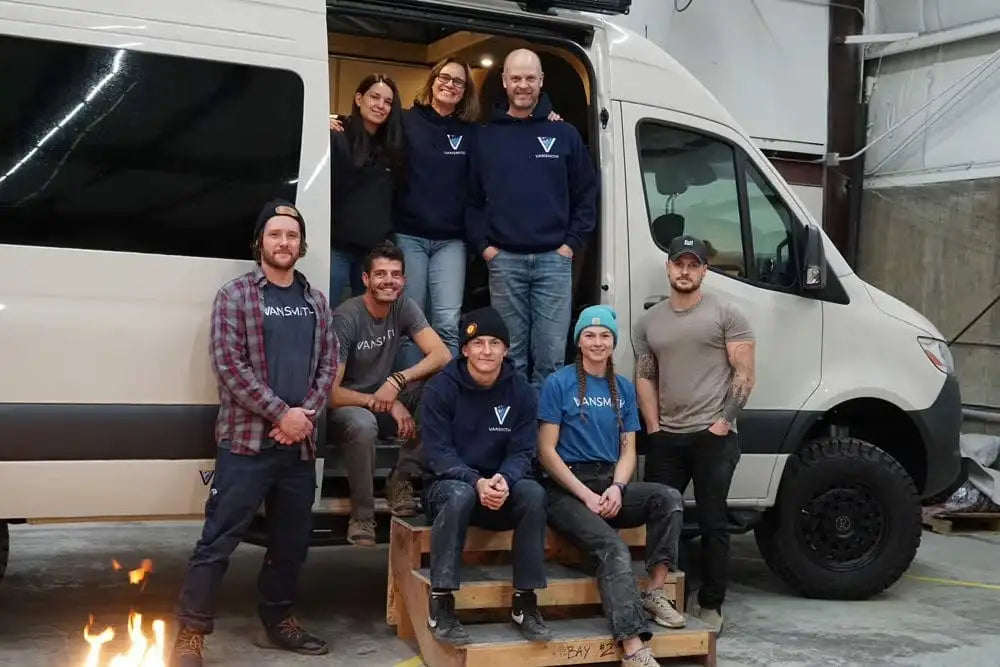
The Vansmith has been family-owned since 2016 and has built more than 300 vans across both platforms and multiple wheelbases.
Nine tailored layouts plus three pre-built Bivy trims offer options for different sleeping arrangements, storage needs, and travel styles.
Lithium battery storage, solar, DC-DC charging, shore power, inverter capacity, and monitoring are designed as an integrated system. In a region where smoke season can reduce solar output just when cooling demand peaks, an appropriately specified system helps keep the van usable away from hookups.
The Vansmith crafts camper vans in Boulder, Colorado, where outdoor travel, mountain roads, and changing weather are familiar considerations. That experience informs planning for electrical systems, insulation, ventilation, storage, and vehicle specifications.
The Vansmith offers a lifetime cabinetry warranty to the original owner, plus service and upgrade work at the Boulder shop. Contact the team for current customer reviews, service availability, and support options for your selected vehicle.
See camper vans for sale, tailored models, and inspected used vans.
Use the van designer and the Bivy comparison to compare configurations, equipment, and available models.
Current stock is listed on the camper vans for sale page. Pre-built Bivy models are typically ready in 8 to 10 weeks, subject to availability.
Call (303) 414-6834, use our contact page, or visit us at 7209 Valtec Court Unit B, Boulder, CO 80301. For the statewide view, explore camper vans in Oregon.
Ready to start planning? Browse camper vans for sale, compare tailored models, or call (303) 414-6834 to discuss your Medford, Oregon travel plans.









Email: info@thevansmith.com
Text: 303-414-6834
Form: Tell us what you need
Call: 303-414-6834
Book a call:
(We are currently not booking any new service work while we revamp our service department.)
Visit us (by appointment):


