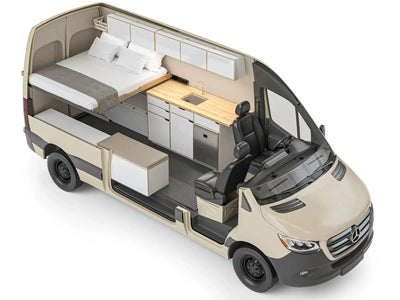
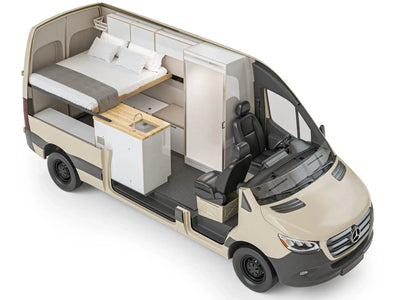
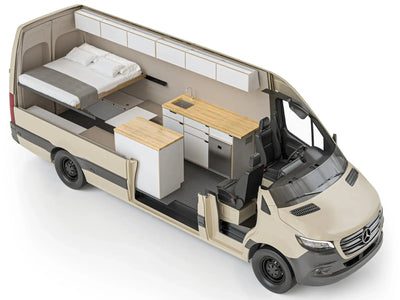
The best camper van for tall people depends on one hard fact first: up to about 6'3", most buyers are comfortable in both high-roof Sprinter and high-roof Transit builds. Transit is a bit more forgiving up to about 6'5". Beyond that, most people will hunch some in a finished camper. In our shop, tall buyers are usually happiest when they size the bed first, then let the rest of the layout follow.
What makes the best camper van for tall people?
For tall buyers, this choice usually comes down to three fit questions. Can you stand up, can you sleep flat, and can you still keep a usable kitchen and storage layout after the bed is sized right. Those are the numbers that matter most, and Mercedes publishes them clearly on the 2026 Sprinter cargo van page.
High-roof vans are the real starting point here. Low-roof and standard-roof shells get tight in a hurry once you add a finished floor, ceiling, and insulation. That's why most tall shoppers skip them, and why we steer people toward Sprinter conversions or Transit conversions built around high-roof platforms.
Ford still belongs in the mix. Its 2026 Transit lineup includes low, medium, and high roof options, but the official shopper-facing info is less direct for camper planning than what Mercedes shows. You can confirm the roof families on Ford's official materials, but layout validation matters more with Transit.
In our Boulder shop, tall customers most often regret choosing a shorter van just to save parking length. Later, they find out the bed steals aisle width, the cabinets get squeezed, or the rear garage disappears. That regret comes up a lot, especially after the first rainy trip when you spend hours inside.
The three dimensions tall buyers should care about first
Standing height affects your whole day. It changes how it feels to get dressed, cook dinner, or just move around when the weather turns bad. In real builds, both Sprinter and Transit work well for many buyers up to about 6'3". Transit tends to stay a bit more forgiving up to about 6'5".
Cargo floor length is the next big one. Those numbers matter if you want a true north-south bed and don't want to cheat mattress length.
Width matters too, especially if you're hoping to sleep sideways. That is one reason bed design matters as much as shell choice.
Mercedes helps tall buyers in a different way. The 2026 Sprinter page lays out cargo-bed-length figures across the 144-inch, 170-inch, and 170-inch Extended vans. That makes it easier to plan a real bed before you commit to a chassis, and it's part of why people often start with a custom camper van design instead of trying to solve it later.
Ford's 2026 Transit tech specs confirm high-roof cargo variants on long and extended bodies. That's the right place to start if you're tall and looking at Transit. But brochure numbers are still just shell numbers, so you need to subtract finished walls and furniture before assuming a mattress will fit.
Why finished conversions feel smaller than the spec sheet
OEM numbers describe an empty cargo shell. Once you add an insulated floor, finished ceiling, wall panels, lights, and trim, both standing room and sleeping width shrink. It doesn't take much material to eat up the inches that looked safe on paper.
This is where builder-level drawings help. The Mercedes upfitter 2D drawings show body shape, not just headline cargo figures. That matters because the widest point in the shell is not always the point where a mattress can actually live.
Wall curve, ribs, window framing, and cabinet depth can matter more than total cargo width. That's especially true for anyone over 6'2" trying to make an east-west bed work. One thing a lot of builders overlook is mattress height, because the wall shape often changes as you move up the van side.
A flare can get useful length back across the van. But it also adds cost, body work, and design tradeoffs, so it isn't the answer every time. Most builders want a fixed bed. Or they think they do, until they see what it costs them in garage space.
If you want a fixed bed, a shower, and family seating, the longest chassis usually solves more problems than a short van with clever tricks. That's why we often point tall buyers toward longer layouts, or toward DUO XL and Family XL style thinking early in the process.
2026 standing height comparison: Sprinter vs Transit vs ProMaster
For real-world use, both high-roof Sprinter and high-roof Transit work well for many buyers up to about 6'3". Transit is often a bit more forgiving up to about 6'5". Beyond that, most people will hunch once the van is fully finished.
Ford confirms low, medium, and high roof Transit models, and lists the High Roof at 108.6 inches externally. That's useful, but it still leaves more interpretation for camper buyers. Mercedes lands in the middle, with a strong consumer page that includes standing-height figures by configuration.
One thing we've learned over time is simple: the tallest shell is not always the best finished camper. If the bed gets awkward or the storage plan falls apart, those extra inches overhead don't fix the layout. Height and length need to work together.
| Van | Published height info | Tall-person takeaway |
|---|---|---|
| 2026 Mercedes Sprinter Standard Roof 144 | 68 in. standing height | Usually too short for tall camper builds |
| 2026 Mercedes Sprinter High Roof | See model-specific standing height on cargo page | Good fit for many buyers up to about 6'3" |
| 2026 Ford Transit High Roof | High roof confirmed, 108.6 in. external height | Good fit for many buyers up to about 6'3", often more forgiving up to about 6'5" |
2026 Mercedes Sprinter standing room
The 2026 Sprinter cargo van page is the right source for current standing-height figures by roof and wheelbase. It also shows why the standard-roof 144-inch model, with 68 inches of standing height, is usually a non-starter for tall camper shoppers. Once you finish the interior, the math gets even tighter.
High-roof Sprinters are the real comparison set for tall buyers. That's where you get the upright room needed for full camper use, and where the platform starts to make sense for daily living. In our experience, many buyers up to about 6'3" do well here.
That's a big reason longer Sprinters stay popular. On builds we've delivered, the 170 and 170 Extended are especially useful when a tall client wants a comfortable bed plus a full galley or rear gear garage. If you want to see how that planning comes together, our process is built around these tradeoffs early.
2026 Ford Transit and Ram ProMaster standing room
Ford's 2026 Transit model line includes low, medium, and high roof versions, and the high roof is the one tall shoppers should care about. Ford's tech specs also list 56.6 inches of first-row headroom for high-roof cargo models, which confirms the taller roof family even if it doesn't spell out cargo standing height the way some buyers want.
Transit has a real place here. Buyers who want Ford's service network and a familiar factory platform often end up happy in a high-roof long or extended Transit. In our experience, Transit is often a bit more forgiving up to about 6'5".
You still need to validate the layout carefully, which is one reason people often start with Transit conversion planning instead of guessing from a spec sheet.
Best bed layouts for sleepers 6'2" and up
A 6'2" sleeper needs at least 74 inches of true mattress length. A 6'4" sleeper needs about 76 inches. By 6'6", you want about 78 inches of real usable sleeping length, and that is before pillows, bedding, trim tolerance, and wall taper start stealing space.
That is why tall buyers should decide the bed first. Cabinetry, dinettes, and showers are all easier to adjust later. The bed is the least forgiving part of the floor plan, and if you get it wrong, you feel it every night.
Mercedes answers this well with its longer Sprinter bodies, which are often the easiest path to a true fore-aft bed without layout gymnastics. Transit can also support long north-south layouts in the right body length. Our VersaBed is also near king size, which accommodates most tall folks well.
East-west beds: when width is enough and when it is not
An east-west bed runs across the van. It saves floor space, which is a huge win in shorter vans, but it only works if the finished interior width at mattress height is still long enough for your body. That's the part many people miss.
In a bare shell, crosswise sleeping can sound close for a 6'2" sleeper. In a finished camper, insulation, wall panels, trim, and bed framing reduce what you actually get.
For many 6'2" sleepers, a carefully planned east-west bed can work in the right van body. At 6'4" and up, though, clients often still want flares or a different bed orientation to avoid sleeping diagonally. The Sprinter drawings help explain why, since the van's sidewall shape and taper matter as much as the widest single point in the shell.
This layout is usually most valuable in shorter vans. If preserving aisle length, kitchen space, or rear seating matters just as much as sleeping length, east-west can be the right compromise. If not, a longer chassis usually feels better in daily use.
North-south beds: the safer move for very tall sleepers
A north-south bed runs lengthwise down the van. That shifts the limiting dimension from width to cargo length, which is usually the safer path for very tall sleepers. It takes more floor length, but it gives you a more predictable result.
Mercedes shows cargo-bed-length figures across the Sprinter range, and the 170 and 170 Extended are the most natural choices for a permanent longitudinal bed. Ford's Transit tech specs also confirm long and extended high-roof cargo variants, which keeps Transit in the conversation.
In The Vansmith's experience, once a client is 6'4" or taller and wants a fixed rear bed plus cabinetry, moving to a longer wheelbase is usually a better outcome than forcing a crosswise bed. This one surprised us less over time, because the same tradeoff keeps showing up. Tall people don't just need inches. They need forgiving inches.
Which 2026 van is the best fit for 6'2", 6'4", and 6'6" buyers?
For most buyers up to about 6'3", both high-roof Sprinter and high-roof Transit can work well. Transit is often a bit more forgiving up to about 6'5". Beyond that, most people will hunch some in a finished camper.
A 6'2" buyer has more flexibility. In many cases, you can choose based on parking length, gear storage, or service preference because several high-roof platforms can be made comfortable with a smart layout. That's where floor plan choices start to matter more than a single headline number.
A 6'4" buyer needs to be more careful. Short-wheelbase vans and crosswise beds can still work, but only if the build is engineered around every inch of wall finish and bed width. For a 6'6" buyer, the margin gets very small, so the safest move is usually a longer body and a bed plan built around real finished dimensions.
That is the real answer to best camper van for tall people. It usually isn't the van with the one biggest spec. It's the van whose height, bed orientation, and storage plan still work after the shell becomes a real camper.
Best choice if standing height is your top priority
If standing comfort is your top priority, both high-roof Sprinter and high-roof Transit belong on the short list. For many buyers up to about 6'3", either can work well once built out. Transit is often a bit more forgiving up to about 6'5".
Still, don't stop at shell numbers. Shower pans, raised floors, insulation, lights, and vent trim all reduce the standing room you feel each day. A slightly shorter shell can still be the better real-world camper if the layout is more refined and the bed works better.
Best choice if sleeping comfort is your top priority
If sleeping comfort comes first, the Sprinter 170 and 170 Extended usually rise to the top. Mercedes publishes cargo-bed-length figures by configuration, which makes these long-body vans the most straightforward choices for a fixed lengthwise bed. That clarity helps a lot when you're trying to avoid guesswork.
Transit layouts can also support generous north-south beds in the right body length. But for The Vansmith's core conversion work, the strongest fit is usually a longer Sprinter or a carefully validated high-roof Transit. Our VersaBed is near king size, which accommodates most tall folks well.
The most common mistake tall shoppers make is picking a van around parking convenience first. Then they try to solve sleeping comfort after the shell has already imposed hard limits. If you're in that stage now, our van build articles and DIY blog can help you pressure-test your plan before you lock it in.
Cost, build choices, and how The Vansmith solves tall-person layouts
If you want a finished camper, tall-sleeper layout choices need to happen at the design stage. Bed orientation affects cabinetry, storage, seating, and even where windows or flares can go. By the time the bed is an afterthought, the hard decisions have already been made for you.
The Vansmith's semi-custom builds take about 8 to 10 weeks. That timeline matters for buyers who already know they need a taller or longer sleeping layout and don't want a long open-ended custom process. We also offer Foundation builds for people who want a strong starting point.
As of 2026, the Duo starts at $114,450 on Sprinter and $112,450 on Transit. The Family starts at $119,450 on Sprinter and $117,450 on Transit. We also sell ready-to-drive Bivy models, which helps buyers who want a pre-built van instead of sourcing a chassis and coordinating a full conversion timeline.
The company is based in Boulder, Colorado, and holds a 4.8-star Google rating across 85-plus reviews, along with a lifetime cabinet warranty. Those trust signals matter when the layout is being tailored to your body size. For tall customers who already own a van, we also handle window and flare installs, which can be the most practical fix when a crosswise bed is just a few inches short.
When to choose a longer chassis instead of adding flares
A longer chassis solves sleeping length at the floor-plan level. Flares solve it in one local zone at the bed. The right answer depends on how many other features you want in the van.
If you want a fixed bed, a galley, gear storage, and open aisle space, moving to a longer body often creates a cleaner layout than relying on flares alone. Mercedes shows multiple cargo-bed-length options across the 144, 170, and 170 Extended Sprinter bodies. Those longer shells give you more than bed room. They give you breathing room.
Flares make the most sense when you want to keep the van shorter overall but still need a crosswise bed that approaches real adult mattress length. In our experience, clients are happiest when they choose the van length that fits their sleep needs first, then use flares as a refinement tool. Not as the whole plan.
How to turn this decision into a real build
Start by deciding what matters more: standing comfort or sleeping comfort. That one choice narrows the field quickly. Then pick the bed orientation, east-west if floor space matters most, north-south if guaranteed sleeping length matters most.
After that, match the layout to the shell numbers. Sprinter 170-family stands out for long-bed packaging, and Transit high-roof long or extended models make sense for buyers who prefer Ford's platform. In our core work, though, we focus on Sprinter and Transit because that's where our semi-custom process fits best.
If you already own a van, you may not need to start over. A flare install, new windows, or an interior rework can be more cost-effective than replacing the whole build. If you're ready to sort it out, compare vans for couples or family van conversions, then contact us with your height, bed orientation, and must-have features.
FAQ
What is the best camper van for tall people in 2026?
For most buyers up to about 6'3", both high-roof Sprinter and high-roof Transit can work well. Transit is often a bit more forgiving up to about 6'5". Beyond that, most people will hunch some in a finished camper. If sleeping length matters most, longer Sprinter bodies are often the safer choice.
How much camper van standing height do I need if I'm 6'2" or taller?
A person who is 6'2" is 74 inches tall, so many high-roof builds can work well on paper. But a finished camper loses some of that to flooring, insulation, ceiling panels, and trim. That's why roof choice matters so much, and why tall buyers should always think in finished dimensions, not shell dimensions alone.
Can a 6'4" person sleep sideways in a camper van?
Sometimes, yes. But it depends on the real finished width at bed height, not just the shell width. Many 6'4" sleepers still need flares or a lengthwise bed after finishes go in. Our VersaBed is near king size, which accommodates most tall folks well.
Is a Sprinter or Transit better for a van conversion for a tall person?
For a tall-person conversion, the Sprinter usually has the edge when a true lengthwise bed is the priority. The 2026 cargo page presents longer-body cargo-bed-length options across the 170 and 170 Extended models, which makes planning easier. The 2026 Transit High Roof is still a strong choice, especially for buyers up to about 6'5" who want a bit more forgiveness in standing room.
How much does a tall-friendly camper van conversion cost?
At The Vansmith, as of 2026, the Duo starts at $114,450 on Sprinter and $112,450 on Transit, while the Family starts at $119,450 on Sprinter and $117,450 on Transit. For tall buyers, cost is tied less to height by itself and more to layout choices. A longer chassis, flares, and a more space-hungry bed orientation can all shape the final build path.
About the author

Eugene Smit
CEO
Eugene is the CEO of The Vansmith, based in Boulder, Colorado. He writes across topics related to van builds, ownership, and the camper van industry.
Read more about Eugene