The Agile Off Road RIP Kit is meant to fix ride control problems on loaded vans. Visible product pricing runs from $650 for the Transit STS Shock Package to more than $11,000 for the top Sprinter RIP tier before install. Which end of that range makes sense for you depends on loaded weight, rear axle load, and the exact symptom you feel from the driver’s seat. On camper vans, the real question usually is not stance. It’s whether the stock suspension still feels calm once cabinets, batteries, water, gear, and people are on board. That matters even more after a full build, when the van no longer behaves like an empty cargo shell.
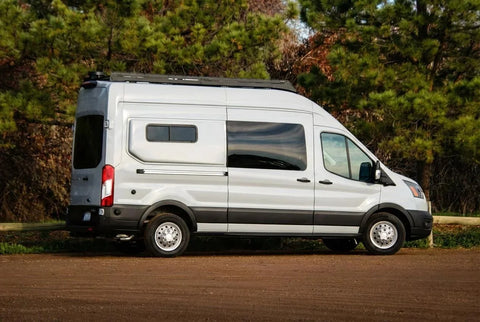
The featured photo shows a Vansmith Sprinter 4x4 camper van on all-terrain tires in the Colorado foothills, the kind of loaded, built van this guide is about. (Photo: The Vansmith)
What the Agile Off Road RIP Kit is actually meant to fix

The photo above shows a Vansmith Sprinter 4x4 build carrying a roof rack, a spare tire, recovery boards, and fuel cans. Every one of those adds permanent weight, much of it up high, and that load is what changes how the stock suspension behaves. (Photo: The Vansmith)
Agile uses RIP to mean Ride Improvement Package. On its Sprinter RIP overview page, the pitch is clear: this is a ride and handling upgrade first. Added height can come with it, but height is not the main point.
That framing matters for camper vans. A true lift kit and a ride-control package are not the same buy. Agile says its Sprinter packages are built to transform ride quality while balancing on-road comfort with off-road control. That is much closer to what most converted van owners are actually chasing.
Transit owners get even more direct language. On Agile’s Ford Transit Ride Improvement Package page, the company says the goal is to reduce the harsh ride and swaying traits of the stock suspension. Its STS product page adds that the factory Transit suspension is tuned for an empty cargo van and quickly becomes overwhelmed as weight is added.
Suspension complaints usually start after the van gains permanent weight from cabinets, batteries, water, roof gear, and passengers. Owners tend to describe the van as busy, harsh, or unsettled on broken pavement.
OEM guidance backs that up. Mercedes points builders to axle loading, weight distribution, and upfit planning in its Sprinter Body and Equipment Guidelines. In plain terms, a converted van is not operating in the same condition as the stock shell that left the factory.
If your van still feels composed at travel weight, you may not need a big suspension package. If it sways, crashes over joints, or never settles on rough pavement, then a RIP-style setup starts to make more sense. That is the fork in the road.
Sprinter symptoms the RIP Kit is trying to correct
Agile’s Sprinter messaging stays centered on ride quality, control, and suspension behavior. That speaks right to the common complaint on a built Sprinter: the van feels underdamped once the conversion is done. You feel it in the seat and in the wheel.
The Standard RIP Kit for the 2500 4WD/AWD Sprinter is pitched to overlanders, builders, and daily drivers. So Agile is not treating this as a niche race-van problem. It’s aimed at normal loaded vans that need better control.
Mercedes makes the same issue visible from another angle. Its body-planning guidance keeps axle load and weight distribution front and center. That matters once heavy systems stack up behind the B-pillar. Water, batteries, and cabinetry can shift the whole feel of the van before you ever hit a dirt road.
Common descriptions are more pitch, more side-to-side movement, and less calm in crosswinds. Many owners who ask for lift really want less fatigue on the highway.
That fatigue is often the real trigger. It shows up as steering correction, harsh hits on expansion joints, and a rear end that never quite settles. For Sprinter owners, the best way to think about RIP is control under load, with lift as a side effect.
If you’re still deciding between upgrading the van you own and starting with a build planned around final weight, it helps to look at Sprinter conversions and see how a complete build changes the load picture from day one.
Transit-specific problems Agile calls out
Agile is blunt about the Transit. It names harsh ride and sway as the stock van’s main weak spots once weight goes in. That’s useful because it keeps the conversation tied to symptoms instead of hype.
On its STS product page, the company also says the factory Transit suspension is tuned for an empty cargo van. A camper build adds fixed mass, and fixed mass changes the job the suspension has to do. Two Transits can look almost the same outside and need very different parts underneath.
Agile also sells an STS Shock Package for the Transit. The company says this package is meant to reduce body sway, improve stability, and make handling more predictable on loaded vans. That gives lighter builds a clear option before they jump to a full spring-based setup.
Transit choices get very weight-sensitive, very fast. Agile recommends picking rear leaf spring rate based on actual rear axle weight within about plus or minus 300 pounds. It also says vans under 5,000 pounds rear axle weight should use V4 shock tuning, while vans over 5,000 pounds should use V5. Reservoir shocks cover the full range.
There’s one more threshold that matters. For lighter Transits under 4,000 pounds rear axle weight, Agile recommends keeping the stock leaf springs and using lift blocks instead. That’s a strong sign that not every Transit needs the full hardware stack.
That is why weighing the van matters so much on a Transit. If you’re still planning your build, our custom van process is a good place to think through battery size, water load, and storage before suspension parts get picked too early.
Agile Off Road RIP Kit cost: Sprinter vs Transit
Sprinter pricing is easier to see at a glance. On Agile’s overview page, starting prices show up around $3,213.90 for the Sprinter 2500 2WD, $2,746.44 for the Sprinter 3500 2WD, and $3,213.90 for the Sprinter 2500 4WD/AWD. So the visible Sprinter entry point is already in the upper two-thousand to low three-thousand dollar range before labor.
The 2500 4WD/AWD lineup stretches much higher. Agile lists Standard from $2,983.90, Premium from $4,485.89, Pro from $5,285.87, Performance Elite from $8,189.85, Factory Race from $10,389.88, and Race from $11,170.95. That is a big spread. It tells you these packages are solving more than one level of problem.
Transit pricing is more modular. The STS Shock Package is listed from $650 with Bilstein B6 shocks, $899.97 with Fox 2.0 shocks, or $1,249.97 with Fox 2.0 reservoir shocks, which gives owners a useful benchmark if the main complaint is sway and predictability. A full Transit Ride Improvement Package depends on whether the van needs shocks and struts only, leaf springs, lift blocks, or reservoir shocks.
Budgeting should start with symptoms and scale weight. A van that only needs better damping can cost a lot less than one with the wrong rear spring rate. If you’re comparing this to a full camper project, it also helps to know that complete builds live in a much bigger budget world, with options like the DUO XL layout and family builds designed around final use from the start.
| Platform or package | Visible product price | What it shows |
|---|---|---|
| Transit STS | $650 to $1,249.97 | Lower-cost sway and control step |
| Sprinter 3500 2WD RIP start | $2,746.44 | Lowest visible Sprinter entry point |
| Sprinter 2500 2WD RIP start | $3,213.90 | Typical Sprinter starting range |
| Sprinter 2500 4WD/AWD Standard | $2,983.90 | Entry tier in that collection |
| Sprinter 2500 4WD/AWD Race | $11,170.95 | Top visible tier before install |
The price gap buys very different things. On Transit, modular pricing lets you spend closer to the actual issue. On Sprinter, the published ladder makes shopping easier, but it can also tempt buyers to choose by tier name instead of by what the van is doing.
What drives the Sprinter price ladder
Agile splits Sprinter RIP Kits by chassis and drivetrain. There are separate categories for 2500 2WD, 3500 2WD, and 2500 4WD/AWD. Right away, that tells you the platform is not one-size-fits-all.
Inside the 2500 4WD/AWD collection, the jump from Standard at $2,983.90 to Premium at $4,485.89, then to Pro at $5,285.87, is not trivial. Shock and component choices clearly move the price in a major way. The same is true once you step into Performance Elite, Factory Race, and Race territory.
Those higher tiers suggest Agile is serving more than one kind of owner. Some buyers want a practical camper van that rides better under load. Others want a van built for rougher terrain or stronger performance expectations.
That’s why the smartest way to read the ladder is not, “How high can I go?” It’s, “What problem am I paying to fix?” Product price is only part of the invoice too, since install labor, alignment, and possible tire changes can add up. If you’re early in planning, our build process helps put those choices in the right order.
Why Transit pricing is more modular
The Transit page does not show one neat ladder the way the Sprinter collection does. Instead, Agile walks you through a package built around weight, spring choice, and shock tune. That makes the Transit feel less simple to shop, but more honest to the platform.
The STS package, from $650, gives a clear lower-cost reference point. If your loaded van mainly feels tippy or vague, that may be enough. If the rear spring rate is wrong for the weight, though, shocks alone may not solve the whole problem.
Agile’s under-4,000-pound guidance is especially useful. For lighter vans, it recommends keeping stock leaf springs and using lift blocks instead. That can keep a build from overcommitting to parts it does not need.
Once the van is heavier, the parts list can shift fast. Rear leaf spring choice is tied to actual rear axle weight within about 300 pounds, and shock tune changes at 5,000 pounds. This modularity is a benefit. It lets Transit owners spend closer to the real problem, and readers looking at Transit conversions can see why layout and system size matter so much.
When the Agile RIP Kit makes sense, and when it doesn’t
The strongest case for a RIP-style upgrade is a van that is now built out and clearly rides worse than it did as an empty shell. That’s the whole premise behind Agile’s Transit guidance, and it tracks with what Mercedes says about axle loading on Sprinter. Once the van changes, the suspension question changes too.
A substantial package makes the most sense after the interior is in, the water and battery systems are real, and the owner can describe a repeatable complaint. Sway on mountain highways, harshness on expansion joints, rear sag, or poor rough-road control are all useful clues. Vague unease is not enough by itself.
A full package is harder to justify on a lighter van that still drives well at loaded weight. On Transit, Agile’s own under-4,000-pound recommendation makes that plain. In some cases the right answer is a simpler damping change, a lighter sway fix, different tires, or no suspension change at all.
Timing matters too. It is much easier to plan ride upgrades once the full weight picture is known. If you’re building for family travel, roof gear, or a lot of storage, looking at family van layouts can help you see how fast those pounds stack up.
Good candidates for a full RIP-style package
A converted van that feels harsh on expansion joints yet still wallows in corners is a classic candidate. That mix usually means the stock setup is no longer well matched to the build. You end up getting the worst of both worlds.
Owners who split time between highway miles and rough forest roads are also close to Agile’s target use case. The company keeps framing RIP around on-road comfort and off-road control, and that blend fits a lot of real camper use. Colorado roads make this obvious fast.
Transit owners over 5,000 pounds on the rear axle have a stronger case for more serious hardware, since Agile points them to V5 tuning. Owners under 5,000 pounds are guided toward V4, which still shows how weight-specific the answer is.
Suspension needs rise fast for vans carrying family passengers, dogs, bikes, water, and roof gear. The center of gravity moves up. Total mass goes up too. Readers thinking through a complete build can compare couple-focused layouts at vans for couples with larger family setups to understand why two finished vans may need different suspension plans.
Cases where a lighter upgrade may be enough
Agile’s own lineup gives a clear lighter-touch option. The STS package exists to reduce sway and improve predictability without forcing a full spring-based package. Starting at $650, it creates a very different entry point from a multi-thousand-dollar Sprinter RIP setup.
Agile also says lighter Transits under 4,000 pounds rear axle weight should keep stock leaf springs and use lift blocks instead. That is direct evidence from the manufacturer that full spring replacement is not always needed.
A near-stock van with only occasional weekend gear may not show enough deficiency to justify a full package. Actual loaded weights and a clear symptom should come before expensive hardware. That protects buyers from turning suspension into a style category.
Sometimes the issue is still in flux because the build is still changing. If you’re adding roof gear, storage, or even a pop-top later, that can move the target. Even a later roof change, such as adding a pop-top, adds weight up high, which is one more reason to wait until the final weight picture is real.
How Sprinter and Transit RIP decisions differ
Sprinter shoppers usually see a cleaner package ladder with published prices. Transit shoppers are more likely to be guided through a weight-based setup process. Same broad goal, very different buying logic.
On Sprinter, Agile talks about ride quality, control, and suspension behavior across named tiers. On Transit, Agile is much more explicit that the stock suspension was tuned for an empty cargo van and may need different springs and shock choices as weight rises. The Transit process is less glossy, but very practical.
Transit also comes with hard thresholds. Under 4,000 pounds rear axle weight, keep stock leafs. Under 5,000 pounds, use V4 shock tuning. Over 5,000 pounds, use V5. Reservoir shocks cover the full range. That is unusually specific and very helpful.
Sprinter gets the same weight story through Mercedes guidance instead of a neat set of aftermarket cutoffs. Upfitters still have to account for axle load and weight distribution.
Sprinter: simpler shopping, but still weight-sensitive
Agile makes Sprinter shopping easy to scan. Standard, Premium, Pro, Performance Elite, Factory Race, and Race are all visible at a glance on the collection page. That is nice for browsing, but it can hide the harder question.
The hard question is whether your loaded van actually needs that tier. A camperized Sprinter with water, lithium batteries, cabinetry, and recovery gear is dealing with a different suspension problem than a mostly empty cargo van. Same wheelbase does not mean same answer.
Mercedes keeps that reality in view with its body and equipment guidance, including the Sprinter Body and Equipment Guideline PDF. So while the aftermarket menu looks simple, the van underneath is still weight-sensitive. Buyers who mostly want better pavement manners and only occasional dirt-road use may not need the uppermost tiers.
If you’re weighing upgrade costs against a fresh build, our Foundation builds show another path: start with a van planned around the right load and use case from the beginning.
Transit: configuration matters more than kit name
The Transit page is built around component choice, not brand-tier shopping. Rear axle weight and intended use drive the setup. That makes the process feel more technical, but it usually leads to a tighter fit.
The plus-or-minus 300-pound spring-rate guidance is a big clue. Small weight differences can change the right rear spring choice. That matters on camper vans, where battery bank size, water capacity, and rear storage can swing the load more than people expect.
The under-4,000-pound threshold is another strong line. So is the shock-tune change at 5,000 pounds, with V4 below and V5 above. Reservoir shocks fit the full range, but they do not erase the need to know what the van weighs.
This is why Transit owners benefit from a builder who asks for loaded weights and use case before naming parts. If you want more background before talking shop, our van build blog and DIY articles can help you think through how systems and storage affect final weight.
How The Vansmith approaches suspension upgrades in Boulder
We do suspension upgrades for Sprinter and Transit vans in Boulder. The question usually comes up once an owner has enough miles on a built van to know what feels off. The symptom list is pretty consistent: sway, harshness, wandering, rear sag, or poor control on rough roads.
Our first questions are basic. Is the van fully built, or is it still gaining major components? How is it used: highway travel, mountain passes, washboard roads, family trips, bikes, water load, roof accessories? Those answers shape the recommendation more than the internet’s favorite kit name.
On Transit, Agile’s own guidance makes rear axle weight one of the most important inputs. On Sprinter, Mercedes pushes the same general logic through axle loads and weight distribution. We treat those as practical shop inputs, not paperwork.
That diagnostic approach is often what saves people from under-buying a quick fix or over-buying a premium package they don’t need. It also fits the bigger build picture. Complete Vansmith builds start at $113,950 for a Transit Duo and $115,950 for a Sprinter Duo, so suspension is usually one piece of a much larger decision.
Colorado exposes weak suspension fast. Mountain highways, crosswinds, uneven campground roads, and seasonal load changes all show you what the van is really doing. If your current van feels off, the practical next step is to contact us with your platform, loaded weight, and symptoms.
For people still deciding between upgrading what they own and starting with a new build, it helps to compare complete layouts like the Family XL against your current setup. Sometimes the right move is suspension work. Sometimes it’s planning the whole build around the weight from the start.
What we look at before recommending suspension work
We want to know if the van is done, or close to done. Suspension picked too early can miss the final weight picture by a lot. That is one of the easiest ways to spend money twice.
Use case comes next. Highway miles, mountain driving, washboard roads, family travel, bikes, water load, and roof gear all matter because they change both total mass and where that mass sits. A van used for city weekends is a different case from one crossing passes with a full tank and four people inside.
Then we sort the complaint. Harshness, sway, wandering, rear sag, and poor rough-road control are not the same symptom. Breaking those apart is what keeps the recommendation grounded.
That process may sound simple, but it is usually the difference between a fix that feels right and one that only looks right. It’s also why we’d rather hear loaded weight, platform, and symptom than a request for the “best” kit.
Next steps for owners and planners
The cleanest next step for current owners is a suspension evaluation, not a blind parts order. If you already own a Sprinter or Transit and the ride has changed after conversion weight went in, we can help diagnose what the van is actually asking for.
Readers still in planning mode should think about suspension alongside the full build. Big battery banks, water systems, awnings, roof racks, and family layouts all move the final answer. That’s true on both platforms, even though the shopping path looks different.
Boulder is relevant here because local driving exposes these issues quickly. Long highway stretches, crosswinds, rough access roads, and mountain grades make a van’s weak spots easier to feel. You don’t need a dramatic trail to notice bad damping.
And if you’re comparing upgrade spend to a full van project, that context helps too. A suspension package may be a smart fix for the van you have. Or it may tell you the next build should be planned around final weight from the start.
FAQ
What does the Agile Off Road RIP Kit actually do?
RIP stands for Ride Improvement Package. According to Agile, the goal is to improve ride quality, control, and suspension behavior, with extra height as a secondary benefit. That is a different mission from a simple appearance lift. For camper vans, that usually means better composure once real build weight is on board.
How much does an Agile RIP Kit cost for a Sprinter?
Current visible Sprinter pricing starts around $2,746.44 to $3,213.90 on Agile’s overview page, depending on chassis. In the 2500 4WD/AWD lineup, pricing runs from $2,983.90 for Standard to $11,170.95 for Race. So most Sprinter shoppers are looking at roughly $3,000 to $11,000 in product cost before installation.
Is there an Agile offroad ride improvement package for Ford Transit?
Yes. Agile’s Ford Transit Ride Improvement Package is presented more as a configurable system than one fixed boxed kit. Agile recommends parts by rear axle weight, including keeping stock leaf springs under 4,000 pounds rear axle weight, using V4 tuning under 5,000 pounds, and V5 over 5,000 pounds. That makes Transit fitment much more weight-driven.
When is the Agile rip kit Sprinter upgrade worth it?
It is most worth a look when a built Sprinter feels harsh, sways more than expected, or has lost composure after conversion weight was added. Agile frames the package around better on-road comfort and off-road control, while Mercedes supports the bigger point that axle load and weight distribution change how an upfitted van behaves. In plain use, the upgrade earns its keep when the stock van no longer feels calm at travel weight.
Can a lighter Transit upgrade be enough instead of a full RIP-style package?
Often, yes. Agile’s STS Shock Package for the Transit is listed from $650 to $1,249.97, depending on the rear shock, and is aimed at reducing sway, improving stability, and making handling more predictable on loaded vans. That can be a smart first move for some lighter builds. It also shows that better control does not always require a full spring replacement package.
Should I weigh my van before choosing suspension parts?
Yes, especially on Transit. Agile recommends choosing Transit rear leaf spring rate based on actual rear axle weight within roughly plus or minus 300 pounds, which shows how much the correct setup depends on real loaded weight. Even on Sprinter, axle load and weight distribution still matter. Guessing usually costs more than weighing.
About the author

Nathan Nicolette
Chief Van Builder
Nathan is Chief Van Builder at The Vansmith. He writes on topics spanning van builds, logistics, and life on the road.
Read more about Nathan