
DUO

Mercedes Sprinter 144
OR
Ford Transit 148

Perfect for solo travelers or couples who want a compact adventure-ready van.
Seat & Sleeps
2Length
19'Shower
Exterior * * Optional Add-OnsClass B RVs, Conversion Vans & Campervans for Sale in Manchester, NH
Mercedes Sprinter 144
OR
Ford Transit 148
Perfect for solo travelers or couples who want a compact adventure-ready van.
Seat & Sleeps
2Length
19'Shower
Exterior * * Optional Add-Ons
Mercedes Sprinter 144
OR
Ford Transit 148

Includes a shower setup for longer trips without compromising comfort or space.
Seat & Sleeps
2Length
19'Shower
Bench * * Optional Add-Ons
Mercedes Sprinter 170
OR
Ford Transit 148 E

Ideal for those who want extra living space and more storage for extended adventures.
Seat & Sleeps
2Length
22'Shower
Full
Mercedes Sprinter 170
OR
Ford Transit 148 E

Luxury model with full amenities, extended power systems, and interior bathroom.
Seat & Sleeps
2Length
22'Shower
Full
Mercedes Sprinter 144
OR
Ford Transit 148

Perfect for families who want space, comfort, and functionality in a compact build.
Seat & Sleeps
4Length
19'Shower
Exterior * * Optional Add-Ons
Mercedes Sprinter 170
OR
Ford Transit 148 E

A larger build for families who love extended adventures and more storage.
Seat & Sleeps
4Length
22'Shower
Bench * * Optional Add-Ons
Mercedes Sprinter 170
OR
Ford Transit 148 E

The luxury upgrade with interior shower and full power systems for long trips.
Seat & Sleeps
4Length
22'Shower
Full
Manchester is well placed for a camper van. The White Mountains are an hour and a half north, Lake Winnipesaukee is forty-five minutes away, Pawtuckaway is half an hour east, and Mount Monadnock is fifty minutes west. The Maine coast, the Green Mountains, and the Berkshires are all within a half day's drive. For a state this small, the variety is unusual.
What the van has to handle is a New England four-season year: 60 or more inches of snow in a typical Manchester winter, long stretches below freezing, spring mud season when forest roads turn to soup, humid summers in the upper 80s, and an autumn that offers some of the best camping of the year but can be the hardest time to find a campsite.
One local advantage worth knowing when comparing a purchase here with one across the border is that New Hampshire has no general sales tax, which changes the arithmetic on a vehicle at this price. Registration runs through your town as well as the state, so confirm the applicable figure locally before you budget.
The Vansmith builds Mercedes-Benz Sprinter and Ford Transit camper vans in Boulder, Colorado, and delivers across New Hampshire. Conversion packages start at $46,950, complete vans with the chassis included start at $115,950, and pre-built Bivy models run from $119,700 to $192,570. For the statewide picture, see
camper vans in New Hampshire.
A fuel-fired air heater drawing from the vehicle's own fuel tank, plus full insulation on all six sides. The heater produces heat from diesel or gasoline rather than from the battery, which lets it run through the night in single-digit temperatures without significantly draining the house battery. Insulation is the other half, and in the White Mountains, where nights can be much colder than in Manchester, it helps determine whether the heater maintains a comfortable temperature or runs constantly. Our heater service page covers the systems we install, and pre-built Bivy models use Havelock wool insulation.
Air conditioning is available on every build and standard on the Bivy Deluxe. New Hampshire summers are warm and humid rather than extreme, and camping at elevation in the White Mountains is noticeably cooler than in the Merrimack Valley. Air conditioning is the largest electrical draw in any van, so overnight use without hookups requires a battery bank sized to support it.
A powered roof fan with variable speed and reversible direction helps maintain airflow, supported by ventilation paths behind cabinetry rather than sealed cavities. New England is wet in every season, and condensation can form behind cabinets in a cold van where moisture may go unnoticed. A roof fan handles routine air exchange, removes cooking moisture, and helps reduce condensation buildup.
Lithium battery banks are sized around your real overnight load, with capacity up to 15 kWh in the Bivy Deluxe, plus roof solar and DC-DC alternator charging on every build. Solar can contribute meaningfully from April through October. Winter performance is weaker because of shorter days, low sun, cloud cover, and snow on the panels, which makes alternator charging particularly valuable. Cold weather can also reduce usable battery capacity, and lithium batteries generally need protection against charging below their permitted temperature. See our Electrical System and solar installation work.
Fresh and gray water tanks are sized to your layout, with a pressurized pump and accessible drain points. For winter use, the location of the tanks and water lines matters: keeping them inside the heated and insulated living area helps protect the system from freezing. This is one of the key considerations when choosing a four-season camper van rather than a three-season setup.
For winter travel, keep the water system heated and in use with tanks and lines protected inside the insulated space, or fully winterize it before temperatures drop. Complete winterization includes draining the fresh and gray tanks, water heater if fitted, and water lines, following the manufacturer's procedure and leaving taps open as appropriate. New Hampshire winters can remain cold for extended periods, and water left in fittings or pipes can freeze and cause damage.
| Specification | What We Build | Why It Matters in Manchester |
|---|---|---|
| Base Vehicle | Mercedes-Benz Sprinter or Ford Transit, supplied by you or included in a complete vehicle. | The Transit is cheaper to buy and service locally; the Sprinter's 4x4 option suits White Mountain forest roads. |
| Wheelbase and Dimensions | Approximately 19.5 ft on the short wheelbase or 22.5 ft extended, with a high-roof height of 9 to 10 ft. | The shorter van is easier to maneuver through White Mountain National Forest campground loops and is more likely to fit a residential garage. |
| Sleeping Capacity | Two on a fixed bed in the DUO Series, or four with convertible seating in the FAMILY Series. | A fixed bed is warmer and simpler to use during winter trips than converting the sleeping area every night. |
| Heating System | A fuel-fired air heater running on the vehicle's own fuel, or a Rixen hydronic system on the Bivy Deluxe. | White Mountain nights can be much colder than Manchester, and a fuel-fired heater uses very little house battery power. |
| Insulation | Full insulation on all six sides; Havelock wool in pre-built Bivy models. | Insulation helps retain heat in winter, limit summer heat gain, and manage condensation during New England's four-season year. |
| Ventilation | A powered roof fan with variable speed and reversible direction, plus airflow behind cabinetry. | New England experiences wet weather throughout the year, and good airflow helps reduce moisture buildup behind cabinets. |
| Air Conditioning | Available on every build and standard on the Bivy Deluxe. | Air conditioning helps maintain comfort during humid valley summers, while cooler nights at White Mountain elevations may reduce its use. |
| House Battery | A lithium battery bank sized around your actual overnight power needs, with capacity up to 15 kWh. | Cold weather can reduce usable battery capacity, so the system should be sized around winter power needs rather than summer use alone. |
| Solar Charging | A roof solar array sized to your layout and daily energy use. | Solar can contribute well from April through October, but short days, cloud cover, and snow on the panels can reduce winter production. |
| Alternator Charging | A DC-DC charger on every build. | Alternator charging replenishes the battery while driving between destinations, making it especially useful when winter solar output is low. |
| Fresh Water | Tanks sized to your layout, with a pressurized pump and accessible drain points. | Dispersed camping areas in White Mountain National Forest may not offer water refill points, and accessible drains help with winterization. |
| Wastewater | A gray water tank matched to fresh-water capacity, with accessible drains. | Seasonal closures at some New Hampshire state park dump stations make wastewater capacity and trip planning important outside summer. |
| Refrigeration | A 12V compressor refrigerator that runs on battery power alone. | It requires no propane or level-parking setup and provides reliable refrigeration throughout changing New England temperatures. |
| Electrical Monitoring | A battery monitor that shows actual state of charge rather than relying on voltage alone. | Cold weather affects battery performance, making accurate monitoring useful for understanding available power during winter trips. |
| Payload | The chassis payload rating is evaluated against your realistic loaded weight during the design call. | Water, batteries, skis, bikes, and winter camping gear can add weight faster than buyers expect. |
| Tires and Brakes | Tires and brakes selected around your planned routes, with three-peak mountain snowflake-rated tire options. | Proper winter-rated tires are essential for icy roads and mountain passes; four-wheel drive does not replace winter traction. |
| Ground Clearance | Ground clearance depends on chassis, trim, and drivetrain, with suspension and tire upgrades available. | Clearance affects forest road access, while spring mud season can make soft, muddy roads more challenging than winter snow. |
| Vehicle Dimensions for Storage | Approximately 19.5 or 22.5 ft long and 9 to 10 ft tall when built; dimensions are checked against your storage space before ordering. | Garaging the van through a salted New England winter can help reduce exposure to road salt and limit corrosion. Check garage clearance before ordering. |
| Warranty | A lifetime cabinetry warranty for the original owner, with no mileage or year limit. | Appliance warranties are provided by their respective manufacturers, and The Vansmith is NOAH certified. |
Exact figures for payload, ground clearance, tire sizing, and vehicle dimensions depend on the chassis, trim, and drivetrain you choose. The Vansmith confirms each specification against your selected van during the design call.
Nine tailored layouts across the two-person DUO Series and the four-person FAMILY Series, on Sprinter 144 and 170 wheelbases and Transit 148 and 148 extended, plus three pre-built Bivy trims. Browse all tailored models.
A Class B RV is a camper built inside a van body rather than on a truck chassis. In northern New England, that compact footprint helps you access White Mountain National Forest campgrounds, travel the Kancamagus Highway, and navigate smaller campground loops around the lakes, where larger motorhomes may be restricted or difficult to maneuver. Browse our Class B RVs for sale.
DUO starts at $46,950, DUO S at $53,950, DUO XLS at $63,950, and DUO XL is available on request. FAMILY starts at $51,950, FAMILY XL at $61,950, and FAMILY XLS at $68,950. Three pre-built Bivy trims start at $119,700: Classic with 5 kWh, Plus with 10 kWh and a diesel cabin heater, and Deluxe with 15 kWh, air conditioning, and a Rixen hydronic heater. See the Bivy comparison.
The Sprinter offers all-wheel drive and 4x4 options and is a strong platform for forest roads and winter access. The Transit costs less to buy and service, with good dealer coverage across southern New Hampshire and all-wheel drive available on current model years. See Sprinter van conversions, Ford Transit van conversions, and our Sprinter vs. Transit comparison.
Our full current stock, including inspected used vans, is on the camper vans for sale page.
The DUO Series is designed for two people, with a fixed bed and a gear garage that makes efficient use of the available space. The FAMILY Series accommodates four with convertible seating and sleeping arrangements. See camper vans for couples and family van conversions.
A short-wheelbase van, approximately 19.5 feet long, is a practical choice for New Hampshire. It can be easier to maneuver through White Mountain National Forest campground loops, navigate notch roads, and park in a residential driveway or garage. See small camper vans.
A gear garage beneath the bed with rear-door access and a drain, plus roof and hitch racks, helps organize outdoor equipment. In New Hampshire's climate, the drain is particularly useful: skis, boots, bikes, and paddles often come back wet or snowy, and that moisture is better kept out of the cabin.
Water, gray-water, and battery capacity determine how long you can stay out. White Mountain National Forest permits dispersed camping in designated or otherwise permitted areas under applicable rules, generally without facilities or water. Self-sufficiency is what extends a trip when services are unavailable.
A fuel-fired air heater drawing from the vehicle's own fuel tank, plus full insulation on all six sides. The heater produces heat from diesel or gasoline rather than from the battery, allowing it to run through cold nights without significantly draining the house battery. Insulation is the other half, and in the White Mountains, where nights can be much colder than in Manchester, it helps determine whether the heater maintains a comfortable temperature or runs constantly. Our heater service page covers the systems we install, and pre-built Bivy models use Havelock wool.
Air conditioning is available on every build and standard on the Bivy Deluxe. New Hampshire summers are warm and humid rather than extreme, and camping at elevation in the White Mountains is noticeably cooler than in the Merrimack Valley. Air conditioning is the largest electrical draw in any van, so overnight use without hookups requires a battery bank sized to support it.
A powered roof fan with variable speed and reversible direction, supported by airflow paths behind cabinetry rather than sealed cavities. New England is wet in every season, and condensation can form behind cabinets in a cold van where moisture may go unnoticed. A roof fan handles routine air exchange, removes cooking moisture, and helps reduce condensation buildup.
Lithium battery banks are sized around your actual overnight load, with capacity up to 15 kWh in the Bivy Deluxe, plus roof solar and DC-DC alternator charging on every build. Solar can contribute meaningfully from April through October. Winter performance is weaker because of shorter days, low sun, cloud cover, and snow on the panels, which makes alternator charging particularly valuable. Cold weather can reduce usable battery capacity, and lithium batteries generally need protection against charging below their permitted temperature. See our Electrical System and solar installation work.
Fresh and gray tanks are sized to your layout, with a pressurized pump and accessible drain points. For winter use, the location of the tanks and water lines matters: keeping them inside the heated and insulated living area helps protect the system from freezing. This is a key consideration when choosing a four-season camper van rather than a three-season setup.
Choose a winter-use approach: keep the system heated and in use with tanks and lines protected inside the insulated space, or fully winterize it before freezing temperatures arrive. Complete winterization includes draining the fresh and gray tanks, water heater if fitted, and water lines, following the manufacturer's procedure and leaving taps open as appropriate. New Hampshire winters can remain cold for extended periods, and water left in fittings or pipes can freeze and cause damage.
Four DUO layouts for two, three FAMILY layouts for four, and three pre-built Bivy trims starting at $119,700. Bivy models are based on the Sprinter 144 AWD with a pop-top and Havelock wool insulation, and are typically ready in 8 to 10 weeks. Because a pop-top uses a fabric section, the lower berth is generally the more practical sleeping space on deep winter nights, while the upper section is better suited to three-season use. See the Bivy comparison.
Approximately 19.5 feet long on the Sprinter 144 or Transit 148, and about 22.5 feet on the Sprinter 170 or Transit 148 extended, with high-roof vans approximately 9 to 10 feet tall. Length affects campground access; height determines whether you can store the van in a garage, which can be valuable protection from New England road salt.
The DUO Series sleeps two on a fixed bed, the FAMILY Series sleeps four with convertible seating, and Bivy models accommodate two below plus two in the pop-top. In a cold, wet climate, daytime living space matters because you may spend rainy and snowy days inside the van.
Heating options include a fuel-fired air heater or the hydronic system on the Bivy Deluxe. Electrical equipment includes a lithium battery bank, roof solar, DC-DC alternator charging, shore power, and battery monitoring. Fresh and gray tanks have accessible drain points, with the option of keeping the water system inside the heated envelope.
Payload is evaluated against your realistic loaded weight during the design call. Ground clearance depends on chassis, trim, and drivetrain, with suspension and tire upgrades available. It affects which forest roads you can use, particularly during spring mud season.
Approximately an hour and a half to two hours north, Franconia Notch State Park offers the Flume Gorge, Cannon Mountain, Lafayette Place campground, and the notch itself, where I-93 narrows to a parkway. The Kancamagus Highway, Route 112, runs about 35 miles east to west, with campgrounds along the route and limited services. Fill up before starting the drive. Weather in the White Mountains can change quickly, and a camper van is not safe shelter above treeline, so plan hikes conservatively.
About 45 minutes north, Lake Winnipesaukee offers waterfront recreation and camping options, including Ellacoya State Park and campgrounds around Meredith and Wolfeboro. The area is busy in summer and often more relaxed in September as crowds thin.
About half an hour east, Pawtuckaway State Park offers a lake, campground, bouldering, and a fire tower. Its proximity to Manchester makes it a convenient destination for a weeknight trip or a first overnight in a new van.
About 50 minutes west, Mount Monadnock is a popular hiking destination, with camping options at Monadnock State Park and Gilson Pond. Arrive early on weekends or consider a midweek visit to avoid the busiest periods.
About an hour north, the Lakes Region spreads across dozens of lakes, with state park and private camping options. It can offer an alternative to the busiest White Mountain destinations during peak season.
Fall foliage is one of New England's biggest attractions for camper van travel. The Kancamagus Highway, notch roads, Route 112, and the Mount Washington Valley are especially scenic from late September into mid-October. Campgrounds can book out months ahead for peak weekends, and traffic on the Kancamagus can be slow during peak foliage. If your schedule allows, consider traveling midweek. The Mount Washington Auto Road has vehicle restrictions, so check its current rules before planning to drive a camper van there.
Many New Hampshire state park campgrounds operate from mid-May through mid-October, while some White Mountain National Forest campgrounds have similar seasonal schedules and others may remain open longer. Summer and foliage weekends book well ahead. Forest roads can close seasonally, and spring mud season can create genuine access problems. Check current campground and road conditions before departure.
Choose proper winter tires with the three-peak mountain snowflake rating and pair them with all-wheel drive rather than treating AWD as a substitute for winter tires. Notch roads and mountain approaches can ice over while valley roads are merely wet. Leave more stopping distance than you would in a car because a loaded van takes longer to stop.
Keep the fuel tank reasonably full in cold weather to support the heater. Keep the water system heated and inside the insulated envelope, or drain it completely when the van is not in use. Expect reduced usable battery capacity and ensure the battery management system protects the bank from charging below its permitted temperature.
In summer, solar and DC-DC alternator charging can support extended stays, with water capacity often setting the limit. In winter, battery capacity and driving time become more important because solar production is lower and heating increases energy demands. A battery monitor showing actual state of charge helps you plan power use accurately.
Services are limited along the Kancamagus Highway and on some back roads in the White Mountains. Refill water and fuel in nearby towns such as Lincoln, Conway, or Plymouth before heading into remote areas, rather than waiting until supplies are low.
Forest road gates, mountain pass conditions, campground seasons, and fire restrictions can change throughout the year. Check current information from New Hampshire State Parks and White Mountain National Forest before traveling instead of relying on previous-season conditions.
Conversion packages start at $46,950 and range to $68,950, complete vehicles with the chassis included start at $115,950, and pre-built Bivy models range from $119,700 to $192,570. Bivy XL starts at $153,700. Confirm the equipment included in your selected configuration and quote.
New Hampshire has no general sales tax, which can be a meaningful consideration when comparing a vehicle purchase with one in neighboring states. Registration involves both state and town fees, so confirm the applicable amount with your town clerk. A camper van may be registered and insured differently from a standard cargo van. NOAH certification may matter to some insurers and lenders, so confirm their requirements before purchasing.
Chassis servicing follows the vehicle manufacturer's schedule. Add the cost of a winter tire set and seasonal changeovers, plus regular underbody washing. In a region where road salt is widely used, cleaning the underbody is an important part of corrosion prevention.
Keep the battery bank within the manufacturer's recommended state-of-charge range rather than allowing it to remain depleted. Check terminals and connections as recommended, and maintain appropriate ventilation around the battery bank during hot weather. Follow the battery manufacturer's guidance for cold-weather charging and storage.
If the van sits from December to April, drain the water system completely, maintain the battery appropriately, and follow the vehicle and fuel-system manufacturer's guidance for seasonal storage. Use a suitable breathable cover if needed. Indoor storage can also reduce exposure to road salt, snow, and severe weather.
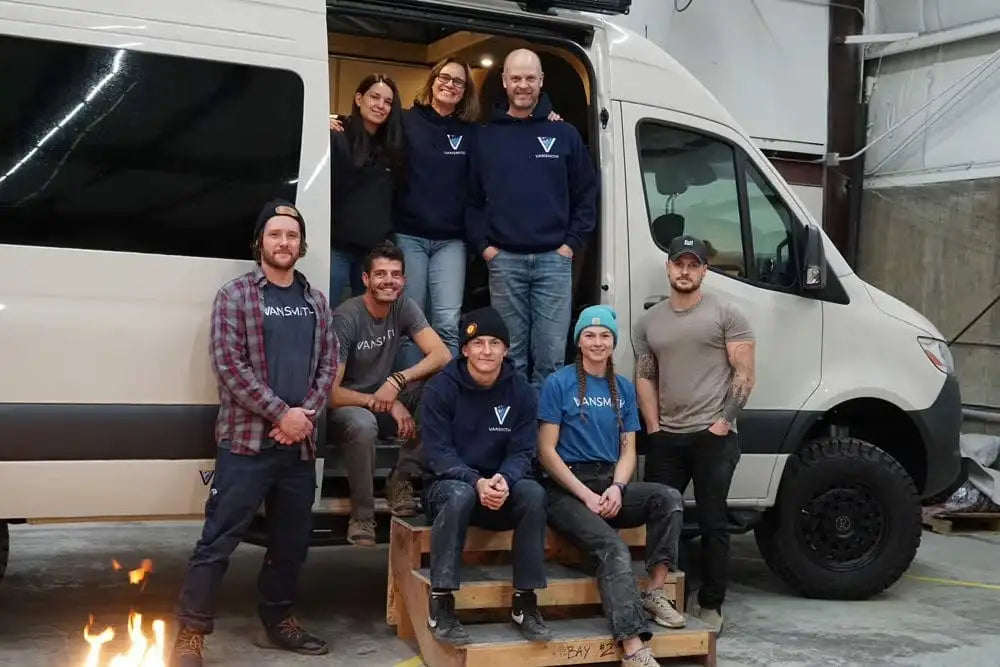
The Vansmith has been family-owned since 2016 and has built more than 300 vans across both platforms and multiple wheelbases.
Nine tailored layouts plus three pre-built Bivy trims provide options for different sleeping arrangements, storage needs, and travel styles. Compare tailored models to find a configuration that suits your trips.
Lithium battery storage, solar, DC-DC charging, shore power, inverter capacity, and monitoring are designed as an integrated system. For overnight air conditioning or winter travel, battery capacity, charging options, and heating loads need to work together.
The Vansmith creates camper vans in Boulder, Colorado, where outdoor travel and changing weather are familiar considerations. That experience informs planning for electrical systems, insulation, ventilation, storage, and vehicle specifications for the routes you intend to travel. The team also offers service and upgrade work through its Boulder shop.
Contact The Vansmith for current customer review information, service availability, and support options for your selected vehicle. You can also discuss installation and upgrade needs through the repairs, installations and services page.
Browse camper vans for sale, compare tailored models, and explore inspected used vans. Use the van designer and Bivy comparison to review configurations.
Options are priced individually, so the quote can itemize the selected equipment and configuration. Tailored builds typically take 12 to 16 weeks, while pre-built Bivy models are typically ready in 8 to 10 weeks. Confirm current lead times and final pricing before placing your order.
Manchester is approximately 2,000 miles by road from Boulder, Colorado. Delivery can be quoted as part of the purchase, or you can fly to Denver and drive the van home. Confirm the delivery arrangements and costs for your specific order.
The original owner receives a lifetime cabinetry warranty with no mileage or year limit. Appliance warranties are provided by their respective manufacturers. The Vansmith is NOAH certified. Ask the team about coverage, service options, and ownership documentation for your selected vehicle.
Call (303) 414-6834, use our contact page, or visit us at 7209 Valtec Court Unit B, Boulder, CO 80301. Use our RV loan calculator and read how to finance a camper van conversion. For the statewide overview, see camper vans in New Hampshire.
Ready to plan your New Hampshire adventures? Browse camper vans for sale, compare tailored models, or call (303) 414-6834 to discuss a camper van for your Manchester, NH travel plans.









Email: info@thevansmith.com
Text: 303-414-6834
Form: Tell us what you need
Call: 303-414-6834
Book a call:
(We are currently not booking any new service work while we revamp our service department.)
Visit us (by appointment):


