
DUO

Mercedes Sprinter 144
OR
Ford Transit 148

Perfect for solo travelers or couples who want a compact adventure-ready van.
Seat & Sleeps
2Length
19'Shower
Exterior * * Optional Add-OnsClass B RVs, Conversion Vans & Campervans for Sale in Honolulu, HI
Mercedes Sprinter 144
OR
Ford Transit 148
Perfect for solo travelers or couples who want a compact adventure-ready van.
Seat & Sleeps
2Length
19'Shower
Exterior * * Optional Add-Ons
Mercedes Sprinter 144
OR
Ford Transit 148

Includes a shower setup for longer trips without compromising comfort or space.
Seat & Sleeps
2Length
19'Shower
Bench * * Optional Add-Ons
Mercedes Sprinter 170
OR
Ford Transit 148 E

Ideal for those who want extra living space and more storage for extended adventures.
Seat & Sleeps
2Length
22'Shower
Full
Mercedes Sprinter 170
OR
Ford Transit 148 E

Luxury model with full amenities, extended power systems, and interior bathroom.
Seat & Sleeps
2Length
22'Shower
Full
Mercedes Sprinter 144
OR
Ford Transit 148

Perfect for families who want space, comfort, and functionality in a compact build.
Seat & Sleeps
4Length
19'Shower
Exterior * * Optional Add-Ons
Mercedes Sprinter 170
OR
Ford Transit 148 E

A larger build for families who love extended adventures and more storage.
Seat & Sleeps
4Length
22'Shower
Bench * * Optional Add-Ons
Mercedes Sprinter 170
OR
Ford Transit 148 E

The luxury upgrade with interior shower and full power systems for long trips.
Seat & Sleeps
4Length
22'Shower
Full
Owning a camper van on Oahu works differently from owning one anywhere else we deliver, and understanding those differences can help you make a more informed decision. Three things are genuinely different here.
Shipping is the first consideration. A van crafted in Boulder reaches Honolulu by ocean freight from a West Coast port, adding cost and weeks to the timeline. High-roof vans are tall vehicles that may be handled and priced differently from cars, so shipping costs depend on the exact vehicle dimensions rather than a standard rate.
None of that makes a camper van a bad idea on Oahu. It makes it a considered purchase for someone who wants a specific vehicle, plans to keep it, and will use it for North Shore and windward trips as well as everyday driving. If that sounds like you, The Vansmith can create your van and arrange delivery to Hawaii.
The Vansmith crafts Mercedes-Benz Sprinter and Ford Transit camper vans in Boulder, Colorado. Conversion packages start at $46,950, complete vans with the chassis included start at $115,950, and pre-built Bivy models range from $119,700 to $192,570, with ocean freight quoted separately. For the statewide picture, explore
camper vans in Hawaii.
Air conditioning is available on every build and standard on the Bivy Deluxe. Honolulu temperatures stay in the mid-80s for much of the year, with high humidity, while trade winds help keep the windward side comfortable. Cooling matters most when the trades stop for stretches and on the leeward side. Since air conditioning is the largest electrical draw in any van, overnight use without hookups requires a battery bank sized for the load.
A powered roof fan with variable speed and reversible direction helps manage everyday airflow in a tropical climate. Oahu's year-round humidity makes ventilation especially important because still air behind cabinetry can encourage mildew. The Vansmith designs airflow paths behind cabinetry rather than sealed cavities. When the trade winds are blowing, a fan and open windows can often feel more comfortable than air conditioning.
Insulation is often presented as a cold-weather feature, but it also helps manage tropical heat. Direct sunlight on a van roof is a major source of interior heat in Honolulu, making full insulation on all six sides, especially the roof, important when the vehicle is parked. Insulation also reduces the cooling load and can extend battery life by limiting how long the air conditioner needs to run. Pre-built Bivy models use Havelock wool.
Lithium battery banks are sized around your actual overnight power needs, with capacity up to 15 kWh in the Bivy Deluxe. In a warm climate, cooling is a key factor in determining battery capacity. Hawaii's mild temperatures also avoid the cold-weather battery capacity losses that can affect mainland travel. Explore The Vansmith's Electrical System work to learn more about available electrical setups.
Hawaii's strong sunshine, long days and year-round solar potential make rooftop solar a valuable part of an off-grid electrical system. For a van used around Oahu, a well-sized solar array paired with a suitable battery bank can reduce reliance on shore power. The Vansmith also installs DC-DC alternator charging on every build to help replenish the house battery while driving. Explore our solar installation services and solar sizing guide.
Fresh and gray water tanks are sized to your layout and paired with a pressurized water pump. With freezing conditions rarely a concern in Honolulu, water capacity and convenient rinse-off options take priority. An exterior shower is available and comes standard on the Bivy Plus and Bivy Deluxe. For island outings that involve swimming and salt water, an exterior shower offers a practical way to rinse off before getting back inside.
| Specification | What We Build | Why It Matters in Honolulu |
|---|---|---|
| Base Vehicle | Mercedes-Benz Sprinter or Ford Transit, supplied by you or included in a complete vehicle. | The Transit has better dealer and parts coverage in Hawaii, which matters more on an island than on the mainland. |
| Wheelbase and Dimensions | Approximately 19.5 ft on the short wheelbase or 22.5 ft extended, with a high-roof height of 9 to 10 ft. | Height affects parking and freight handling. The short wheelbase is often the more practical choice for Oahu roads. |
| Sleeping Capacity | Two on a fixed bed in the DUO Series, or four with convertible seating in the FAMILY Series. | Sleeping capacity determines the layout, while a fixed bed leaves a gear garage for boards and wet equipment. |
| Air Conditioning | Available on every build and standard on the Bivy Deluxe. | Cooling matters most when the trade winds stop and on the leeward side of the island. |
| Insulation | Full insulation on all six sides; Havelock wool in pre-built Bivy models. | Roof exposure is a major source of heat gain, so insulation helps reduce cooling runtime. |
| Ventilation | A powered roof fan with variable speed and reversible direction, with airflow behind cabinetry. | Consistent airflow helps manage moisture and reduce mildew risk in year-round humid conditions. |
| Heating System | A fuel-fired air heater is available but rarely specified for Hawaii. | Freezing conditions are uncommon, so many owners may prefer to allocate the budget to cooling, ventilation or electrical capacity instead. |
| House Battery | A lithium battery bank sized around your actual overnight power needs, with capacity up to 15 kWh. | Without cold-weather capacity loss, the battery can provide its intended capacity under suitable operating conditions year-round. |
| Solar Charging | A roof solar array sized to your layout and daily energy use, with generous capacity worth considering. | Hawaii's strong solar potential can make rooftop solar a meaningful source of everyday charging. |
| Alternator Charging | A DC-DC charger on every build. | Provides another way to replenish the house battery while driving, alongside solar charging. |
| Fresh Water | Tanks sized to your layout, with a pressurized pump; an exterior shower is available. | Some beach parks and permitted campsites lack potable water, and warm weather can increase water consumption. |
| Wastewater | A gray water tank matched to fresh-water capacity, with accessible drains. | Plan tank capacity and legal disposal ahead of time because suitable wastewater disposal facilities may be limited near your destination. |
| Refrigeration | A 12V compressor refrigerator that runs on battery power alone. | It does not require propane and is designed to maintain food temperatures in warm conditions. |
| Electrical Monitoring | A battery monitor that shows actual state of charge rather than relying on voltage alone. | Helps you track energy use and balance cooling demand against solar input throughout the day. |
| Payload | The chassis payload rating is evaluated against your realistic loaded weight during the design call. | Water, batteries and outdoor equipment add weight, so the complete vehicle's loaded weight needs to be considered. |
| Tires and Brakes | Tires and brakes selected for your vehicle, load requirements, heat and wet-road conditions. | Intense sun and UV exposure can age tires. Monitor tire condition and date codes as well as tread depth. |
| Corrosion Protection | Sealed body penetrations, appropriately rated connectors and accessible service points. | Salt air accelerates corrosion, making regular rinsing, inspection and preventative maintenance particularly important on Oahu. |
| Vehicle Dimensions for Storage and Freight | Approximately 19.5 or 22.5 ft long and 9 to 10 ft tall when built; dimensions are measured before ordering. | Finished dimensions affect parking options and how the vehicle is handled and priced for ocean freight. |
| Warranty | A lifetime cabinetry warranty for the original owner, with no mileage or year limit. | Appliance warranties are provided by their respective manufacturers, and The Vansmith is NOAH certified. |
Exact figures for payload, tire sizing and vehicle dimensions depend on the chassis, trim and drivetrain you choose. The Vansmith confirms each specification against your selected van during the design call. Finished vehicle dimensions are also used to obtain an ocean freight quote for Hawaii.
Nine tailored layouts across the two-person DUO Series and the four-person FAMILY Series, on Sprinter 144 and 170 wheelbases and Transit 148 and 148 extended, plus three pre-built Bivy trims. Browse all tailored models.
A Class B RV is a camper built inside a van body rather than on a truck chassis. On an island 44 miles long with narrow coastal roads and tight parking, it is the most practical RV class for many Oahu travelers. Browse our Class B RVs for sale.
A conversion van traditionally means a passenger van with upgraded seating and trim, designed for comfortable travel rather than living in. A camper van, also called a Class B RV, is equipped as a self-contained vehicle with a bed, galley, water, ventilation and a house electrical system independent of the engine. On Oahu, self-sufficiency matters because onboard power, water and shade can be useful at a beach park or permitted campsite without relying entirely on facilities at the site.
DUO starts at $46,950, DUO S at $53,950, DUO XLS at $63,950, and DUO XL is available on request. FAMILY starts at $51,950, FAMILY XL at $61,950, and FAMILY XLS at $68,950. Three pre-built Bivy trims start at $119,700. Freight to Honolulu is quoted separately.
Our full current stock, including inspected used vans, is on the camper vans for sale page.
Available on both wheelbases with all-wheel drive and 4x4 options. For Oahu buyers, Mercedes-Benz commercial van service is available on the island, but the network is more limited than on the mainland and parts may take time to arrive. See Sprinter van conversions and Sprinter campers for sale.
For Oahu, we would point many buyers toward the Transit, with service availability being an important consideration alongside purchase price. Ford has broader dealer coverage in Hawaii, and parts may be easier to source. See Ford Transit van conversions and our Sprinter vs. Transit comparison.
The 144, at approximately 19.5 feet, is the more practical choice for Oahu's narrow windward roads, tight Honolulu parking and smaller beach park lots. The 170, at approximately 22.5 feet, takes up more space, requires wider turning room and may cost more to ship because freight pricing depends on vehicle dimensions. See small camper vans.
The Transit 148 is comparable in overall length to the Sprinter 144 and is the configuration we would recommend for many Oahu buyers. The Transit 148 extended has similar parking and maneuverability considerations to the longer Sprinter 170.
For most Oahu driving, 4x4 is not necessary, and we would not recommend paying extra for it unless you have a specific use in mind. Most public roads are paved, while many restricted areas are not open to vehicle access. The budget may be more useful for corrosion protection, a larger battery or ocean freight. All-wheel drive may be worth considering for wet pavement and heavy rain. See 4x4 RVs for sale.
Four two-person layouts with a fixed bed and generous gear storage relative to vehicle length. On Oahu, that can mean keeping boards, fins and wet equipment out of the main cabin. See camper vans for couples.
Three four-person layouts with convertible seating and sleeping arrangements. See family van conversions.
Bivy Classic costs $119,700 with a 5 kWh system. Bivy Plus costs $145,845 with 10 kWh, a diesel cabin heater and an exterior shower. Bivy Deluxe costs $192,570 with 15 kWh, air conditioning and a Rixen hydronic heater. Bivy XL starts at $153,700. All are based on the Sprinter 144 AWD with a pop-top and Havelock wool insulation, and are typically ready in 8 to 10 weeks before freight. See the Bivy comparison.
For Hawaii, the cabin heater and hydronic heating on the upper trims may see little use, which is worth factoring into the overall value. The exterior shower on the Plus and Deluxe, on the other hand, can be especially useful after beach and ocean activities.
The DUO Series sleeps two on a fixed bed, the FAMILY Series accommodates four with convertible seating, and Bivy models sleep two below plus two in the pop-top. For an island vehicle, we would prioritize air conditioning, battery capacity, ventilation, an exterior shower and corrosion protection, while considering whether cold-weather equipment is necessary. A tailored layout gives you more control over those priorities. Use the van designer to compare configurations.
Park in shade when possible, use insulated window covers during the day, keep the roof fan running and use air conditioning when conditions require it. On the windward side, open windows and the trade winds can often provide comfortable airflow without running the compressor. These habits can help extend usable battery capacity between charges.
Humidity management is one of the most important long-term maintenance tasks for a van in Hawaii. Keep air moving even when the van is parked, and leave appropriate ventilation rather than sealing the interior completely. Avoid closing the van up while it is damp after a beach day. If it will sit for several weeks, consider a small dehumidifier when shore power is available. Mold often develops in enclosed areas where airflow is limited.
Oahu's salt air creates a challenging environment for vehicles. Salt carried by trade winds can reach inland, so corrosion prevention is not only a concern for beach parking. Rinse the vehicle, including the underbody, regularly rather than only after beach trips. Keep roof rack mounts, hinges, fasteners and the shore power inlet clean. Check sealant around roof penetrations at least annually, and use covered or garage storage when possible. The Vansmith seals body penetrations and uses appropriately rated connectors and terminals, but regular rinsing and inspection remain important parts of ownership.
Tires should be selected for heat, wet-road grip and load requirements rather than snow or rocky off-road use. Hawaii's intense UV exposure can age rubber, so monitor tire date codes as well as tread depth. Suspension should be suited to the van's loaded weight. Oahu's roads generally do not require a lift or aggressive off-road tires, which can increase fuel use and affect clearance without providing much benefit for everyday island driving.
Plan to carry enough water for your intended activities. Potable water may not be available at many beach parks and permitted campsites, and warm weather can increase consumption. Fresh-water tank capacity is worth considering carefully for island use.
Parking and storage are practical constraints to consider before buying. A built high-roof van can stand approximately 9 to 10 feet tall, while many Honolulu parking structures have lower clearance limits. Street parking, surface lots and your own driveway or carport may be more suitable. Measure the height and space where you intend to keep the van before ordering. Covered storage is also valuable protection against UV exposure and salt air.
About an hour from Honolulu, the North Shore includes Waimea Bay, Sunset Beach, Pipeline and Haleiwa, with world-famous surf during winter. Parking at popular breaks fills early during large swells. A van makes a useful base for a full day of exploring, but overnight stays should be planned around permitted camping locations because vehicle camping is not allowed at most beach parks.
About half an hour over the Pali or Likelike highways, Kailua and Lanikai beaches, Kaneohe Bay and the Ko'olau range offer scenic stops. Parking and access restrictions apply in some residential areas, so use designated public parking and follow posted rules.
Approximately 45 minutes up the windward coast, Kualoa Regional Park offers views of Chinaman's Hat and the Ko'olau cliffs. Camping is subject to permits and campground schedules. Check the current Honolulu County rules and book a permit in advance if you plan to stay overnight.
About half an hour over the Pali, at the foot of the Ko'olau range, Ho'omaluhia Botanical Garden offers a dramatic natural setting and camping by permit on designated days. Gate hours and access rules matter, so arrive early and confirm current requirements before planning an overnight visit.
Approximately an hour and 15 minutes west, Yokohama Bay lies near the end of the paved road, with a coastal trail leading toward Ka'ena Point. The point is a protected nature reserve closed to vehicles, so visitors must park legally and continue on foot. This area is exposed and has little shade, so carry sufficient water and plan for the conditions.
Kamehameha Highway along the windward coast and North Shore is one of Oahu's most scenic drives, with narrow sections and one-lane bridges where drivers must yield as required. The Pali Highway, Likelike Highway and H-3 cross the Ko'olau range and are important routes for exploring the island. Allow extra time for traffic and slower coastal sections.
Understand the rules before planning overnight stays, as they shape how you can use a camper van on Oahu. Honolulu County campgrounds require permits and may close on scheduled nights. State parks have their own permit requirements and restrictions. Sleeping in a vehicle overnight is prohibited in many beach, park and public parking areas, and enforcement applies. Requirements can change, so consult the City and County of Honolulu and Hawaii State Parks for current rules.
Oahu traffic can be heavier than visitors expect, particularly on the H-1 corridor during peak hours. Although the island is only about 44 miles long, a journey that looks short on a map can take considerably longer. Windward and North Shore roads can be narrow, with limited places to turn a long vehicle. These conditions make the short wheelbase a practical option for many owners.
Many Oahu outings are long day trips rather than overnight stays, given the camping rules. This shifts the priorities toward shade, an exterior shower, cold drinks, a comfortable place to sit out of the sun and enough battery capacity to power equipment throughout the day without running the engine.
The DUO Series suits two travelers who want fixed sleeping arrangements and generous gear storage. The FAMILY Series accommodates four with convertible seating and sleeping arrangements.
Roof racks are a common way to carry boards on Oahu, while a gear garage with drainage can help manage wetsuits, fins and other wet equipment. Rinse racks and fittings regularly because salt water can affect metal components over time. Plan early whether boards and bikes will travel inside or outside the van, as this affects layout and storage decisions.
Fresh-water capacity, gray-water storage, battery capacity and solar charging all affect how independently you can travel. Hawaii's sunshine makes a generous solar array worth considering, while water planning is essential when refill points are not guaranteed at your destination.
Vehicle dimensions are among the most important practical decisions for Oahu ownership. A high-roof van will not fit many Honolulu parking structures, and the short wheelbase is easier to maneuver and park in tighter spaces than a longer model. Measure the clearance and storage space where you intend to keep the vehicle before ordering.
Conversion packages range from $46,950 to $68,950, complete vehicles start at $115,950, and Bivy models range from $119,700 to $192,570, with Bivy XL starting at $153,700. Confirm the equipment included in your selected configuration. Ocean freight to Honolulu is additional.
Vehicles travel to Honolulu by ocean carrier from a West Coast port. Shipping cost depends on the vehicle's actual finished dimensions, and a tall high-roof van may be handled and priced differently from a standard car. Freight is quoted for the specific vehicle rather than at a single published rate. Transit time adds weeks to the overall timeline, and the vehicle normally must be shipped without personal belongings and meet the port's preparation requirements. The Vansmith can arrange and quote shipping as part of the purchase.
Bringing a vehicle into Hawaii involves state and county requirements, which may include registration, a safety inspection, county weight-based fees and applicable use tax. These costs are set by the relevant authorities and may change. Check current requirements with the Hawaii Department of Transportation and the City and County of Honolulu before committing, and budget for these expenses separately from freight and the vehicle purchase price.
Fuel costs can be higher in Hawaii than in many mainland locations. Camper van insurance depends on how the vehicle is classified, and NOAH certification may be relevant to some insurers and lenders. Requirements vary, so confirm eligibility and documentation before purchase. Vehicle service is available on the island, but the dealer network is more limited for some commercial van platforms and parts may take time to arrive. This is one reason to consider local service coverage when choosing between the Transit and Sprinter.
Budget for corrosion prevention as a recurring maintenance task rather than a one-time expense. Regular rinsing, including the underbody, annual inspection of sealant and fasteners, and covered storage where possible can help protect the vehicle. In Hawaii's coastal environment, consistent care makes a meaningful difference over time.
If the van sits unused for weeks, maintain airflow rather than sealing it completely, keep the battery maintained according to manufacturer guidance and cover the vehicle where practical. Indoor or covered storage can help protect against UV exposure and salt spray, although availability and cost vary around Honolulu.
Supply your own Sprinter or Transit, or choose a complete vehicle with the chassis included, starting at $115,950. Depending on the selected configuration, the interior can include cabinetry, a bed platform, galley, seating and finished surfaces, installed in The Vansmith's Boulder shop.
Depending on the selected configuration, electrical equipment includes a lithium house battery, roof solar, DC-DC alternator charging, shore power input, an inverter and a battery monitor that displays state of charge.
Features may include a 12V compressor refrigerator, sink with pressurized water, cooktop, fixed or convertible bed, insulated window covers and a gear garage with rear-door access on most layouts.
Fresh- and gray-water tanks are sized to the layout, with a pressurized pump and a powered roof fan. Air conditioning is available depending on the selected configuration. Exterior showers are available and standard on Bivy Plus and Deluxe. A fuel-fired heater is standard on tailored builds but can be omitted for a Hawaii-focused specification.
Air conditioning, additional solar, larger battery banks, exterior showers, awnings, roof racks and board mounts may be priced individually. For an island-focused van, we would prioritize solar, battery capacity, ventilation, shade and rinse-off options. Explore repairs, installations and services.
The Vansmith provides a lifetime cabinetry warranty to the original owner, with no mileage or year limit. Appliance warranties are provided by their respective manufacturers. The Vansmith is NOAH certified.
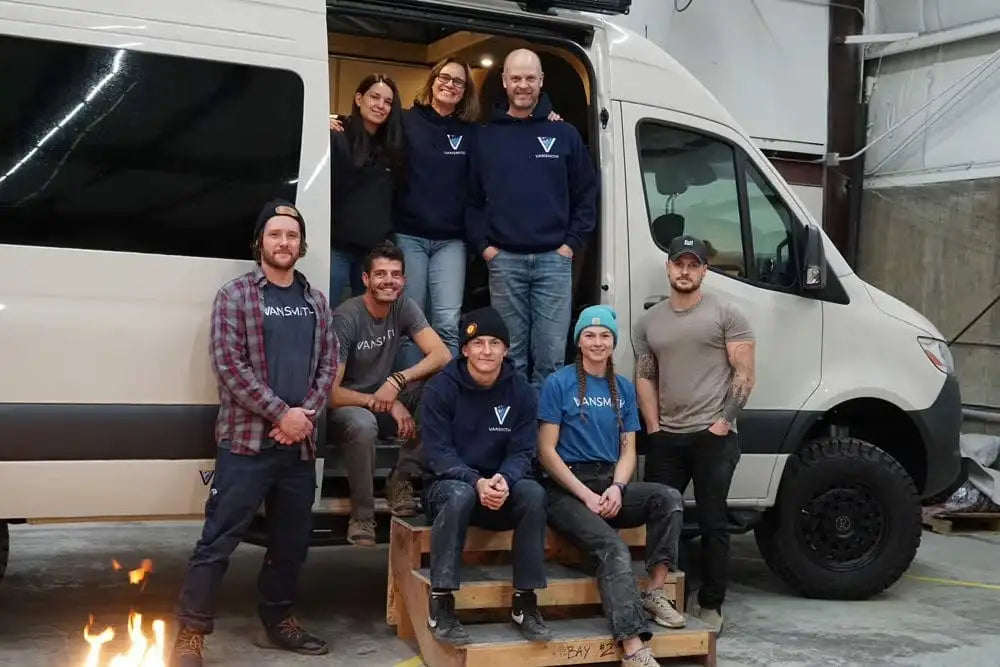
The Vansmith has been family-owned since 2016 and has crafted more than 300 vans across both platforms and multiple wheelbases.
Nine tailored layouts plus three pre-built Bivy trims provide options for different sleeping arrangements, storage needs and travel styles. For Hawaii, a tailored layout can make it easier to prioritize tropical-weather equipment and avoid paying for features you are unlikely to use.
Lithium battery storage, solar, DC-DC charging, shore power, inverter capacity and monitoring are planned as an integrated system. In Hawaii's sunny climate, a properly specified system helps turn available sunlight into practical, usable power.
The Vansmith crafts camper vans in Boulder, Colorado, with attention to the electrical, insulation, ventilation and storage systems that support extended travel. For a vehicle being shipped across the Pacific, careful planning of the specification and delivery requirements is especially important.
The Vansmith provides service and upgrade work through its Boulder shop. Contact the team for current review information, service availability and support options for an owner based in Hawaii. Discussing remote ownership and service needs before purchase helps set clear expectations.
Design calls can be conducted over video, with build photos throughout the process and staged payments. The stated payment schedule is a $2,500 design deposit, 50% at design approval, 25% at build launch and 25% at handover. Review our process and confirm current payment terms with the team.
The Vansmith can arrange ocean freight to Honolulu as part of the purchase. Because a high-roof camper van is a tall vehicle, the finished dimensions are confirmed before obtaining a specific freight quote.
Use the van designer and the Bivy comparison to evaluate available layouts and equipment. Bring the parking height and space measurements for your intended storage location to the design call, as these can affect which configuration is practical for Oahu.
Ocean freight is quoted for your specific vehicle using the carrier's current rates and the van's finished dimensions. The Vansmith can provide a specific quote before you commit, allowing you to consider shipping alongside the purchase price and Hawaii registration costs.
Tailored builds typically take 12 to 16 weeks, while pre-built Bivy models typically take 8 to 10 weeks. Ocean freight adds time beyond the build or preparation period, so plan for a longer overall timeline than a mainland purchase.
The original owner receives a lifetime cabinetry warranty. Service and upgrade work is available through The Vansmith's Boulder shop, while appliance coverage is provided by the relevant manufacturers. Discuss support arrangements for Hawaii before placing your order.
Explore camper vans for sale, tailored models and inspected used vans.
Use the van designer and the Bivy comparison to compare configurations, equipment and pricing.
The technical specifications above cover key systems and Hawaii-specific considerations. Explore our electrical system and solar installation pages for additional details. Use the RV loan calculator to estimate monthly payments.
Call (303) 414-6834 or use our contact page to discuss your layout, equipment, freight and delivery options.
Ask for an itemized quote covering the selected vehicle and equipment, plus ocean freight. You can also read how to finance a camper van and use the RV loan calculator to plan your budget.
Call (303) 414-6834 or visit our contact page to start planning your Honolulu camper van purchase.
Ready to start planning? Browse camper vans for sale, compare tailored models, or call (303) 414-6834 to discuss your Hawaii travel plans.









Email: info@thevansmith.com
Text: 303-414-6834
Form: Tell us what you need
Call: 303-414-6834
Book a call:
(We are currently not booking any new service work while we revamp our service department.)
Visit us (by appointment):


