
DUO

Mercedes Sprinter 144
OR
Ford Transit 148

Perfect for solo travelers or couples who want a compact adventure-ready van.
Seat & Sleeps
2Length
19'Shower
Exterior * * Optional Add-OnsClass B RVs, Conversion Vans & Campervans for Sale in Eugene, OR
Mercedes Sprinter 144
OR
Ford Transit 148
Perfect for solo travelers or couples who want a compact adventure-ready van.
Seat & Sleeps
2Length
19'Shower
Exterior * * Optional Add-Ons
Mercedes Sprinter 144
OR
Ford Transit 148

Includes a shower setup for longer trips without compromising comfort or space.
Seat & Sleeps
2Length
19'Shower
Bench * * Optional Add-Ons
Mercedes Sprinter 170
OR
Ford Transit 148 E

Ideal for those who want extra living space and more storage for extended adventures.
Seat & Sleeps
2Length
22'Shower
Full
Mercedes Sprinter 170
OR
Ford Transit 148 E

Luxury model with full amenities, extended power systems, and interior bathroom.
Seat & Sleeps
2Length
22'Shower
Full
Mercedes Sprinter 144
OR
Ford Transit 148

Perfect for families who want space, comfort, and functionality in a compact build.
Seat & Sleeps
4Length
19'Shower
Exterior * * Optional Add-Ons
Mercedes Sprinter 170
OR
Ford Transit 148 E

A larger build for families who love extended adventures and more storage.
Seat & Sleeps
4Length
22'Shower
Bench * * Optional Add-Ons
Mercedes Sprinter 170
OR
Ford Transit 148 E

The luxury upgrade with interior shower and full power systems for long trips.
Seat & Sleeps
4Length
22'Shower
Full
Eugene sits where the Willamette Valley meets the Cascades, with the Oregon coast an hour west and the McKenzie River corridor running east into the mountains. It is one of the best van towns in the country for access. The thing that decides whether a camper van works here is not any of that. It is moisture.
Eugene gets substantial rain from October through May. A van that manages condensation well is comfortable through a Pacific Northwest winter. One that does not grows mold behind the wall panels within a couple of seasons. The Vansmith builds Mercedes-Benz Sprinter and Ford Transit camper vans in Boulder, Colorado, and delivers them to buyers across western Oregon. Conversion packages start at $46,950, complete vans with the chassis included start at $115,950, and pre-built Bivy models run from $119,700 to $192,570. For the statewide picture, see
camper vans in Oregon.
Boots, shells and packs come back wet most of the year. A gear garage with a washable floor keeps that out of the bed and the galley.
Oakridge is an hour southeast and one of the best riding areas in the country. Bikes travel in the gear garage or on a rear or roof rack.
Tents, tarps and chairs often get packed away damp. Store them where air can move around them rather than sealed in a cabinet.
Dedicated hooks and a ventilated space near the door make a real difference when you are in and out of the rain all day.
An exterior shower for rinsing salt and sand, plus roof racks for boards.
Rods, waders and tackle store along the side walls or in the gear garage, which can be hosed out.
A raised bed creates the single most useful storage area in the van, accessible from inside and through the rear doors.
Sealed, washable rear storage keeps the wet and muddy items contained and separate from anything that needs to stay dry.
| Technical Specification | Eugene Requirement | Why It Matters | What We Build |
|---|---|---|---|
| Insulation | Coverage on all six sides | Keeps interior surfaces above the dew point, which is what prevents condensation | Full insulation with attention to thermal bridging at the ribs; Havelock wool in Bivy models |
| Heating system | Reliable heat that dries the air | A heater does double duty in a damp climate, warming and drying together | Fuel-fired air heater running off the vehicle's own fuel tank |
| Ventilation | Continuous controlled airflow | The primary defense against interior moisture | Powered roof fan with variable speed and direction, run while cooking and sleeping |
| Moisture management | Airflow paths and sealed surfaces | Damp air must have somewhere to go rather than condensing behind panels | Airflow routed behind cabinets, sealed cabinetry, washable surfaces |
| Solar capacity | Supplemental generation | Useful May to September, contributes little under heavy winter cloud | Array sized to roof and layout, with winter expectations set honestly |
| Battery capacity | Sized to overnight load | Supports the fridge, lighting and heater fan through a dark winter night | Lithium bank sized around your largest overnight load |
| Alternator charging | Charging while driving | Does most of the work from November through March | DC-DC charger fitted on every build |
| Shore power | External charging | Useful at Oregon state park campgrounds and at home | Onboard charger and shore connection on every build |
| Fresh water capacity | Sized to trip length | Supports longer trips away from services | Tanks sized to your realistic route |
| Wastewater capacity | Matched gray tank | Determines waste management at dispersed sites | Gray capacity matched to fresh |
| Ground clearance | Suitable for forest access | Willamette and Siuslaw roads vary widely | Suspension and tire upgrades available where routes justify them |
| Tire specification | Wet and mixed surface | Wet pavement and gravel both need the right tire | Chosen around your routes; confirm sizing for your chassis |
| Payload capacity | Capacity for bikes and gear | Equipment, water and passengers add up | Confirm GVWR against final build weight for your chassis |
| Storage capacity | Dry and wet separated | Dry storage is particularly valuable in a rainy climate | Gear garage under a raised bed for wet gear, sealed cabinets for dry |
| Vehicle length | Practical for city and campgrounds | Approx. 19.5 ft short wheelbase or 22.5 ft extended | Choose around parking and forest road access |
| Vehicle height | Garage and covered storage | Roughly 9 to 10 ft in high roof form | Measure your garage door opening before ordering |
| Refrigeration | Reliable food storage | Supports longer Pacific Northwest trips | 12V compressor fridge, low draw in cool weather |
| Electrical monitoring | Real-time state of charge | Matters on a gray four-day stretch when solar contributes little | Battery monitor included on every build |
Exact figures for payload, ground clearance, tire sizing and vehicle dimensions depend on the chassis, trim and drivetrain you choose. We confirm each against your build during the design call.
Nine tailored layouts across the two-person DUO Series and the four-person FAMILY Series, plus three pre-built Bivy trims. Browse all tailored models .
A Class B is a camper built on a van chassis rather than a truck frame. It parks in a standard space, fits most home garages, and drives like a tall van. Browse our Class B RVs for sale .
If you already own a Sprinter or Transit, a conversion package turns it into a camper without buying a second vehicle, starting at $46,950. A conversion van for sale in Eugene, Oregon is built to order in Boulder and either delivered or collected. A Foundation shell starts at $9,970 for self-builders.
Current stock, including inspected used vans, is listed on our camper vans for sale page.
Use our van designer or call (303) 414-6834 for a fixed, itemized quote.
Eugene's wet season runs roughly October through May. It is rarely torrential, but it is persistent, and persistent damp is harder on a van interior than occasional heavy rain.
This is the defining issue for a Eugene camper van, so it is worth understanding properly. Two people breathing and cooking inside a closed van overnight release a significant amount of water vapor. In cool weather that vapor condenses on every cold surface it reaches: windows, the metal ribs behind the wall panels, the underside of the roof. Left alone it produces damp bedding, foggy windows and eventually mold in places you cannot see. The fix is not a dehumidifier. It is insulation that keeps interior surfaces above the dew point, continuous airflow that carries moist air out, and a heater that dries the air as it warms it.
Eugene summers are pleasant but a van parked in direct sun still gets far hotter than the outside air. A roof fan and insulated window covers handle most of it without air conditioning.
Willamette and Siuslaw National Forest access roads range from graded gravel to rough and rutted. Ground clearance and appropriate tires matter more than drivetrain on most of them.
Highway 126 reaches Florence in about an hour. Expect wind, salt air and cool damp nights even in August.
The McKenzie corridor climbs east toward the high Cascades, with Highway 242 over McKenzie Pass closing seasonally under snow.
Portland is two hours north, Crater Lake about three southeast, and the redwoods four to five hours south.
Wet gear is the constant here. Rain shells, muddy boots, dripping tents and damp wetsuits all need somewhere that is not the living space.
An hour west via Highway 126 to Florence, then Highway 101 in either direction. Oregon state park campgrounds along the coast book out well ahead in summer.
Between Eugene and the coast, including the Oregon Dunes south of Florence.
East of the city, with hot springs, waterfalls and dispersed camping down forest roads.
The Three Sisters Wilderness and the high Cascades are two to three hours east, with snow lingering into early summer at elevation.
Highway 126 east follows the river past waterfalls and hot springs. The McKenzie River Trail is a well-known ride.
About three hours southeast. The rim road closes under snow for much of the year, so check current conditions.
Bend is roughly two and a half hours east over the Cascades, with dry high-desert air and cold nights year-round.
Ashland, the Rogue Valley and the Oregon Caves are three to four hours south.
Portland is two hours north and the redwoods four to five hours south. See our Vancouver, WA and Sacramento pages.
Roof penetrations are where water finds its way in. Fans, vents, solar mounts and antenna bases all need properly installed seals, and they are worth inspecting each spring.
Insulation keeps interior surfaces warm enough that moisture does not condense on them. Without it, the metal ribs behind your wall panels become the coldest surfaces in the van and collect water where you cannot see it.
A running heater plus a roof fan dries gear faster than either alone. Hang wet items where air moves around them rather than packing them away damp.
This is the part people get wrong. The instinct is to close everything up when it rains, but that traps moisture inside. A powered roof fan lets you keep air moving with the windows shut.
Sealed cabinetry for anything that must stay dry, and a separate washable gear garage for everything that will not.
Open the van up and run the fan when you get home rather than closing it and walking away. Check seals each spring, and rinse the underbody after coastal trips because salt air is as corrosive as road salt.
A used van costs less and is available sooner, but in the Pacific Northwest the single biggest risk is hidden moisture damage. Before you buy, check under the floor, behind wall panels where accessible, around roof fans and windows, and in the corners of cabinets. Trust your nose: a musty smell almost always means water has been getting in somewhere.
We keep a rotating selection of inspected used camper vans that ship from Boulder. For private listings, use our used van buying checklist and read buying new vs. used .
Two-person layout on a Sprinter 144 or Transit 148, about 19.5 feet, with a convertible VersaBed, full galley and gear storage. From $46,950 as a conversion.
The same short footprint with a bench shower inside, which earns its place after a wet day outdoors. From $53,950 as a conversion.
Extended platform around 22.5 feet, with more storage and a flexible sleeping system.
The most complete two-person layout, with a full interior bathroom and extended power. From $63,950 as a conversion.
Four seatbelts and four berths on the short wheelbase. From $51,950 as a conversion.
Extended family layout with a bench shower and extra storage. From $61,950 as a conversion.
Full interior shower and full power systems for longer trips without hookups. From $68,950 as a conversion.
Pre-built on a Sprinter 144 AWD with a pop-top and four-season Havelock wool insulation, which handles moisture well. Ready in 8 to 10 weeks. Classic from $119,700, Plus from $145,845, Deluxe from $192,570. See our Bivy comparison .
For Eugene buyers, the useful question is how much wet gear you carry. If your trips involve surfing, mountain biking or multi-day hiking in the rain, a layout with a raised bed and a generous gear garage matters more than extra living space. If you mostly do dry-season coast and Cascade trips, a short-wheelbase DUO covers it comfortably.
Conversion packages on a van you already own start at $46,950 for the DUO, $53,950 for the DUO S, $63,950 for the DUO XLS, $51,950 for the FAMILY, $61,950 for the FAMILY XL and $68,950 for the FAMILY XLS. Complete vans with the chassis included start at $115,950. Pre-built Bivy models run $119,700, $145,845 and $192,570 by trim, all ready in 8 to 10 weeks.
Our van conversion cost breakdown shows how these numbers come together, and our Financing calculator estimates monthly payments.
Every tailored layout on the Sprinter 144 or 170, plus the pre-built Bivy on a Sprinter 144 AWD. See our Sprinter van conversion lineup and Sprinter camper for sale listings.
The DUO and FAMILY layouts on the Transit 148 and 148 extended, including AWD. See our Ford Transit conversion builds.
Nine tailored layouts, three pre-built Bivy trims and a Foundation shell for self-builders.
Battery, solar, charging and monitoring specified as one system. See our Electrical System work and Solar Installation page.
A gear garage beneath a raised bed, designed so wet equipment stays separate from the living space.
Moisture management is not an afterthought in our builds. Insulation coverage, airflow paths behind cabinets and roof fan specification are all decided with damp climates in mind.
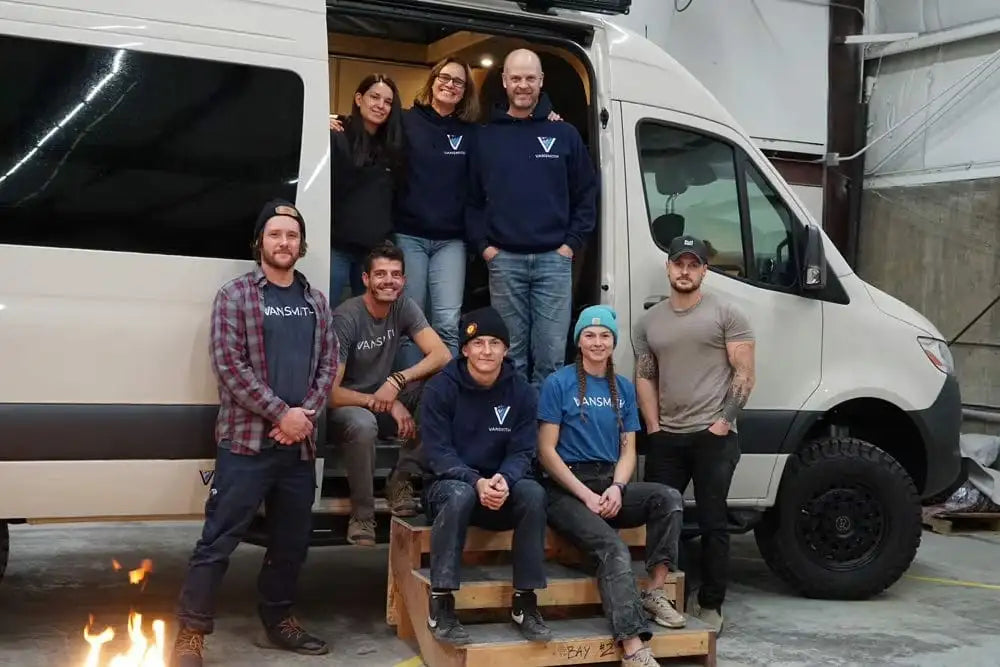
Every system installed by our own team, so the people who wired your van can service it later. See Repairs, installations, and services and Heater Service .
Design, approve and pay from Eugene over video and email.
Pickup in Boulder or transport to your door. We deliver across all 50 states .
Ready to find the right camper van for sale in Eugene, Oregon? Design your van , browse vans available now , or call (303) 414-6834 to talk with a builder. See camper vans in Oregon , or our Vancouver, WA and Seattle pages.









Email: info@thevansmith.com
Text: 303-414-6834
Form: Tell us what you need
Call: 303-414-6834
Book a call:
(We are currently not booking any new service work while we revamp our service department.)
Visit us (by appointment):
