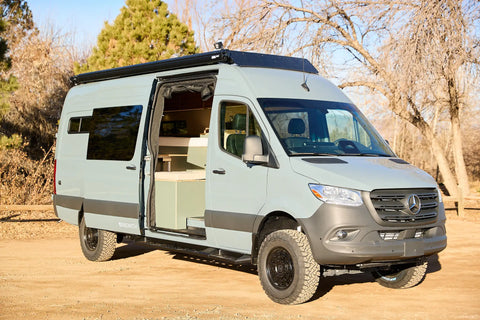
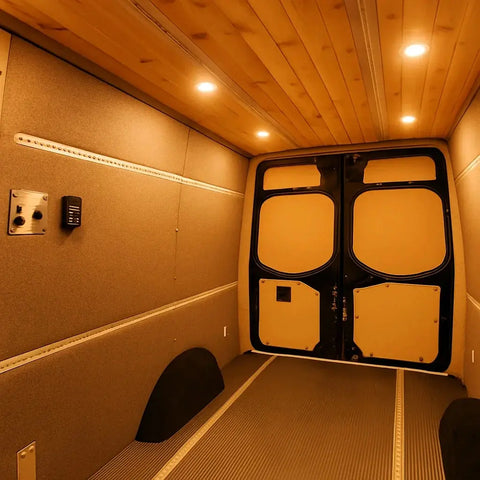
A rear storage box for Sprinter van setups works best when the whole rear-door system is planned around about 100 pounds of rated load, not just around box size. Which setup fits you comes down to hinge type, how often you open the rear doors, and whether your gear is bulky, dense, or just plain messy. In most cases, a door-mounted box shines when you want fast daily access and want to keep muddy or wet gear out of the cabin. It makes less sense if your rear doors already carry too much hardware or if your hinge setup rules out the box you want.
How to choose a rear storage box for a Sprinter van
The first thing to know is simple: most rear storage boxes are not direct-to-door products. They usually mount to a carrier, base rack, or ladder system. For example, Owl says the Monster Box 30 needs a rear door carrier, and Aluminess shows its box and tire carrier depends on a rear door ladder structure.
That matters because you are not really buying just a box. You are buying into a mounting ecosystem. In our Boulder shop, the better question is rarely, "Which box is biggest?" It is usually, "What gear needs to live outside all season, and how often do you need rear-door access?"
Rear-door systems also solve a different problem than bumper swing-arms. A door-mounted box moves with the door, so your storage opens when the rear door opens. Owl leans hard on that rear-door access benefit, and it is easy to see why if you open the back of your van every day.
Departure angle is another big reason people choose a door-mounted van exterior storage box. Owl says its Sherpa keeps that angle because the gear stays on the rear door instead of hanging off a bumper structure. If your van sees rough roads or steep driveways, that can matter more than raw box volume.
Load ratings tend to cluster in a pretty tight range. Current rear-door systems often land around 100 pounds for a mounted box or carrier assembly, while a supporting base rack can go up to 200 pounds when evenly spread while traveling. So the real choice is about total system weight, not just which box looks roomy.
Hinge fitment can end the search fast. Owl says its 2019 and newer VS30 rear-door products need 180-degree hinges, while Aluminess advertises one 2019 to 2026 rear-door box and tire rack for both 180-degree and 270-degree hinges. Before you compare brands, check your hinges.
One more layer sits under all of this. Mercedes-Benz treats its bodybuilder guidance as the OEM baseline for upfitters, so accessory instructions should be checked against factory mounting and corrosion guidance before install. That's extra boring, maybe, but it is part of doing the job right.
Rear-door box vs bumper swing-arm
A sprinter rear door storage box is usually easier in daily use. The box moves with the door, so you do not have to unlatch a swing-arm first. If you are grabbing chairs, hoses, or recovery boards at camp, that one-step access feels better fast.
A bumper swing-arm does have one clear edge. It can move weight off the door and hinges. The trade-off is more hardware behind the van and more steps every time you want into the cargo area.
Door-mounted systems also tend to preserve departure angle better. That is one of the core claims behind Owl's Sherpa carrier. If you care about the back of the van not dragging, that point carries real weight.
The choice gets trickier once you add more rear gear. Spare tire, fuel, and water all compete for the same load budget and the same door geometry. Aluminess even notes that moving the spare to the rear door can free underbody space for extra fuel or water tanks, which can make a rear-door strategy part of a bigger build plan.
For vans with hitch bike racks or rear steps, a door-mounted box can package more cleanly than a full swing-arm bumper. The hitch area stays less crowded. Still, the rear door has to clear those parts when it opens, and that is where clearance checks become more than a paper exercise.
At The Vansmith, the regret usually shows up when someone buys for the once-a-year trip instead of the weekly routine. A box for dirty recovery gear is great. A box that makes every grocery stop annoying usually stops feeling cool after a few trips.
Who actually benefits from exterior storage
Exterior storage makes the most sense for dirty, wet, or awkward gear. Think recovery gear, hoses, tools, muddy camp gear, and outdoor stuff you do not want near bedding or food. Owl markets its Monster boxes for gear and tools, which lines up with how most people use them.
A compact box is often enough. The Monster Box 30 gives you 6.6 cubic feet, which is useful, but it is still much smaller than true interior garage storage. That is why exterior boxes work best as support storage, not as a replacement for smart interior planning.
Larger boxes can help, but they raise the stakes on compatibility and weight planning. The Monster 40 is the larger option in Owl's line, and it still depends on the carrier system doing the real support work. Bigger box does not mean bigger payload.
If your interior layout is already dialed, a rear box can protect that livability. You keep utility gear outside and save the bed, galley, and aisle for actual living. That is often the sweet spot for couples looking at van layouts for two or families comparing family van conversions.
For most family and couple builds, people are happiest when the exterior box holds niche gear, not daily essentials. Most builders want the biggest box. Or they think they do, until they see what it costs them in door weight and easy access. If you are still not sure, it helps to compare interior-first layouts like the DUO XL or Family XL before adding more hardware outside.
Rear door storage box options and mounting ecosystems
 The market splits into two broad camps. One is carrier-first, where you start with the support rack and then add accessories. The other is an integrated rack, ladder, and box setup that is designed to work as one package.
Owl is the clear carrier-first example. Its rear-door setup centers on the Sherpa cargo carrier, then adds boxes like the Monster 30 or Monster 40. Aluminess takes a more integrated route with a rear door base unit, ladder structure, and box or tire rack combinations.
Owl's Sherpa is a modular aluminum rear-door cargo carrier with a published load capacity of up to 100 pounds. That makes it a useful benchmark. Not because it carries everything, but because it shows the class these systems live in.
The Aluminess rear door box and tire rack for 2019 to 2026 Sprinters stands out for a different reason. It bolts to factory door locations with no drilling required, and Aluminess advertises it for both 180-degree and 270-degree hinges. For some owners, that fitment range is the deciding factor.
Real installs rarely happen on a blank van. Ladder, spare tire, hitch gear, rear step, and even suspension setup can change what feels clean and what feels cramped. That is why we usually look at the whole rear package, then work backward to the best storage choice.
Owl Sherpa and Monster Box combinations
The Sherpa is the backbone of Owl's rear-door ecosystem. Owl describes it as a modular rear door cargo carrier for Sprinter vans. It is built from lightweight aluminum, which matters because every pound of hardware eats into your remaining cargo allowance.
Owl publishes the Sherpa at up to 100 pounds of load capacity. That number is easy to misread. You need to count the carrier, the box, and the packed gear together, not assume the box alone gets 100 pounds.
The Monster Box 30 is pre-drilled for Owl B2 and B2 Pro carrier systems and requires a rear door carrier to mount. The Monster 40 follows the same logic with integrated mounting points and pre-drilling for those carrier systems. In both cases, the box is part of a system, not a direct-mount shortcut.
Both Owl boxes add a nice usability touch. The top door lifts up, and the lower section folds down into a work surface. If you have ever set a muddy recovery strap on a bumper in February and watched it slide off into slush, that little fold-down shelf starts to look pretty smart.
In our experience, Owl-style systems fit owners who want modular add-ons and who are willing to stay strict about load math. That discipline matters. Dense gear can use up your budget faster than expected.
Aluminess rear-door rack, ladder, and box systems
Aluminess takes a more integrated approach. Its 2019 to 2026 Sprinter rear door box and tire rack is sold as a bolt-on setup that uses factory door locations and needs no drilling. For buyers who want to avoid permanent body changes, that is a big plus.
The install documents add needed context. The box and tire carrier instructions state a 100-pound maximum load once installed. Those same instructions also say the carrier must be used with the company's rear door ladder system, which shows how even a simple-looking box still relies on a broader structure.
Aluminess also publishes a rear door base unit manual with a 200-pound evenly distributed rating while traveling. The base unit instructions also walk through Torx fastener removal, bracket placement, and clearance checks. That is a good reminder that fitment is about geometry as much as it is about bolts.
One fitment detail many buyers miss is dually compatibility. Aluminess notes a specific incompatibility with dually Sprinter applications in the bolt-on box and tire carrier instructions. Shopping by photos alone will not catch that.
From a shop view, integrated systems are easier to recommend when you want one brand's tested package. Mixing ladders, carriers, and boxes from different brands can work, but it often makes the install harder to predict.
Weight limits, hinge compatibility, and real-world load planning
 The most useful number in this whole category is not cubic feet. It is the published system load limit. Aluminess states 100 pounds maximum on the installed box and tire rack, and 200 pounds evenly spread on the base unit while traveling.
Owl puts the Sherpa in the same general class with a published capacity of up to 100 pounds. That tells you these are moderate-load solutions. They are great for the right gear, but they are not unlimited cargo platforms.
Hinge type can decide the purchase before weight does. Owl says its 2019 and newer VS30 rear-door products require 180-degree hinges unless you change the hinges. Aluminess advertises one rear-door box and tire rack for both 180-degree and 270-degree hinges, which can make the path simpler for some vans.
OEM guidance still matters here. Mercedes' small-conversion manual puts real emphasis on proper drilling and corrosion protection. Even when a product is sold as bolt-on, that factory guidance is still the baseline.
Clearance geometry matters just as much as static weight. A box can technically fit, then still hit a ladder, light, or door edge once everything is tightened and loaded. In practice, we start with the published limit, then check the whole rear system: box weight, carrier weight, spare tire, hinge style, and how the owner will actually use it week after week.
Published load ratings you can actually use
Aluminess gives a clear 100-pound maximum for the installed box and tire rack assembly. Read that as the total allowable load on the mounted accessory. It is not a dare, and it is not extra room on top of the hardware weight.
Its base unit rating is different. Aluminess specifies 200 pounds evenly distributed on the rear door base rack while traveling. That helps because it separates a structural rack rating from the rating of one specific accessory mounted to it.
Owl's Sherpa also lands at up to 100 pounds. So if you are comparing systems, you need to sort out three different numbers: carrier capacity, accessory capacity, and actual packed cargo after hardware weight. Brands do not always present those numbers the same way.
A larger box does not mean a higher usable payload. The Monster 40 is a good example. It gives you more volume, but it still lives inside the carrier's load strategy.
One thing a lot of builders overlook is how fast dense gear adds up. Recovery gear, tools, and chains can burn through that load budget long before the box looks full. Big difference.
Hinges, door swing, and clearance checks
For a lot of buyers, hinge type is the first filter. Owl states that its rear-door products for 2019 and newer VS30 Sprinters require 180-degree hinges unless the hinges are swapped. If your van has 270-degree hinges, that can end the conversation right there.
Aluminess makes a broader fitment claim on its 2019 to 2026 rear door box and tire rack by advertising both 180-degree and 270-degree compatibility. That can save time and simplify the plan. Still, hinge compatibility alone does not guarantee a clean install.
The base unit instructions include clearance checks for a reason. Brackets, door edges, ladders, and nearby accessories all affect how the door swings. If your van already has rear cameras, lights, or other door gear, each part can change the opening angle or create a contact point.
In the shop, hinge issues are one of the fastest ways a good product turns into a poor install candidate. Confirming hinge style early saves time, money, and the headache of buying into the wrong ecosystem.
Installation realities: bolt-on, drilling, and OEM guidance
Not all rear box installs ask the same from the van. Aluminess markets its rear door box and tire rack as a no-drill setup that bolts to factory door locations. That is appealing if you want to keep changes as reversible as possible.
But bolt-on does not mean standalone. Aluminess still requires the correct ladder or support hardware, and Owl's Monster boxes still require a rear door carrier. So even the easiest install in this category is really a system install.
Mercedes' bodybuilder portal is the OEM starting point for install-sensitive choices, and the small-conversion manual backs that up with guidance on drilling and corrosion protection. That matters most any time an install moves beyond factory mounting points.
The rear of a van is one of the most crowded zones on a build. Ladders, spare tires, rear cameras, bike racks, and hitch gear all want the same space. That is why a rear storage box install often goes best when it is planned alongside Foundation builds or other rear accessory work, not treated like a last-minute add-on.
What 'no drilling' really means
No drilling is a useful claim, but it has limits. Aluminess says its rear door box and tire rack bolts to factory door locations with no drilling required. That reduces one major risk, but it does not make the install universal, tool-free, or free from fitment checks.
If drilling does enter the picture on any rear-door project, corrosion control matters. Mercedes calls that out in its small-conversion guidance for good reason. Untreated holes and poor sealing can create long-term rust issues.
Owl's product language is a good reminder here too. The Monster 30 and Monster 40 may be pre-drilled, but they still are not direct-mount boxes. The install starts with the right carrier, then works outward from there.
After hardware is torqued, the job still is not done. Rear-door installs should be checked for alignment, latch feel, opening angle, and interference once the van is loaded and used. The cleanest installs are usually the ones planned as a full rear system from the start.
When professional installation makes sense
Professional install makes more sense once the van already has mixed-brand rear accessories. Most instructions assume the maker's own ecosystem, not a custom mix. That is true in Owl's carrier-first world and in Aluminess' ladder and base-unit approach.
It also helps when hinge fitment is unclear. Owl's 180-degree requirement for 2019 and newer VS30 rear-door products is a good example of a detail that can derail the project before the box even goes on. Catching that early saves a lot of backtracking.
A shop can also read OEM guidance against the real van in front of it. That means looking at corrosion-sensitive mounting points, hardware choices, and how the rear system works as one package. We often bundle box installs with ladder or tire-carrier work, hitch attachments, or suspension upgrades so one upgrade does not block the next.
If you are still deciding between a full layout and targeted upgrades, Customize your van and the Foundation page are the best next stops. If your van is already part of a larger travel build, it is usually smarter to judge the rear box as part of the whole cargo plan.
Cost, trade-offs, and the best setup for daily use
The real cost is not just the box. It is the carrier or base rack, any ladder requirement, hardware, and install labor. The source documents make that plain, because both Owl and Aluminess tie their boxes to larger support systems.
A smaller box can be the better value if it solves the actual problem. With door-system load limits around 100 pounds, buying more volume does not always buy more useful heavy-gear capacity. Sometimes it just buys empty space you cannot pack densely.
The daily-use premium of a rear-door system is easy access. Open the door, and the box comes with it. That advantage is strongest for people who use the rear doors all the time and weakest for people who only reach rear gear once in a while.
The main trade-off against a swing-arm is where the load lives. Rear-door systems keep departure angle and simplify access, but they make hinge fitment, door loading, and clearance planning more important. If underbody space matters for future upgrades, a rear-door spare and box setup can also free space elsewhere on the van.
| Setup | Published load rating | Mounting notes |
|---|---|---|
| Owl Sherpa carrier | Up to 100 lb | Rear-door carrier ecosystem, 2019+ VS30 products require 180-degree hinges |
| Owl Monster Box 30 | Depends on carrier system | 6.6 cu ft, requires rear door carrier, pre-drilled for B2 and B2 Pro |
| Owl Monster Box 40 | Depends on carrier system | Larger box, integrated mounting points, pre-drilled for B2 and B2 Pro |
| Aluminess box and tire rack | 100 lb max | Bolt-on to factory door locations, requires Aluminess ladder, advertised for 180-degree and 270-degree hinges |
| Aluminess rear door base unit | 200 lb evenly distributed | Base rack rating while traveling, system-level support structure |
In our experience, the best daily-use setup is usually a moderate-size box packed with discipline. Keep dirty gear outside, but do not make the rear doors feel heavy or awkward. That balance tends to age well.
What buyers often underestimate
Most people underestimate how many parts sit behind a simple-looking box purchase. Carrier, ladder, base unit, hardware, and hinge fitment all shape the result. Both Owl and Aluminess make it clear that the box is only one piece of the system.
They also underestimate weight. A published 100-pound limit leaves less room once the mounted accessory itself is part of that total. Heavy tools and recovery gear can hit the limit long before the box looks full.
Hinge fitment is another common miss. Owl's 180-degree requirement on 2019 and newer VS30 rear-door products means some owners have to change plans before they pick that route. And many people judge the setup in a parking lot, then forget how repeated opening, rough roads, and real packing habits change the feel over time.
The best storage upgrade is the one that cuts interior clutter without turning the rear doors into a daily annoyance. If the van is still in planning, it is usually cleaner to integrate exterior storage into the build early. You can see that bigger-picture approach on our Sprinter conversions pages and in the DIY blog if you want more context first.
Best next step for a Sprinter owner
Start by confirming hinge type and current rear accessories. Those two details rule out bad options faster than brand preference does. If your van has 270-degree hinges, for example, that changes the field right away.
Next, define the cargo by weight and use frequency, not just by volume. Published ratings from Owl and Aluminess show that dense gear can be the limit before space runs out. Then decide if preserving departure angle and one-motion rear-door access matter more to you than moving weight off the door with a swing-arm.
Use Mercedes upfitter guidance as the baseline if any install involves drilling, hardware changes, or corrosion-sensitive mounting. After that, the practical next step is simple: if you are ready for rear storage or related upgrades, head to Contact us. If the storage question is really a layout question, compare interior-first solutions through our Sprinter conversion collection.
FAQ
What is the best rear storage box for a Sprinter van?
The best rear storage box for a Sprinter van depends on hinge type, mounting ecosystem, and how much weight you need to carry. Owl's Sherpa is rated up to 100 pounds and supports add-on boxes like the Monster 30, while Aluminess offers a 2019 to 2026 rear door box and tire rack that bolts to factory door locations and is advertised for both 180-degree and 270-degree hinges. In practice, the best choice is the one that fits your door hardware and daily use, not the one with the biggest shell.
How much weight can a Sprinter rear door storage box hold?
Published ratings vary by system, but current documents commonly show about 100 pounds for the mounted box or carrier assembly. Aluminess states a 100-pound maximum for its installed box and tire rack, and Owl lists up to 100 pounds for the Sherpa rear-door carrier. The key is to count the hardware and the packed gear together, because the rating is for the whole mounted setup.
Do Sprinter rear door storage boxes require drilling?
Some do, and some do not. Aluminess says its 2019 to 2026 rear door box and tire rack bolts to factory door locations with no drilling required, which is appealing for owners who want a cleaner install path. Even then, Mercedes still expects upfitters to follow current mounting and corrosion guidance any time modifications are made or hardware choices affect the body.
Will a rear door storage box work with 270-degree Sprinter hinges?
Not always. Owl states its 2019 and newer VS30 rear-door products require 180-degree hinges unless the hinges are changed, while Aluminess advertises compatibility with both 180-degree and 270-degree hinges for one of its 2019 to 2026 rear door box and tire rack products. That is why hinge type is one of the first things to confirm before you buy anything.
Is a rear door box better than a swing-arm for van exterior storage?
A rear-door box is usually better for quick daily access because it opens with the door and can preserve departure angle. A swing-arm can move weight off the door, but it usually adds another latch-and-swing step before you can open the rear of the van. For most daily drivers, the better answer comes down to how often you use the rear doors and how much rear-door load you are comfortable carrying.