Upper Pines is Yosemite’s only year-round reservable campground, and sites release five months ahead on the 15th at 7:00 a.m. Pacific. If you want a park-once basecamp, this is one of the best options in the valley. To get one, you need to understand the booking window, choose your site area with walkability in mind, and treat food storage as part of camp setup.
The photo above shows Half Dome rising above the Merced River on the floor of Yosemite Valley. Upper Pines sits on the valley floor near Curry Village, so this is the landscape you are camping in. (Photo: Dexter Perkins, CC0)
Why Upper Pines is the Yosemite Valley camping choice people compete for

The photo above shows Half Dome above a meadow on the Yosemite Valley floor. Staying in the valley puts views like this within walking or shuttle distance of your campsite. (Photo: Jon Sullivan, public domain)
Upper Pines Campground sits in Yosemite Valley and is part of the three Pines campgrounds: Upper, Lower, and North Pines, according to the National Park Service Pines Campgrounds page. That location is a big reason people start here. You’re in the middle of the valley, not way out from the places most visitors actually spend time.
It is also the only campground in Yosemite on reservations all year, according to the NPS camping page. That helps in every season, but it also means booking day gets crowded fast.
The campground connects directly to shuttle stop 15, and the Upper Pines shuttle stop page notes that Curry Village is nearby. Each site also comes with a picnic table, fire ring, and food storage locker on the Upper Pines Recreation.gov listing.
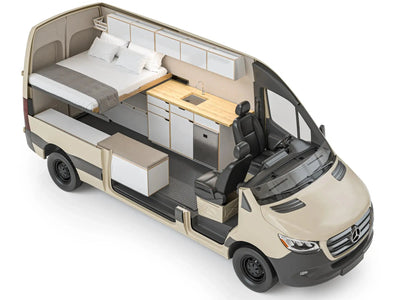
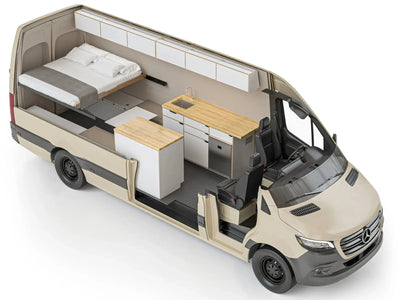
Once you are set up, you can leave the van parked and get around on foot, by bike, or by shuttle. If you are still working out your own layout, start one in our van designer or read about our build process.
Who Upper Pines fits best
Upper Pines makes the most sense if you plan to spend most of your trip in Yosemite Valley. If your days revolve around valley walks, shuttle stops, and nearby services, the location saves you a drive every morning.
The shuttle connection is a real advantage. The official Yosemite Guide places Upper Pines at stop 15, Curry Village at stops 14 and 19, Happy Isles at stop 16, Mirror Lake at stop 17, and Yosemite Village at stops 1, 2, 4, and 5. For families or couples trying to avoid the day-use parking scramble, that setup is hard to ignore.
Upper Pines is not first-come, first-served, and it rewards planning or steady cancellation checks. The food locker at every site helps too, because you don’t have to come up with a food-security plan after you arrive.
Strict food-storage campgrounds are easier when your cookware, toiletries, and pantry items already live in clear zones, so loading the bear box takes minutes. If you’re thinking through storage ideas, our van build blog has more on how daily camp flow shapes a good layout.
What makes it different from just staying anywhere in Yosemite
Lower Pines and North Pines share the valley location and shuttle access, but only Upper Pines takes reservations all year.
The NPS camping page also states that if you are not in a registered campsite, sleeping in a vehicle is not allowed. That matters a lot for van travelers. Yosemite Valley is not a place to wing it if your reservation falls through.
The official place to start is the Pines Campgrounds page, because that’s where you can download the map and see how Upper Pines fits into the broader valley campground cluster. The shuttle stop at the entrance also cuts down on how often you need to move your vehicle after setup. If nearby food, showers, and services matter, Upper Pines has a stronger case than more remote options.
For a park-once trip like this, fast setup, easy bedding access, and simple outdoor gear storage matter more than a complicated interior. You can browse real examples in our Sprinter conversions and Transit conversions.
How Upper Pines reservations work
Upper Pines reservations open up to five months in advance on the 15th of each month at 7:00 a.m. Pacific.
Recreation.gov also notes that sites can sell out in minutes. So release day is not the time for casual browsing. You want to be logged in, ready to pay, and aiming at a small group of acceptable sites instead of one perfect site number.
If your travel dates are tied to school breaks, flights, or fixed time off, set reminders well before the 15th.
The exact release cadence to remember
Arrival dates are released in blocks that run from the 15th of one month through the 14th of the next. Recreation.gov gives this example: on January 15, arrival dates from May 15 to June 14 become available. So a June 5 arrival opens on January 15, not February 15.
Since Upper Pines is reservable all year, winter and shoulder-season trips still need the same attention. A quieter month does not mean an easy booking process.
What happens if you miss out
If you miss the release, NPS advises campers to monitor for cancellations. Recreation.gov is where you’ll see live inventory and site-specific openings. That means your best move is steady checking, not guessing.
The bigger problem is overnighting in the valley. Since sleeping in a vehicle is only allowed when you are in a campsite you are registered for, a missed booking can mean losing the ability to stay in Yosemite Valley on those dates. That’s why backup lodging or alternate campground plans matter.
Recreation.gov says that if you will arrive one or more days late, you need to call (209) 372-8502, and your reservation will be canceled if the campground does not hear from you within 24 hours of your arrival date. You also need to check in at the campground kiosk. If you arrive after hours, Recreation.gov says to sign in and return to the kiosk the next morning to finish check-in, or your reservation may be canceled. Keep a screenshot or download of your reservation handy.
For van trips, a little schedule flex helps. One or two movable nights can make a cancellation opening useful instead of useless.
Upper Pines campground layout and how to pick a site area

The map above is the Upper Pines section of the current NPS Yosemite Valley campgrounds map. The campground entrance and dump station are at the top, off the road toward Lower Pines. Shuttle stop 15 is at the top left corner, on the road that runs along the campground's west side between Curry Village and Happy Isles. Numbered sites sit on loops off a single campground road that runs south from the entrance. The map is not to scale. (Map: National Park Service, public domain)
The official map matters here. The Pines Campgrounds page is where to download it, and it’s the best source for loop orientation and relative position inside the campground. User-made diagrams can help, but the park map is the one to trust first.
Recreation.gov fills in the next piece. It shows individual site listings and live availability, so you can match the map with what is actually bookable on your dates. That cross-check keeps you from choosing a site number without knowing where it sits in the loop.
The shuttle stop is at the entrance, so site choice should reflect how much walking you want to do each day. Every site has the same basics, so you are mostly choosing for location.
How to use the official map well
Start with the NPS map, then look at your site in relation to the entrance and the shuttle stop. That gives you a quick sense of your daily walk to transit. It also helps you picture arrival and departure flow.
Next, cross-check the map with Recreation.gov because that’s where the live inventory lives. The broader valley context on the Pines Campgrounds page also shows how Upper Pines connects to roads, bike routes, and the shuttle network.
If trails are your focus, compare your site’s position with the direction of Happy Isles and Mirror Lake in the Yosemite Guide. If services matter more, compare it with the direction of Curry Village and the shuttle route.
With a longer vehicle, camp chairs, kitchen bins, and bikes, even small in-camp moves take effort, which is another reason to set up once and stay put.
Site-selection trade-offs campers actually feel
On the NPS map, the lower-numbered loops near the entrance are closest to shuttle stop 15. If you plan to ride transit every day, that can be worth a lot. A few extra minutes each way adds up over several days.
Other campers care more about path access toward Curry Village or Happy Isles. If showers, food, or a quick coffee run matter, those same lower-numbered loops are closer to the road toward Curry Village. The high-numbered loops at the south end sit along the road toward Happy Isles.
Because Recreation.gov inventory changes in real time, a good-enough site in the right area is often the smart play. The NPS map is not to scale, so use it for relative position. A site several loops from the entrance means a longer walk when you are carrying kids, bikes, coolers, or climbing gear.
Small routines, like where shoes pile up, where food gets sorted, and how fast you can leave in the morning, shape the stay more than tiny differences between sites. Our family van layouts and vans for couples show two very different ways to solve that daily flow.
Bear box rules at Upper Pines and how Yosemite enforces them

The photo above shows the food storage locker at site 193 in Upper Pines, next to the site's fire ring. The sign on the door says all food must be stored in the locker and to leave no food in your vehicle. (Photo: Mx. Granger, CC0)
Every Upper Pines campsite has a metal food locker. The NPS food locker page says lockers are available in every campsite, and Recreation.gov confirms a food storage locker at each site.
NPS says lockers must be closed and latched at all times, even when you are present. Food, drinks, toiletries, and ice chests (even empty ones) must be stored in the locker, and NPS says to treat trash like food: keep it in the locker or put it in a bear-proof dumpster. The current NPS campground map also says no food in vehicles, except that hard-sided RVs may store food inside if it is not visible and all doors and windows are closed when unattended. The NPS bears page adds that food may not be stored in pop-up or tent trailers or other soft-sided campers. In a van, the simplest approach is to put everything with a scent in the locker.
Yosemite works hard to keep bears from getting human food, and the park’s bears and food storage page makes clear that the rules are enforced.
For van campers, life gets easier when scented items already live in a few bins or drawers. Then moving them to the locker at night takes a couple of minutes. If you are reworking storage in your own rig, contact us about storage upgrades.
Packing for the food locker
A good van strategy is to pack one tote for pantry items and one smaller tote for toiletries and scented odds and ends. That keeps you from unloading half the van every evening.
What the enforcement means in real life
NPS says the food storage rules have the force of federal law. Storing food improperly can lead to impoundment of your food or car, a fine of up to $5,000, or removal from your campsite.
Van campers often carry more scented items than they think. Dog treats, electrolyte mixes, trash, sunscreen, and dish soap are easy to forget.
Fewer loose items means faster compliance and less chance of leaving something on the picnic table.
What you can reach from Upper Pines on foot and by shuttle
Upper Pines is served by shuttle stop 15, and the stop is on both the Valleywide Shuttle and East Valley Shuttle, according to the NPS shuttle stop page. That gives you practical no-car access to a big part of Yosemite Valley.
NPS also notes that Curry Village is near Upper Pines. Happy Isles and Mirror Lake are a stop or two away on the same route. Once you’re set up, you can leave the van parked and move through the day another way.
Curry Village has showers, food, gift and grocery options, and seasonal activities, according to the guide. Yosemite Village is farther away, at stops 1, 2, 4, and 5, but it stays well connected by shuttle.
The easiest nearby destinations
Curry Village is the nearest major services cluster called out by NPS for Upper Pines campers. The Yosemite Guide lists showers, food, and gift and grocery options there.
Happy Isles is the next shuttle stop after Upper Pines, at stop 16. Mirror Lake sits nearby in the same east-valley zone at stop 17. If your trip is built around early starts, those nearby destinations are a real advantage.
What is better by shuttle than by foot

The photo above shows a Yosemite Valley shuttle bus at Sentinel Bridge with Yosemite Falls behind it, taken in 2001 for the Historic American Engineering Record. The buses have changed since then, but the free shuttle still connects the campground with the rest of the valley. (Photo: Brian Grogan, HAER / Library of Congress, public domain)
Yosemite Village is reachable from Upper Pines, but it makes more sense as a shuttle destination than a quick walk. The Yosemite Guide lists the Welcome Center, Village Store, museum, bookstore, dining, and post office there. Those are useful stops, just not next door.
Because the campground stop is on both shuttle lines, you can reach more of the valley without moving your vehicle. Bikes make this even better, especially for errands that feel too far on foot but too small to justify breaking camp.
FAQ
When do Upper Pines reservations open?
Upper Pines reservations are released up to five months in advance on the 15th of each month at 7:00 a.m. Pacific Time. Recreation.gov is the booking platform, and both Recreation.gov and Yosemite National Park use the same timing. Sites can disappear very quickly, so it helps to be logged in before the release starts.
Is Upper Pines the only year-round reservable campground in Yosemite?
Yes. NPS says Upper Pines is the only campground in Yosemite on reservations all year. That year-round status is one reason it gets so competitive, even outside peak summer dates.
Does every Upper Pines campsite have a bear box?
Yes. Recreation.gov says each campsite has a food storage locker, and NPS says metal food lockers are available in every campsite. NPS also says lockers must be closed and latched at all times, even when you are in camp.
What has to go in the bear box at Upper Pines?
NPS says food, drinks, toiletries, and ice chests (even empty ones) must be stored in the locker, and trash goes in the locker or a bear-proof dumpster. Penalties include a fine of up to $5,000, impoundment, or removal from your campsite. The easiest way to handle it is to group scented items before you arrive.
What is near Upper Pines Campground?
Upper Pines is at shuttle stop 15, with Curry Village nearby and Happy Isles at stop 16. Mirror Lake is at stop 17, which keeps it in the easy east-valley cluster. Yosemite Village is farther away, but it is well connected by shuttle and includes the Welcome Center, Village Store, museum, bookstore, dining, and post office.
Can you sleep in your van anywhere in Yosemite Valley if Upper Pines is full?
No. Yosemite states that sleeping in a vehicle is not allowed unless you are in a campsite you are registered for. If Upper Pines is full, you need a confirmed cancellation pickup or another overnight plan before you enter the valley expecting to stay.
About the author

Electra Chronis
Head of Marketing
Electra leads marketing at The Vansmith. She writes across van life, camping and travel, from planning a trip to choosing and building the van that gets you there.
Read more about Electra