Dispersed camping means camping outside developed campgrounds on public land, usually with no toilets, water, trash service, or marked pads. Whether you can legally do that depends on the land agency, the local office, and the road or route you used to get there. For van travelers, that makes dispersed camping a self-contained way to travel, not a guaranteed campsite product. Free only works when the site is legal, the van can handle a few nights off-grid, and you leave the place looking untouched.
The featured photo shows a tent pitched in the sagebrush at a dispersed site on Bald Mountain, on public land managed by the BLM Eagle Lake Field Office in California. (Photo: Stan Bales / BLM, public domain)
What dispersed camping actually means

The photo above shows dispersed campsites along Forest Road 171 in the Wing Mountain area of the Coconino National Forest, Arizona. There are no hookups, tables, or toilets, just open sites along a designated road. (Photo: Coconino National Forest, public domain)
The Bureau of Land Management defines dispersed camping as camping on public lands away from developed recreation facilities. The U.S. Forest Service uses similar language, but puts more emphasis on primitive settings outside developed campgrounds. That difference matters. A lot of first-timers assume all public-land camping works the same way.
On most BLM land, dispersed camping is generally allowed unless the area is posted closed or has local restrictions. So yes, it can be free, but free does not mean everywhere. A common beginner mistake is treating it like blanket overnight parking instead of a land-use rule tied to maps, access, and local guidance.
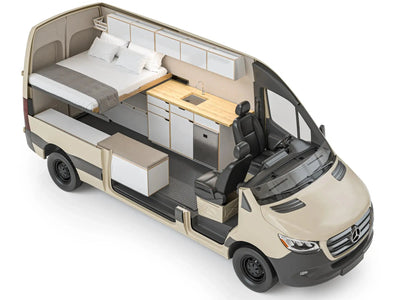
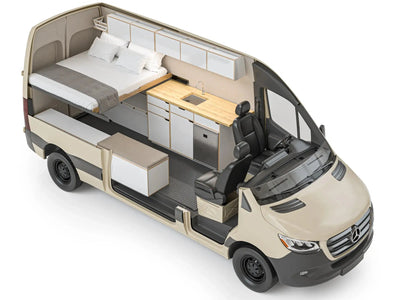
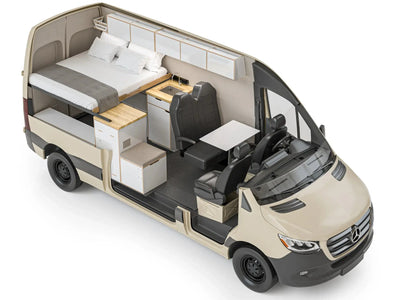
You should also expect very few amenities. No toilets. No picnic tables. No trash cans. No potable water. That changes what your van needs onboard, which is why many readers end up looking at Foundation builds or a full custom camper van build before they start stringing together long remote trips.
Ethics are part of the definition too. The Leave No Trace 7 Principles lay out the basics: plan ahead, camp on durable surfaces, dispose of waste the right way, and keep campfire impact low.
Why van travelers care about dispersed camping
The appeal is pretty obvious. You can often skip campground fees and stay somewhere quiet. The tradeoff is that you need your own water, power, toilet plan, and trash setup because the site usually gives you none of that.
In practice, a van has to do more than hold a bed. Battery size, venting, weather protection, and water storage all start to matter once you're out for multiple nights. Couples notice this fast, and families notice it even faster, which is why pages like vans for couples and family van conversions get a lot more relevant once campground hookups disappear.
A self-contained van is also useful because local guidance may point you toward a portable latrine where toilets aren't available. That's much easier to manage if the van already has a clean place to store the gear and enough ventilation to keep the cabin comfortable. Dispersed camping works best when you treat it as a public-land access skill, not just a money-saving hack.
Comfort matters more than people expect. Heat at night, bug control, and simple interior organization can make the difference between a calm three-night stay and leaving after one.
What dispersed camping is not
It is not the same as staying in a developed campground. The Forest Service draws that line clearly, and it's a useful one. If you need hookups, dump stations, or a guaranteed site in bad weather, a developed campground may fit better.
It is also not automatically legal anywhere on public land. BLM closures and local restrictions can override the general allowance. National Forest rules can be even more route-specific, which is why a random pullout is never enough proof by itself.
It is not a license to drive cross-country either. BLM guidance says vehicles need to stay on designated roads and trails unless a local rule says otherwise. On National Forest land, visitors may drive only on roads and trails shown on the local Motor Vehicle Use Map, or MVUM.
And it is not impact-free by default. Leave No Trace pushes campers toward established sites and durable surfaces instead of making new ones. If a site only works because you crush plants, move rocks, or create a fresh spur, it's probably the wrong site.
Where dispersed camping is legal on BLM and National Forest land

The photo above shows a Vansmith Sprinter on a gravel pullout below a rock spire. A pullout like this may or may not be legal for an overnight stay, which is exactly what the land agency and local maps decide. (Photo: The Vansmith)
This is the core question for most readers. BLM land and National Forest land both allow dispersed camping in many places, but they are not managed the same way. A lot of confusion starts when people treat them like they're interchangeable.
BLM's baseline is fairly broad. Most BLM lands are open to dispersed camping unless posted closed or otherwise restricted. National Forest land often takes more local checking, and some forests limit dispersed camping to specific sites only.
On Forest Service land, the MVUM is one of the most important tools you can use. The agency notes that staff and law enforcement use it, which makes it more than a planning aid. It helps decide what is legal on the ground.
For van owners, the safest habit is simple: verify the land agency first, then verify the local office or forest guidance. A long-wheelbase van can reach many legal sites, but road condition and route legality matter more than any off-road label.
BLM land: the general rule and local exceptions
BLM says dispersed camping is generally allowed on public lands away from developed recreation facilities. That's why BLM land is often the easiest place for beginners to start. The broad rule is more open than many people expect.
Still, local field offices can add restrictions. Before you arrive, check closures and local office pages. A spot that worked last season may not be open now, and a broad national summary won't always catch that.
BLM's camping guidelines also recommend using already used or established campsites. They recommend camping at least 200 feet from water sources, and they note a practical access norm of traveling within 300 feet of existing roads, vehicle ways, and trails to access campsites, subject to local rules.
That makes BLM land a good first step for new van travelers, but it does not remove the need to check local details. BLM often looks simpler at first, but a closure sign or local notice can change the answer, which is why the local office still matters.
National Forest land: why the MVUM matters
On National Forest land, the MVUM is the first stop for route legality. The Forest Service says visitors may legally drive only on roads and trails identified on that map. If a road is not shown as open, that matters more than what a map app suggests.
The Gifford Pinchot MVUM page explains that the map shows legal roads, seasonal closures, and routes open to vehicles. On that forest, visitors may use motor vehicles within 150 feet of many roads on the MVUM to reach dispersed campsites. That detail is a good example of how access rules can change from one forest to the next.
The Forest Service also advises pairing the MVUM with other official visitor maps because the MVUM is a legal map, not always the easiest one to read by itself. A separate dispersed camping handout tells users to contact the local forest office and refer to the MVUM for each forest. That's a strong hint that forest-level rules drive the answer.
Some National Forest areas limit dispersed camping to specific sites only. So even if the road is legal, camping may not be legal everywhere along it.
How to decide if a site is legal before you pull in
Start by confirming who manages the land. BLM and National Forest parcels often sit right next to each other, but their route and camping rules can differ. One side of a boundary may be open while the other side is not.
On BLM land, look for posted closures, local restrictions, and field office guidance. On National Forest land, check the local MVUM to see if the road is open to your vehicle and whether roadside access to dispersed sites is allowed.
After that, look at the site itself. Leave No Trace says good campsites are found, not made, and it recommends established or previously impacted sites on durable surfaces. Staying at least 200 feet from lakes, streams, or other water sources is another key filter.
If a site requires driving off a legal route, crossing vegetation, or inventing a new campsite, skip it. A secluded view is not worth the damage. For bigger vans, that call matters even more because a small mistake leaves a bigger footprint.
How to find free dispersed camping without guessing

The photo above shows the printed Motor Vehicle Use Map for the Coconino National Forest. Each national forest publishes its own MVUM, and it is the map that decides which roads are legal to drive. (Photo: Coconino National Forest, public domain)
The best workflow is simple. Identify the land agency first. Then use that agency's local maps and guidance instead of trusting generic pins or old screenshots. That step saves a lot of wrong turns.
For National Forest land, start with the local MVUM because it is the route-legal map used by staff and law enforcement. For BLM land, start with the local field office page and area guidance because site-specific closures and restrictions can change the answer fast.
A legal site is the goal, but the best site is one that already shows durable prior use.
In practice, the easiest setup is a van that stays comfortable without hookups for a few nights. That's the use case behind Vansmith builds, whether you're looking at Transit conversions, Sprinter conversions, or ideas from the van build blog.
Use official maps first, not crowd-sourced assumptions
For trip planning, the Forest Service advises using the MVUM with other official forest visitor maps. BLM's camping page is the right starting point for whether an area is generally open to dispersed camping and what local office rules may change that. Official sources should decide legality, not the fact that a spot appears on an app.
This matters even more in a full-size van. A dead end, closure gate, or tight turnaround is a much bigger problem in a high-roof vehicle than it is for a tent camper in a small SUV. That is one more reason to scout a site, or the road in, before committing a tall van to it.
If you want standing room without the height of a full high roof while you are driving, one of our pop-tops is another option for longer dispersed trips.
What an established site looks like
BLM recommends choosing already used or established campsites in undeveloped areas. Leave No Trace says to use established campsites and durable surfaces such as rock, gravel, dry grass, or previously impacted ground. That's a good visual test when you pull up.
Leave No Trace also says good campsites are found, not made. In popular areas, it recommends keeping use on existing trails and campsites instead of letting impact spread outward. For vans, that matters because a wide turn or a second parking angle can enlarge a site fast.
A legal dispersed site should not require flattening plants, moving rocks, or cutting a new spur just to fit the van. Site shape matters almost as much as legality for long-wheelbase models. A spot can be legal and still be a bad fit if the slope, entry angle, or turnaround is poor.
That is where a well-laid-out interior helps. If your gear is easy to reach and your bed stays made, you can use a modest site without spilling outside. Many people start with ideas from the DIY blog, then decide which parts they want a shop to handle.
The cost side of free dispersed camping
Dispersed camping is often free on eligible public land. The site itself may cost nothing. But there are usually no toilets, no potable water, no trash collection, and no hookups, so the cost shifts into the van.
Battery storage, ventilation, water carrying, heat, and sanitation become the real infrastructure. That is why free dispersed camping is only cheap if your setup can actually support nights without facilities. A vent fan upgrade, more solar, a heater, or a water tank can do more for your trip than another campground app.
| Model | Platform | Starting price |
|---|---|---|
| Transit Duo | Ford Transit | $116,950 |
| Sprinter Duo | Mercedes Sprinter | $117,950 |
| Transit Family | Ford Transit | $121,950 |
| Sprinter Family | Mercedes Sprinter | $122,950 |
As of 2026, those are the starting prices for self-contained Vansmith builds. A ready-built Bivy takes about 8 to 10 weeks and a tailored build about 12 to 16 weeks, which matters if you're trying to get ready before a travel season. If you already own a van, targeted upgrades can be the smarter move, and contacting us is often where that conversation starts.
The 14-day rule and other stay-limit realities
A common BLM rule is 14 days within a 28-day period, but local offices may vary and may require moving a substantial distance after the limit.
National Forest land often uses 14-day limits too, but forests may apply more occupancy limits over a longer period. This is one of the clearest cases where broad internet summaries fall short. Local verification matters because the details can shift by forest or district.
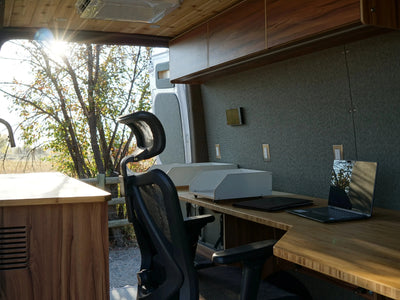
For van travelers, the real question is not only how long you can stay. It is whether your water, battery, fridge, and waste setup can support that stay in comfort. Legal stay length and comfortable stay length are often two different numbers.
Many people picture using the full 14 days. In practice, weather, road conditions, water capacity, and work signal often shorten the stay first. A well-designed van helps because dispersed camping rules are built around mobility, not parking in one favorite spot forever.
How the BLM 14-day rule usually works
BLM's main camping page says the common stay limit is 14 days within a 28-day period. The camping guidelines PDF adds a distance rule after that stay: move at least 5 miles. It also says you may not return for 28 consecutive days after reaching the stay limit in that area.
That is clear enough to plan around, but it still is not universal in the exact same form everywhere. Field offices may add more restrictions or handle specific areas differently. So the national language is your starting point, not your final answer.
If you work from the road, build your route around legal movement days. That usually means knowing your next water stop, your next trash stop, and your next legal area before you need them.
National Forest stay limits can differ
The Forest Service dispersed camping handout says campsites can be occupied for no more than 14 days in many areas. It also notes that total camping may be limited over a longer period depending on the forest. So the rule can go beyond a simple two-week cap.
The agency tells visitors to contact the local forest office and consult the MVUM for each forest. Some areas also limit dispersed camping to specific sites only, which affects both where you stay and how long you can remain there. One memorized version of the 14-day rule is rarely enough for a long trip.
Simple systems help here. When you have to move, breakdown should take minutes, not an hour, which is why layouts like the Family XL can make a big difference on longer trips.
How to plan around stay limits in a van
Stay limits are easier to follow when the van is provisioned for mobility. Water and waste are usually the first limiting factors because dispersed sites do not come with facilities by default. A nice legal maximum means little if your tanks are done by day three.
Portable toilet solutions can make longer legal stays more realistic where burying waste is a poor fit or discouraged. Leave No Trace also notes that area-specific waste rules may apply, so moving to a new district can change what disposal practices are allowed. That is another reason to keep your system simple and self-contained.
A strong itinerary often alternates remote sites with developed reset stops for water, trash, and cleanup. That rhythm tends to work better than trying to squeeze every last day from one spot. It also gives you more freedom if weather or road conditions change.
Waste, water, and Leave No Trace for vehicle-based dispersed camping
BLM advises campers to pack out trash and used toilet paper. For vehicle camping, that's the realistic baseline. Assuming every area can absorb buried waste is one of the faster ways to turn a nice site into a bad one.
Leave No Trace says area-specific waste rules may apply, so the right answer can change by place. The best setup is a van that arrives self-contained enough that the site only needs to provide legal space to park.
For vans, durable surfaces and established sites matter even more because bigger vehicles can widen impact quickly.
This is where thoughtful systems pay off. Ventilation, water storage, easy-clean surfaces, and a realistic toilet plan reduce the temptation to cut corners. If you are building toward that, our customize your van page is a good next step.
Human waste and toilet strategy
BLM recommends a portable latrine where there are no toilets. That is often the lower-impact option in undeveloped areas, especially for longer stays. Leave No Trace also notes that portable toilets may fit better than cat holes in some situations, including family camping.
If burying waste is allowed, BLM says to bury it 6 to 8 inches deep and at least 200 feet from water, campsites, or trails. It also says to pack out used toilet paper rather than leaving it onsite. Poor waste handling can contaminate the area, affect other visitors, and attract wildlife.
In van travel, a toilet plan that feels slightly overbuilt usually works better than one that only works in ideal weather. Rain, wind, kids, or a rough road can make a flimsy plan fall apart fast.
Water, gray water, and protecting riparian areas
BLM recommends camping at least 200 feet from water sources in undeveloped areas. Leave No Trace repeats that same 200-foot distance for lakes and streams to protect riparian areas. That spacing is one of the simplest rules to remember because it solves several problems at once.
Because dispersed sites usually have no potable water, you need enough onboard water for drinking, cooking, and basic cleanup. Water discipline matters as much as tank size. Small habits like low-water dishwashing and controlled rinse use can stretch a stay more than people expect.
For gray water and other wastewater, the safest guidance here is the official one: follow local rules and protect the site. Leave No Trace is clear that area-specific waste rules may apply, and those local differences matter.
That is another reason many travelers add more water storage or cleanup-friendly systems instead of relying on improvised habits.
Campfire, site impact, and leaving no trace

The photo above shows what not to leave behind: a rock fire ring at a dispersed site in the San Rafael Swell, Utah, with trash dumped in it. BLM shared it as a reminder to pack it in, pack it out. (Photo: BLM Utah, public domain)
BLM advises using existing fire rings or camp stoves and checking current fire restrictions before lighting any fire. Leave No Trace includes minimizing campfire impacts as one of its seven principles. In many van trips, a stove is simply the cleaner and easier answer.
Leave No Trace also recommends keeping use on existing trails and campsites in popular areas. Its durable-surfaces guidance favors rock, gravel, dry grass, or already impacted ground over undisturbed vegetation. For a van, the cleanest standard is simple: if your wheels, leveling, chairs, or fire setup would spread the footprint, choose another spot or scale back.
A dispersed campsite should look essentially unused when you leave. Vehicle-based campers are visible, and they shape how land managers and other visitors feel about access.
FAQ
What is dispersed camping?
Dispersed camping means camping outside a developed campground on public land, usually without toilets, tables, trash service, or potable water. On most BLM lands it is generally allowed unless the area is posted closed or otherwise restricted. On National Forest land, the rules can be more route-specific and forest-specific, so the local map and office matter more.
Is dispersed camping always free?
It is often free on eligible BLM and National Forest land, but free does not mean unrestricted. You still need to verify closures, route legality, and stay limits. You should also expect no developed services at the site, so the van has to carry more of the load.
How long can you stay dispersed camping?
A common BLM rule is 14 days within a 28-day period. BLM guidance also says campers generally must then move at least 5 miles and may not return for 28 consecutive days. On National Forest land, 14-day limits are also common, but forests may add other occupancy limits, so local verification still matters.
How do I find legal dispersed camping on National Forest land?
Start with the local Motor Vehicle Use Map, because the Forest Service says visitors may legally drive only on roads and trails identified on the MVUM. Then pair that map with the forest's official visitor guidance. Some forests limit dispersed camping to specific sites only, so a legal road does not always mean legal camping everywhere along it.
Can you use a toilet or bury waste while dispersed camping?
BLM says that where there are no toilets, a portable latrine is preferred if possible. If burying waste is allowed, it should generally be 6 to 8 inches deep and at least 200 feet from water, campsites, or trails. BLM also advises packing out used toilet paper, and Leave No Trace notes that local waste rules may override general habits.
How far from water should you camp when dispersed camping?
Both BLM guidance and Leave No Trace recommend camping at least 200 feet from water sources such as lakes and streams. That buffer helps protect riparian areas and lowers contamination risk. It is one of the easiest rules to remember because it applies in so many places.
About the author

Electra Chronis
Head of Marketing
Electra leads marketing at The Vansmith. She writes across van life, camping and travel, from planning a trip to choosing and building the van that gets you there.
Read more about Electra