By Eugene, January 31, 2026
Introduction: Why RV loan rates matter

When you buy an RV, the APR you get shapes both your monthly payment and the total cost to own it. This snapshot gives useful current RV loan rates bands buyers are seeing today. It also explains which buyer and rig factors move those bands. Then it walks through three clear examples so you can see how term and credit turn into dollars and cents. Think of it as a quick map you can use when you call lenders or compare online offers. A few minutes spent here can save you a lot over the life of a loan.
Current RV loan rate bands, what buyers are seeing now

Rates fluctuate daily, and lenders price loans based on buyer profile, rig type, and term. Below are about APR bands readers should expect today: low, mid, and high for common buyer profiles. These are ranges, not promises, meant to help you shop with context. According to AAA auto financing guidance, borrowers will often see different APRs for the same profile depending on lender type and loan structure, so it pays to compare current RV financing rates across several providers.
Typical APR bands (illustrative)
- Excellent-profile borrowers: 6.0%-7.5% APR (low to mid)
- Good-profile borrowers: 8.0%-11.0% APR (mid to high)
- Fair-profile or specialty financings: 12.0%-18.0% APR (high band)
These bands shift with broader loan rates and lender demand. (Consumer Reports) Expect captive RV lenders and credit unions to often show more aggressive pricing to strong buyers, while some banks or finance firms may sit higher in the band. Keeping an eye on prevailing motorhome loan rates and overall vehicle financing trends can help you time your application.
Typical APR ranges by term (10, 15, 20 years)
Longer terms tend to carry slightly higher APRs and always increase total loan costs because they stretch out payments. Sample layout guidance:
- 10-year term: APRs generally sit near the low end of your band; best for minimizing total interest.
- 15-year term: Midpoint trade-off between lower monthly payment and moderate total interest.
- 20-year term: Often the highest APR within a borrower's band and the largest total interest; used to lower monthly payments when needed.
How new vs. used RVs affect rates
New RVs usually qualify for better rates because lenders value the lower risk and resale profile. (RVIA) Used RVs, even newer used rigs, can bring a modest APR premium. The age and shape of the rig clearly affect review and so where you fall in a rate band. Industry data from RVIA market reports shows that newer units generally retain value better, which supports stronger lender terms and more favorable camper loan rates.
Lender types: banks, credit unions, captive RV lenders - rate differences
Credit unions and captive lenders often have the best pricing for strong buyers. Local banks and big banks may be strong on price but are often tougher on down payment or rig age. Shop across lender types when checking rates, and consider pre-qualification offers to compare apples to apples and see where your recreational vehicle loan rates really land.
Key factors that move your RV loan rate

Credit score and credit history
Credit score is one of the biggest drivers of APR. (Consumer Reports) Top scores push you toward the low band; fair scores push you to the high band. Lenders also review recent negative items, length of credit record, and payment patterns. Guidance from the Consumer Financial Protection Bureau notes that paying on time and keeping balances low are two of the most important ways to improve your score before you apply.
Down payment and trade-in value
A larger down payment cuts loan-to-value (LTV) and often lowers the APR. Trade-in equity that cuts your loan amount can have a similar effect, mainly if it moves your LTV below lender thresholds.
Loan-to-value (LTV) and loan amount
Lower LTVs usually attract better pricing. Small loan amounts can at times bring slightly higher APRs due to fixed review costs; very large loans may be priced in another way based on lender risk appetite.
Loan term length and amortization effects
Shorter terms keep more of your payment going to the amount you borrowed earlier and reduce total loan costs. Longer terms lower monthly payment but increase total loan costs paid, and lenders often offset that risk with a higher APR.
RV type and age (motorhome vs. towable)
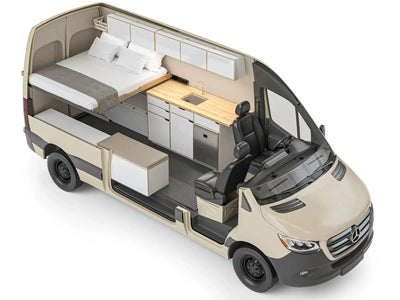
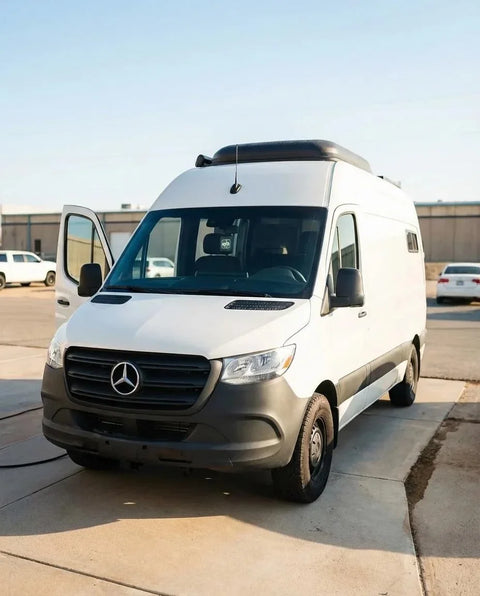
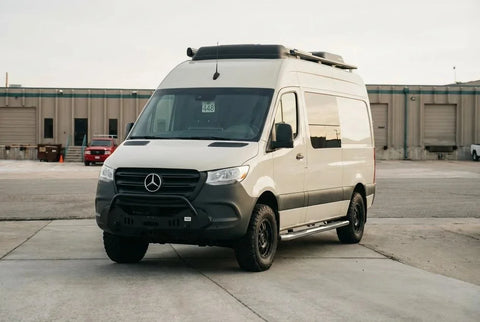
Motorhomes with more complex systems and higher values can carry different risk checks than towables. New motorhomes often get better pricing versus older, higher-mileage units. For example, a new Class B built on a modern chassis like the Ford Transit or Mercedes-Benz Sprinter will typically be easier to finance than a much older motorhome, and manufacturers such as Ford and Mercedes-Benz highlight durability and safety features that lenders may view favorably. If you are comparing platforms, our overview of AWD vs 4x4 cargo vans can also help you match financing plans to the right base rig and understand how camper van loan rates might differ by chassis.
Sample scenarios, real-world examples
Below are three sample examples using simple payment math to show monthly payment and total loan costs. These use rounded APRs in line with the bands above.
Numbers are examples to help you compare trade-offs. Get lender quotes for exact offers and to see your personal RV loan interest rate.
Scenario 1, Strong borrower (excellent credit) buying a new Class C, 20-year loan
Assumptions: $80,000 loan amount, 7.0% APR, 20-year term.
- Monthly payment (approx): $620 per month
- Total interest paid over life: about $68,860
- Why this happens: the long term lowers monthly cash flow but increases total interest; excellent credit keeps APR toward the low end.
Scenario 2, Average borrower (good credit) buying a used travel trailer, 15-year loan
Assumptions: $50,000 loan amount, 9.5% APR, 15-year term.
- Monthly payment (approx): $522 per month
- Total interest paid over life: about $43,980
- Why this happens: shorter term than scenario 1 so total interest is lower; APR sits in the mid band for a used unit and good credit.
Scenario 3, Lower-score borrower (fair credit) financing a late-model motorhome, 10-year loan
Assumptions: $100,000 loan amount, 14.0% APR, 10-year term.
- Monthly payment (approx): $1,552 per month
- Total interest paid over life: about $86,320
- Why this happens: shorter term keeps total interest lower than a 20-year loan but the high APR from fair credit pushes monthly cost up.
Comparison: monthly payment and total interest across scenarios
These examples show common give-and-takes: longer terms cut monthly payments but raise total loan costs; better credit lowers APR and both monthly and total cost. Use these examples to guess where your own quote might land and to work out break-even comparisons for refinancing later.
How to shop and negotiate for better RV loan rates
Pre-qualification and rate-shopping tips
Get pre-qualified by several lenders, credit unions, banks, and captive lenders, so you can compare APRs and terms. Pre-qualification helps you know where you stand without hurting your credit score when done as a soft pull, and it strengthens your bargaining power when you're ready to buy. This is one of the best ways to benchmark current RV loan rates for your specific profile.
When to consider a shorter term or larger down payment
If keeping total loan costs low is a main goal and monthly budget allows it, choose a shorter term or increase the down payment. If monthly budget is tight, a longer term can make the purchase work. Plan to redo the loan later if rates fall or your credit gets better.
Ready to run the numbers on a custom camper instead of a basic RV? Reach out to our team to talk build options and clear budgets based on today's RV loan rate environment—contact us or explore our custom camper van design and build services. You can also browse our latest available camper vans for sale to see real-world price points that pair well with the sample financing scenarios in this guide.
Refinancing: when it makes sense and expected savings
Refinancing can lower APR and monthly payment if market rates drop or your credit gets better. Think about fees, early payoff charges, and the break-even period. Often it makes sense to refinance after rate moves or a clear credit improvement that cuts your APR by a full percentage point or more. Resources like Edmunds refinance guides can help you estimate savings and compare offers.
Quick checklist and next steps for prospective RV buyers
- Check your credit report and correct errors before applying.
- Get pre-qualified by at least two lender types (credit union and captive or bank).
- Compare APRs for the same term and same loan amount—look at total interest, not just monthly payment.
- Consider a larger down payment or trade-in to lower LTV.
- Plan for refinancing if you accept a longer-term loan to lower monthly cash flow today.
Conclusion: Using the snapshot responsibly, getting personalized quotes
This snapshot is a starting point to see how APR bands, loan term, and buyer factors affect payments and total cost. For a custom rate, get pre-qualified offers and compare total loan costs across terms.
If you're also weighing builds or looking at inventory, our Vansmith guides like pages on vans for sale, heater installs, and our guide to buying a Sprinter vs. Transit can help you turn loan plans into a real purchase plan that fits your trip needs. Once you have a budget range, you can narrow in on specific layouts in our Signature camper van build collection or explore add-ons like diesel and gas van heater systems that may affect your total financed amount and the effective RV financing rates you qualify for.
FAQ
What are typical RV loan interest rates right now?
Rates vary by term and buyer profile. Present ranges (low, mid, high) rather than exact quotes. Exact APR depends on credit, down payment, lender type, and whether the RV is new or used. Checking multiple lenders will give you the clearest picture of current RV loan rates for your situation.
How much higher are 20-year RV loan rates compared with 10-year loans?
Longer terms often carry slightly higher APRs and much greater total loan costs due to longer payment periods. Expect the APR on a 20-year loan to be a bit higher than a 10-year loan for the same buyer. Plan on higher total loan costs even if monthly payments are lower.
Does my credit score make a big difference for RV loan rates?
Yes. Credit score is one of the largest drivers. Usual rate band changes show clear APR gaps between top, good, and fair credit, and lenders have cutoffs that affect pricing.
Should I choose a longer term to lower monthly payments?
Longer terms lower monthly payments but increase total loan costs paid. Choose a longer term when monthly cash flow is the main goal and you have a plan to redo the loan or pay extra on the amount you borrowed later if possible.
Can I refinance an RV loan to get a better rate?
Often yes. Refinancing can reduce APR and monthly payments if rates drop or your credit gets better. Think about break-even timing and any fees in the mix before refinancing.
Get pre-qualified and compare RV loan offers from several lenders to find the best APR and term for your budget. Start your pre-qualification now.
About the author

Eugene Smit
CEO
Eugene is the CEO of The Vansmith, based in Boulder, Colorado. He writes across topics related to van builds, ownership, and the camper van industry.
Read more about Eugene