
DUO

Mercedes Sprinter 144
OR
Ford Transit 148

Perfect for solo travelers or couples who want a compact adventure-ready van.
Seat & Sleeps
2Length
19'Shower
Exterior * * Optional Add-OnsClass B RVs, Conversion Vans & Campervans for Sale in Anchorage, AK
Mercedes Sprinter 144
OR
Ford Transit 148
Perfect for solo travelers or couples who want a compact adventure-ready van.
Seat & Sleeps
2Length
19'Shower
Exterior * * Optional Add-Ons
Mercedes Sprinter 144
OR
Ford Transit 148

Includes a shower setup for longer trips without compromising comfort or space.
Seat & Sleeps
2Length
19'Shower
Bench * * Optional Add-Ons
Mercedes Sprinter 170
OR
Ford Transit 148 E

Ideal for those who want extra living space and more storage for extended adventures.
Seat & Sleeps
2Length
22'Shower
Full
Mercedes Sprinter 170
OR
Ford Transit 148 E

Luxury model with full amenities, extended power systems, and interior bathroom.
Seat & Sleeps
2Length
22'Shower
Full
Mercedes Sprinter 144
OR
Ford Transit 148

Perfect for families who want space, comfort, and functionality in a compact build.
Seat & Sleeps
4Length
19'Shower
Exterior * * Optional Add-Ons
Mercedes Sprinter 170
OR
Ford Transit 148 E

A larger build for families who love extended adventures and more storage.
Seat & Sleeps
4Length
22'Shower
Bench * * Optional Add-Ons
Mercedes Sprinter 170
OR
Ford Transit 148 E

The luxury upgrade with interior shower and full power systems for long trips.
Seat & Sleeps
4Length
22'Shower
Full
Alaska asks more of a camper van than anywhere else we build for. Winter nights run well below zero, December gives about five and a half hours of daylight, services thin out fast once you leave the Anchorage bowl, and much of the best country is bear habitat. A camper van for Anchorage is not a milder version of a Lower 48 build. The heating, water and electrical systems all need specifying differently.
The Vansmith builds Mercedes-Benz Sprinter and Ford Transit camper vans in Boulder, Colorado, and delivers to Alaska. We have built more than 300 vans since 2016, and our four-season systems are tested through Colorado winters. Conversion packages on a van you already own start at $46,950, complete vans with the chassis included start at $115,950, and pre-built Bivy models run from $119,700 to $192,570 depending on trim. For the statewide picture, see our guide to
camper vans in Alaska.
| Technical Specification | Anchorage Requirement | Why It Matters | What We Build |
|---|---|---|---|
| Heating system | Reliable cold-weather heat | Interior heat is what makes the van usable through an Alaska winter | Fuel-fired air heater running off the vehicle's own fuel tank, sized to van volume |
| Insulation | Strong thermal performance | Reduces heat loss in deep cold and heat gain in summer | Insulation on all six sides, with attention to thermal bridging at the ribs; Havelock wool in pre-built Bivy models |
| Battery system | Cold-capable electrical storage | Lithium capacity drops temporarily in extreme cold | Lithium bank sized with cold derating in mind, not room-temperature figures |
| Battery heating and protection | Protection against freezing | Lithium cannot safely charge below freezing | Bank mounted inside the heated living space, self-heating batteries, or both |
| Water system | Freeze protection and winterizing | Freeze damage is the costliest cold-weather failure | Protected routing where the layout allows, accessible drain points, handover walkthrough |
| Fresh water capacity | Sufficient for remote travel | Long stretches between services outside Anchorage | Tanks sized to your realistic route, not an average trip |
| Wastewater system | Cold-weather operation | Tanks and plumbing are vulnerable to freezing | Gray capacity matched to fresh, with the same drain and winterizing access |
| Alternator charging | Reliable charging while driving | The primary winter source when daylight is minimal | DC-DC charger fitted on every build |
| Solar capacity | Seasonal supplement | Carries the system in June, contributes very little in December | Array sized to roof and layout, with winter expectations set honestly |
| Shore power | External charging | Useful at developed campgrounds and at home | Onboard charger and shore connection on every build |
| Electrical monitoring | Real-time state of charge | Tells you what you have left on a remote winter night | Battery monitor included on every build |
| Tire specification | Winter-appropriate traction | Snow and ice dominate driving conditions for months | Chosen around your routes; studded tires are permitted seasonally in Alaska |
| Drivetrain | Suited to terrain and season | Mountain highways and winter conditions | RWD, AWD or 4x4 depending on platform |
| Ground clearance | Suitable for rough access | Gravel and frost-heaved surfaces are common | Suspension and tire upgrades available where routes justify them |
| Payload capacity | Capacity for heavy seasonal gear | Winter clothing, recovery equipment and water add up | Confirm GVWR against final build weight for your chassis |
| Vehicle length | Manageable at trailheads and in town | Approx. 19.5 ft short wheelbase or 22.5 ft extended | Choose around parking, storage and the roads you drive |
| Vehicle height | Clearance for covered storage | Sheltered winter storage is valuable in Alaska | Roughly 9 to 10 ft in high roof form; measure your door opening |
| Storage capacity | High priority for bulky gear | Winter and outdoor equipment take real volume | Gear garage under a raised bed, cabinets and roof racks |
| Ventilation | Controlled airflow | Wet clothing, snow and breathing all add interior moisture | Powered roof fan with variable speed and direction |
| Refrigeration | Reliable food storage | Important on extended remote travel | 12V compressor fridge running on battery power |
| Emergency storage | Space for winter supplies | Alaska DOT advises carrying provisions for winter travel | Dedicated accessible storage planned into the layout |
Exact figures for payload, ground clearance, tire sizing and vehicle dimensions depend on the chassis, trim and drivetrain you choose. We confirm each against your build during the design call.
Nine tailored layouts across the two-person DUO Series and the four-person FAMILY Series, plus three pre-built Bivy trims. Browse all tailored models .
A Class B is a camper built on a van chassis rather than a truck frame. It parks in a standard space, fits many garages, and can be plugged in and plowed out like any other vehicle, which matters in a climate where indoor or sheltered winter storage genuinely extends a vehicle's life. Browse our Class B RVs for sale and winter camper vans .
The Sprinter holds its value, its diesel engine gets more range per tank across the long distances between Alaska fuel stops, and its AWD and 4x4 systems have years of proven winter use. Diesel does need cold-weather fuel handling in deep winter, which any Alaska owner will already be familiar with. Browse our Sprinter van conversion lineup or each Sprinter camper for sale we list.
Current stock, including inspected used vans, is listed on our camper vans for sale page.
Every layout is available as a camper van for sale to Anchorage buyers, built to order in Boulder. Use our van designer or call (303) 414-6834 for a fixed, itemized quote including delivery options.
Anchorage winters run below freezing for months, with cold snaps well below zero. Interior heat is not a comfort feature here; it is what makes the vehicle usable.
Studded tires are permitted in Alaska during the winter months, and most local drivers use them. Tires matter more than drivetrain, and a loaded van brakes differently from a car on ice.
This is the detail that changes how the electrical system should be specified. In December, Anchorage gets roughly five and a half hours of low-angle daylight, so solar contributes very little and alternator charging does nearly all the work. In June it barely gets dark, and solar can carry the whole system. A van specified for summer solar alone will not work in January.
Summer days in the 60s and 70s, winter nights well below zero. The same insulation serves both, but heater sizing and battery placement are driven entirely by the cold end.
The Seward, Glenn and Richardson Highways all climb through mountain terrain with long stretches between services and weather that changes quickly.
Once you leave the Anchorage and Mat-Su area, fuel, water and cell coverage all become intermittent. Self-sufficiency is not optional.
Both black and brown bears are common across Southcentral Alaska. A van is far better than a tent, but it is not a bear-proof container. Store food inside with the doors closed, keep the galley clean, avoid cooking right where you sleep in high-density bear areas, and follow current state and park food storage rules, which require bear-resistant containers in some locations.
Fairbanks is around 360 miles, Valdez about 300, and Homer roughly 220. Water, refrigeration, galley and electrical capacity should be sized around those distances.
A fuel-fired air heater is the core of a cold-climate van. It runs off the vehicle's own fuel tank, draws very little electricity and dries the air while it warms it, which also helps with condensation. Paired with insulation on all six sides and attention to thermal bridging at the van's metal ribs, it is what makes winter use realistic. Read our Sprinter van heater guide and see Heater Service .
This is the most common and most expensive cold-weather failure. Water expands as it freezes and can split tanks, pumps and fittings. The two workable approaches are keeping the van heated continuously, or draining and winterizing the system completely. We route tanks and lines to stay protected where the layout allows, provide accessible drain points, and walk every owner through the procedure at handover. Our guide to de-winterizing your van covers bringing it back in spring.
Lithium batteries cannot safely accept a charge below freezing. For Alaska we mount the bank inside the heated living space, specify self-heating batteries, or both. Capacity also falls temporarily in extreme cold, so the bank is sized with that in mind rather than at room-temperature figures. Read our guide to cold-weather battery charging .
AWD or 4x4 with proper winter or studded tires, suspension matched to your routes, and realistic expectations about stopping distances in a loaded van.
Alaska DOT advises carrying winter provisions and emergency equipment for travel outside urban areas. Plan dedicated, accessible storage for recovery gear, extra layers, food and water rather than burying it under camping equipment.
Fresh and gray water, refrigeration, galley and electrical capacity sized to the longest gap on your route, plus a layout that stays secure on frost-heaved highways.
A gear garage beneath a raised bed handles skis, snowshoes, waders and packs, keeping wet equipment out of the living space.
Keep food and scented items inside the van with doors and windows closed, clean the galley after cooking, store waste in sealed containers, and check current food storage requirements for the park or area you are visiting. A powered roof fan helps clear cooking odors before you settle in for the night.
Two-person layout on a Sprinter 144 or Transit 148, about 19.5 feet, with a convertible VersaBed, full galley and gear storage. From $46,950 as a conversion.
The same short footprint with a bench shower inside. From $53,950 as a conversion.
Extended platform around 22.5 feet, with more storage and a flexible sleeping system for long Alaska distances.
The most complete two-person layout, with a full interior bathroom and extended power. From $63,950 as a conversion.
Four seatbelts and four berths on the short wheelbase. From $51,950 as a conversion.
Extended family layout with a bench shower and extra storage. From $61,950 as a conversion.
Full interior shower and full power systems for longer trips without hookups. From $68,950 as a conversion.
Pre-built on a Sprinter 144 AWD with a pop-top and four-season Havelock wool insulation, ready in 8 to 10 weeks. Classic from $119,700 with 5 kWh lithium, Plus from $145,845 with 10 kWh and a diesel cabin heater, Deluxe from $192,570 with 15 kWh, air conditioning and a hydronic heater. For Alaska use, the Plus and Deluxe are the more relevant starting points because of the larger battery capacity and fitted cabin heating. See our Bivy comparison .
South on the Seward Highway, with fishing, glaciers and coastal camping within a few hours.
About two and a half hours south, the gateway to tidewater glaciers and boat-based wildlife viewing.
Forty minutes south along one of the most scenic highway stretches in the country, with skiing in winter and hiking in summer.
Roughly four to five hours north. Park road access is limited and has been affected by a landslide in recent years, so check current conditions and shuttle arrangements before you go.
Palmer and Wasilla are under an hour north, with trail access, farmland and the Talkeetna Mountains beyond.
The route northeast toward Glennallen, a National Scenic Byway with glacier views and long stretches between services.
Connects Glennallen to Valdez through Thompson Pass, which receives some of the heaviest snowfall in the state.
About six hours east, with waterfalls, glaciers and a deepwater port.
Roughly four and a half hours south at the end of the Sterling Highway, with the Homer Spit and Kachemak Bay.
Conversion packages on a van you already own start at $46,950 for the DUO, $53,950 for the DUO S, $63,950 for the DUO XLS, $51,950 for the FAMILY, $61,950 for the FAMILY XL and $68,950 for the FAMILY XLS. Complete vans with the chassis included start at $115,950. Pre-built Bivy models run $119,700, $145,845 and $192,570 by trim.
Alaska buyers should budget separately for getting the van north, which is covered below. Estimate monthly payments with our Financing calculator.
There are two practical routes, and they suit different buyers.
Drive it. Boulder to Anchorage is roughly 3,300 to 3,500 miles depending on route, through Canada on the Alaska Highway. You will need a valid passport, and Canadian border rules apply to firearms, certain foods and other goods, so check current requirements before you leave. Allow five to seven days in good conditions. It is a genuinely memorable drive in summer and a serious undertaking in winter.
Ship it. Vehicle barge and ferry services run from Washington State ports to Alaska, which is how many vehicles reach Anchorage. Transit times and costs vary by carrier, season and vehicle size, and they change frequently enough that quoting a figure here would be misleading. We will help you get current quotes as part of the purchase. If you want to combine the two, several buyers drive to the Seattle area and ship from there, which cuts the drive substantially. See our Seattle page if that route appeals.
Call (303) 414-6834 and we will talk through which option fits your timing and budget.
Every tailored layout on the Sprinter 144 or 170, plus the pre-built Bivy on a Sprinter 144 AWD.
The DUO and FAMILY layouts on the Transit 148 and 148 extended, including AWD.
Nine tailored layouts, three pre-built Bivy trims and a Foundation shell from $9,970 for self-builders.
Battery, solar, charging and monitoring specified as one system, with cold-weather behavior accounted for rather than assumed. See our Electrical System work and Solar Installation page.
Our four-season systems were developed in Boulder and tested through Colorado winters. Alaska is colder and darker, so we size heating, battery capacity and charging differently for it rather than selling the same spec and hoping.
A gear garage beneath a raised bed, built for bulky winter and outdoor equipment.
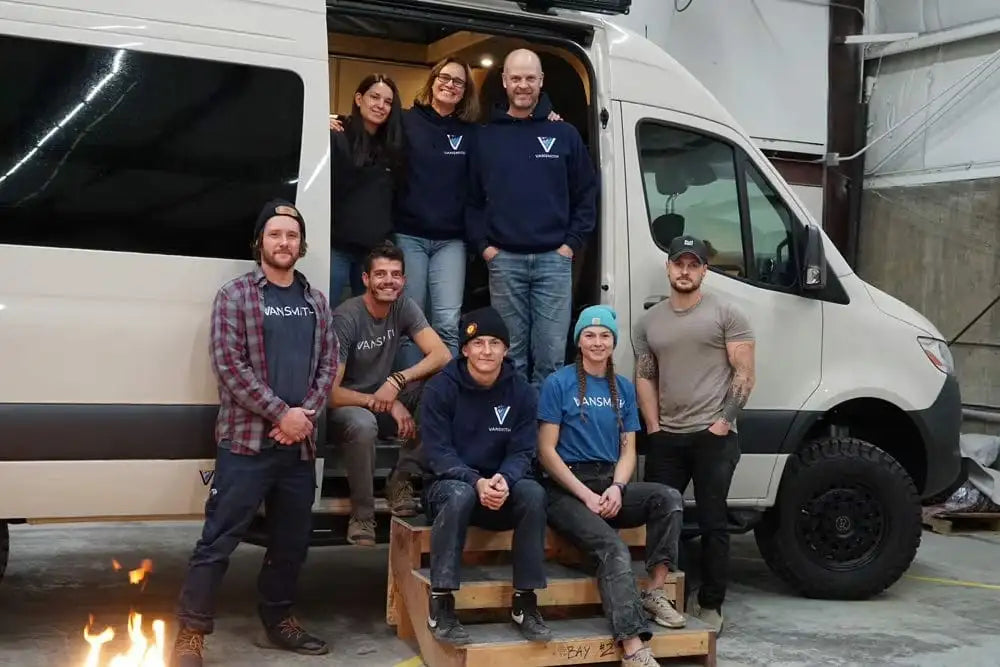
Every system installed by our own team. That matters more for Alaska buyers than most, because the nearest specialist service is a long way off, so the build needs to be right the first time and serviceable when it is not. See Repairs, installations, and services .
Design, approve and pay from Anchorage over video and email.
We work with buyers on both the drive-it and ship-it routes and will help you get current quotes.
Ready to find the right camper van for Anchorage, Alaska? Design your van , browse vans available now , or call (303) 414-6834 to talk through build specification and delivery. See camper vans in Alaska , or our Seattle page if you plan to ship from Washington.









Email: info@thevansmith.com
Text: 303-414-6834
Form: Tell us what you need
Call: 303-414-6834
Book a call:
(We are currently not booking any new service work while we revamp our service department.)
Visit us (by appointment):
