Sprinter Interior: Materials & Finishes — Walls and Ceilings

Choosing wall and ceiling materials for a Sprinter interior forces trade-offs: weight vs. strength, warmth vs. cleanability, scratch resistance vs. cost. This guide compares the common options, including plywood, composites, metal, FRP/PVC, tongue-and-groove wood, and upholstered headliners.
It summarizes weights and behavior, providing clear recommendations by use-case. This way, you can pick the right stackup for a camper, cargo van, or mobile office.
Quick Comparison — Materials at a glance

Use this table as a fast lookup. Numbers are typical ranges — always confirm specific product datasheets for exact weights and R-values.
| Material | Typical Thickness | Weight (lb/ft²) | Thermal Behavior | Scratch Resistance | Cost | Best Use |
|---|---|---|---|---|---|---|
| Luan / Okoume / Baltic Birch | 1/8"–1/2" (3–12 mm) | 0.5–1.5 | Low thermal mass; pairs well with insulation | Moderate (surface dents/scratches visible) | $ – $$ | Warm aesthetic, good screw holding |
| Honeycomb / Composite panels | 6–12 mm (sandwich) | 0.2–0.6 | Low mass; insulating core options | Good (face skins protect core) | $$ | Lightweight builds, long travel |
| Aluminum / ACP (aluminum composite) | 2–4 mm (face + core) | 0.3–0.8 | High thermal bridging if directly fastened | High (scratches visible; dents possible) | $$ | Durable, cleanable surfaces |
| FRP / Fiberglass panels | 1–4 mm | 0.2–0.6 | Low thermal mass; good with insulation | Excellent (impact & abrasion resistant) | $$ | High-use, cleanable interiors |
| PVC foam board (Sintra) / ABS | 2–6 mm | 0.1–0.4 | Low mass; poor thermal mass | Low–moderate (scratches easily) | $ – $$ | Lightweight panels, wet areas |
| Tongue-and-groove cedar / pine | 8–16 mm | 0.6–1.2 | Perceived warmth; moves with humidity | Moderate (dents/scratches visible) | $$$ | Luxury warm interiors |
| Upholstered headliner / fabric-backed | varies | 0.2–0.8 | Adds perceived warmth & sound absorption | Low (fabric stains, scuffs) | $–$$ | Sound control, cozy ceiling |
Plywood options (luan, birch, Baltic birch)

Pros & cons
Plywood variants are the traditional choice. Baltic birch (multi-ply, consistent cores) offers superior screw-holding and a premium appearance (Car and Driver); okoume/luan are lighter and cheaper but more prone to delamination and poorer edge strength.
- Pros: excellent screw-holding, easy to cut/repair, warm look, familiar to most builders.
- Cons: heavier than composites, can dent/scratch, needs edge treatment and sealing for moisture.
Installation and fasteners
Use #6–#8 pancake-head wood screws or trim-head screws into furring strips or directly into the van ribs where possible. Pre-drill 1/16" pilot holes on thinner sheets to avoid splitting.
For ceilings, secure with 3M 4200/5200-style adhesives in high-vibration builds plus screws at the ribs. Edge blocking (1/2" strips) improves screw holding at panel joins.
Finishes and maintenance
Common finishes include water-based primer and 2K polyurethane paint for durability, as well as marine-grade varnish or tung oil for a natural finish. For heavy-use areas, add clear scuff strips or 1–2 mm HPL/laminate.
For repairs, light scratches can be sanded and recoated, while deeper gouges can be filled with epoxy or wood filler. One quick note: tung oil takes a bit longer to cure but repairs very nicely in the long run.
Use-case recommendations
- Camper for warm, artisanal interior: Baltic birch 1/4" over furring with oil or varnish.
- Budget camper or simple mobile office: okoume/luan with painted finish and scuff protection.
- Not ideal when weight is the primary constraint for ultra-light builds.
Van Ceiling Ideas: Popular Materials and Styles
Your ceiling choice plays a major role in comfort, acoustics, and overall interior feel. The right material balances weight, insulation performance, and style while working with the Sprinter’s curved roof shape. These van ceiling ideas highlight popular options used in camper interiors today and can inspire a range of campervan ceiling ideas for your own build.
Wood Slats and Shiplap
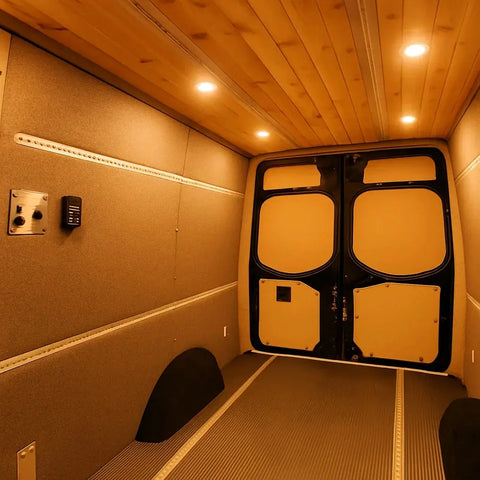
Wood slats and shiplap ceilings create a warm, cabin-like feel that pairs well with natural light and simple layouts. Thin planks installed lengthwise can visually stretch the interior, making the van feel longer and more open.
This option works best when combined with proper insulation and a vapor barrier to protect the wood from moisture. Lightweight wood species or thin panels help reduce added weight overhead, making this a classic choice for custom camper ceiling designs.
Carpet Lining
Carpet lining is a practical and understated option. It is lightweight, flexible, and easy to fit around curves, vents, and roof ribs. Carpet also improves sound dampening and helps retain warmth.
This material is ideal for those prioritizing function over visual impact. It requires minimal framing and can be installed with adhesive, making it a popular choice for quick or budget-conscious projects and simple van roof lining ideas.
Acoustic Panels
Acoustic panels are designed to reduce echo and road noise while adding a clean, modern look. Many panels are made from lightweight composite or felt materials that contour easily to the roof.
They work well in vans used for remote work, content creation, or extended travel, where quiet interiors matter. Proper spacing and secure mounting are important to prevent sagging over time, especially in longer rigs where full-length camper ceiling panels are used.
Mosaic Tiles
Mosaic tiles create a bold, custom look and are often used in small ceiling sections or accent areas. Tiles can add visual texture and a unique design element.
Because tile adds weight and requires strong adhesion, it is best used sparingly. Proper surface prep and vibration-resistant adhesive are essential to prevent cracking or loosening during travel.
Composite and honeycomb panels
Weight and structural properties
Honeycomb cores (nomex, aluminum, polypropylene) laminated to thin faces (plywood, aluminum, or FRP) deliver high stiffness-to-weight ratios — popular for van ceilings where weight matters. Typical sandwich panels can be <50% the weight of equivalent plywood with comparable stiffness across wide spans. We've seen several long-term builds where composites cut overall vehicle weight noticeably and improved fuel economy; this aligns with EPA guidance that reducing vehicle weight can improve MPG.
Edge treatment and bonding
Edges can show the core; seal with epoxy edge fill or aluminum trim. Fastening is typically with structural adhesive (3M 4200/DP) and a limited number of mechanical fasteners at manufacturer-recommended spacing. Avoid overdriving screws into honeycomb; use bonded washers or routed blocks for strong screw points.
Best use-cases
- Long-term travelers maximizing payload and fuel economy.
- Lightweight camper shells and ceiling panels where minimal sag is desired.
Aluminum and metal-backed panels
Scratch/dent considerations and finishes
Aluminum composite panels (ACP) and solid aluminum sheets are durable and cleanable options for van interior walls, though they can show scratches and dents visibly. Opt for painted or PVDF-coated ACP to enhance scratch resistance.
For lightweight walls, consider using protective clear films or trim in high-contact zones. Small dents can often be buffed out depending on the finish.
Thermal bridging and insulation tips
Metal panels conduct heat — ensure an isolation layer (closed-cell foam or furring strips) between metal faces and the van skin to reduce thermal bridging and condensation risk. Use thermal break tapes and avoid fastening through panels directly into the van skin without an isolator. Guidance on minimizing interior condensation is consistent with U.S. Department of Energy recommendations on insulation and moisture control.
FRP, PVC foam, and plastic panels
Scratch resistance and cleaning
FRP panels resist impact and abrasion well and wipe clean (ideal for kitchens and wet areas). PVC foam boards (Sintra) are lightweight and easy to shape but can scratch and show tool marks. ABS sheets are similar — paintability is good but surface prep matters.
Paintability and finishes
FRP accepts gelcoats or automotive paints. PVC/ABS often need primer, such as a plastic-etch or adhesion promoter, before applying topcoats.
For high-wear areas, consider wrapping or applying HPL laminates. To be more precise, adhesion promoters make a surprisingly big difference on longevity.
Tongue-and-groove and plank ceilings (wood)
Warmth, movement, and finish options
Tongue-and-groove cedar or pine gives immediate perceived warmth — wood radiates and looks inviting. Wood moves with humidity; leave expansion gaps and fasten at the tongue so boards can contract/expand with less cupping. Finish with oil (tung/linseed) for a matte, repairable look or marine varnish for higher humidity resistance.
Insulation and backing: how materials affect perceived warmth
Insulation pairings for different panels
- Wood panels + Thinsulate/Sheep wool: great perceived warmth and good condensation control.
- Composite panels + closed-cell foam: ultra-light, good vapor control if sealed correctly.
- Metal panels + thermal isolation layer + closed-cell foam: prevents thermal bridging and surface condensation.
Condensation control and vapor barriers
Condensation is controlled by managing interior moisture, providing continuous vapor control where required, and avoiding direct-fastened metal-to-metal stacks. Use breathable insulation (wool/Thinsulate) in many camper builds to reduce trapped moisture; when using closed-cell foam, ensure seams are taped and edges sealed to stop moisture migration. One tiny caveat: ventilation strategy often matters more than a perfect vapor barrier in day-to-day use. For overall vehicle safety and moisture management, it’s also worth reviewing NHTSA guidance on vehicle safety and modifications.
Key Considerations for Van Ceilings
Before choosing materials, consider how the ceiling will perform in real-world travel conditions.
Insulation and Vapor Barrier
The ceiling is a major source of heat loss. Quality insulation helps regulate temperature in both hot and cold climates. A vapor barrier prevents moisture from reaching metal surfaces, reducing condensation and corrosion risk.
Lighting and Ventilation
Ceiling materials must accommodate lighting fixtures, roof fans, and vents. Plan cutouts in advance and ensure materials allow for easy access to wiring and airflow. Recessed or low-profile lighting helps preserve headroom.
Van Shape
Sprinter roofs are curved, not flat. Flexible materials conform more easily to these curves, while rigid panels may require kerf cuts or additional framing. Understanding the roof shape helps avoid gaps and uneven finishes.
Weight
Every pound added to overhead affects handling and fuel efficiency. Lightweight materials reduce strain on the vehicle and improve long-term durability. Weight is especially important when layering insulation, panels, and lighting. According to EPA fuel economy guidance, carrying extra weight can reduce MPG, so keeping ceilings light supports better efficiency.
Scratch resistance: tests, protective finishes, and hard-wearing trims
Field test suggestions and what to expect
Shop tests to run before committing:
- Light abrasion: rub with 0000 steel wool or a scotch-brite pad — look for surface loss.
- Impact: push a coin or screwdriver edge — note denting vs. cracking.
- Scuff recovery: apply a scuff and try cleaning agents (isopropyl, mild detergent) to gauge cleanability.
Datasheets: ask for abrasion resistance tests (Taber abrasion or similar) and manufacturer-reported scratch/impact data.
Weight considerations: approximate numbers and how to calculate impact on payload
Ballpark weights (per ft²) are as follows: thin plywood ranges from 0.5–1.5 lb/ft², composites from 0.2–0.6 lb/ft², and FRP from 0.2–0.6 lb/ft². To estimate total wall weight, multiply the area (ft²) by the chosen material weight, then add fasteners, trim, and adhesive.
Remember, every 100 lb added reduces payload and affects braking, handling, and fuel economy. Prioritize lightweight materials where payload is tight, such as in a three-people build with systems. This is especially important because official Mercedes-Benz Sprinter specifications published via NHTSA show that payload ratings are finite and should not be exceeded.
A quick rule of thumb we've used is to estimate an extra 10–20 lb for adhesive, trim, and fasteners per 100 ft² of paneling.
Installation tips and finishing touches (fasteners, trim, transitions, LED mounting)
- Fasteners: use trim-head screws for plywood; bonded washers or countersunk machine screws for composites; blind rivets for metal panels.
- Edge treatments: use aluminum or PVC trim, living hinge profiles, or routed edges filled with epoxy to hide cores and protect against moisture.
- Thermal bridging: use furring strips or adhesive-backed foam tape between panel and van skin.
- LED mounting: attach to furring strips or integrated channels; avoid routing LEDs directly to thin panel faces that could flex.
Recommended material picks by use-case
- Lightweight long-term travel van: Honeycomb composite ceiling + thin FRP walls + Thinsulate; add plywood blocking for cabinets.
- Off-grid/outdoors with heavy wear: FRP or aluminum-faced panels on lower walls, Baltic birch upper walls, and scuff/kick strips on high-contact zones.
- Luxury warm interior: Tongue-and-groove cedar or Baltic birch, oil or varnish finish, with wool or Thinsulate insulation.
- Mobile office / high-cleanability: ACP or FRP walls with sealed edges and wipe-clean surfaces; use closed-cell insulation for temperature stability.
Maintenance, repair, and longevity
Keep spare panels or a repair kit on hand, including matching paint or varnish, epoxy filler, and small laminate patches. For scratched metal or ACP, use touch-up paints or protective films.
For wood surfaces, sanding and re-oiling or re-varnishing can fix most wear. When it comes to honeycomb panels, replace damaged sections as repairs are labor-intensive and often require full replacement.
Frequently Asked Questions
-
What is the best material for van walls and ceiling?
It depends on priorities: Baltic birch gives the best balance of aesthetics and screw-holding; composites give the best weight savings; FRP/PVC are best for cleanability and high-wear areas. Pair any panel with the correct insulation for thermal comfort.
-
Is plywood or composite better for van conversions?
Plywood is easier to fasten and repair and looks warm; composites are lighter and can resist moisture and dents better. Choose plywood where cabinetry and firm fastenings matter; composites where weight and corrosion resistance are primary.
For expert advice on choosing the best materials for your Sprinter's lb walls, contact us today or explore our van conversion services to see how we build out ceilings and walls in our professional layouts.
-
How do I make my van interior warm?
Perceived warmth comes from wood or wood-look finishes and soft surfaces. Actual thermal comfort requires proper insulation (Thinsulate, wool, or closed-cell foam), sealing thermal bridges, and managing condensation with ventilation and vapor-control strategies.
-
What material is lightweight but strong for van walls?
Honeycomb-core composite panels (aluminum or fiberglass-faced) provide a high stiffness-to-weight ratio and are the go-to for lightweight structural panels.
-
How do you finish Sprinter van walls to resist scratches?
Use high-wear clear coats (2K polyurethane), HPL or laminate face sheets, scuff/kick strips in contact areas, or protective films. For metal panels, PVDF-coated ACP has improved durability.
-
Can I use tongue-and-groove wood in a van ceiling?
Yes — it looks great and reads warm. Leave expansion gaps and fasten through the tongue to allow movement. Use marine varnish or oil finishes if you expect high humidity.
-
How do I prevent condensation with interior panels?
Manage interior moisture, ventilate, and provide a continuous insulation/vapor strategy. Use breathable insulation (wool/Thinsulate) or sealed closed-cell foam with taped seams. Avoid metal panels directly contacting the van skin without an isolation layer.
-
How heavy is plywood per square foot?
Plywood weight varies by species and thickness. Typical 1/4" birch is roughly 0.7–0.9 lb/ft²; 1/2" ranges around 1.2–1.5 lb/ft². Check supplier datasheets for exact numbers.
-
What paint is best for van paneling?
For durability, a 2K polyurethane topcoat over a good primer is standard. For a natural look, tung or linseed oil with UV protection works; marine varnish is best for high humidity. For plastics, use an adhesion-promoting primer.
Conclusion — Quick decision checklist
- I want light weight: choose honeycomb composites or thin FRP and add plywood blocking where you need screw-holding.
- I want warmth & craft: use Baltic birch or tongue-and-groove wood with wool or Thinsulate insulation.
- I want cleanability & abuse resistance: FRP or aluminum-faced panels with sealed edges and scuff strips.
Want a printable checklist that lays out weights, R-values, and recommended finishes for quick comparison? Download our material comparison PDF and book a consult with a Vansmith builder if you'd like a tailored recommendation for your Sprinter layout. You can also browse our van conversion packages and see how we spec ceilings and wall materials in each build, or get inspiration from our completed projects in the camper van gallery for more campervan ceiling ideas and interior roof inspiration.
Ready to scope your build?
Book a consult
About the author

Santiago Pere
Chief Design Engineer
Santiago is Chief Design Engineer at The Vansmith. He writes on topics spanning van design, builds, and life on the road.
Read more about Santiago